QUESTION IMAGE
Question
property order
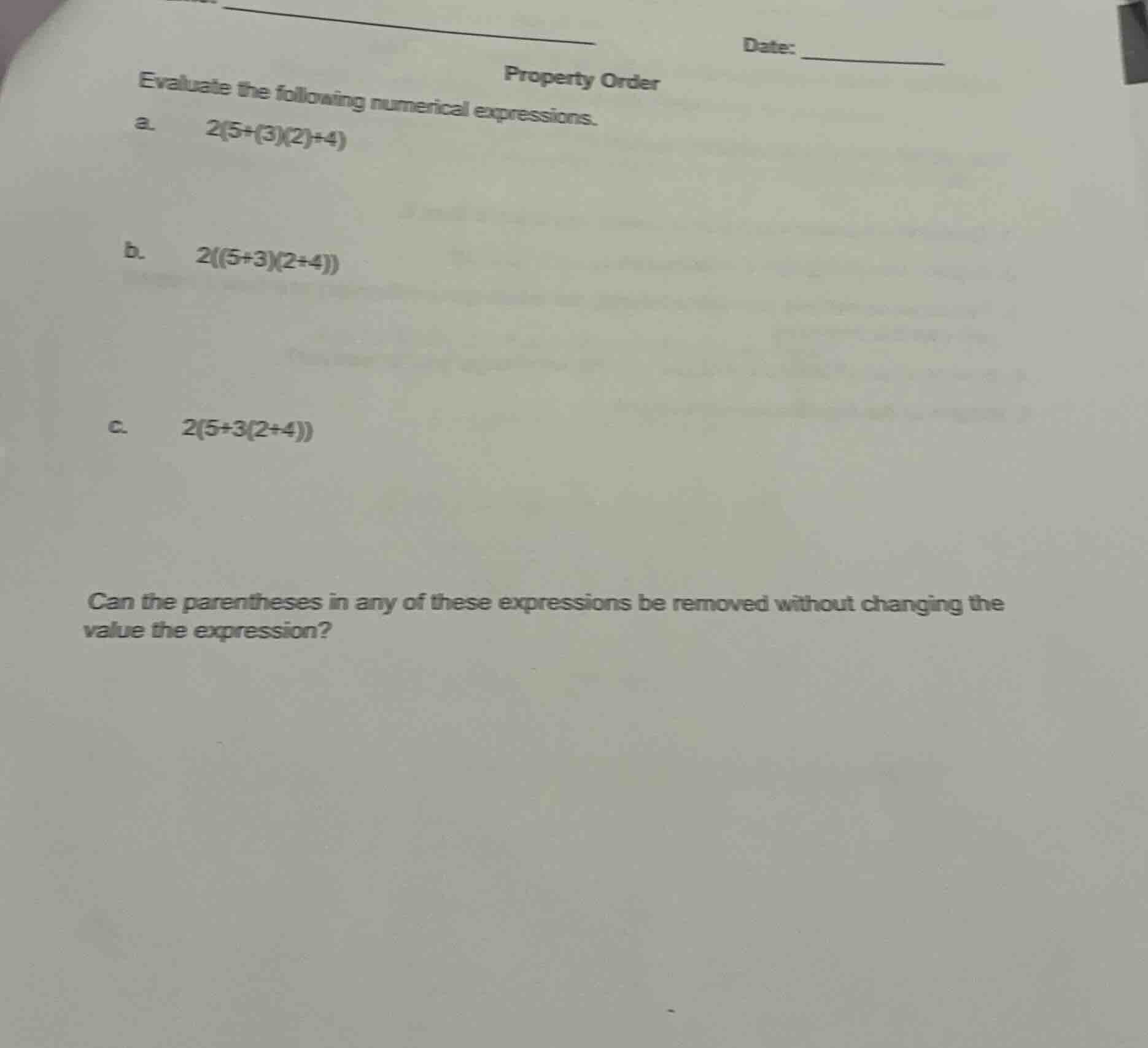
evaluate the following numerical expressions.
a. \\(2(5+(3)(2)+4)\\)
b. \\(2((5+3)(2+4))\\)
c. \\(2(5+3(2+4))\\)
can the parentheses in any of these expressions be removed without changing the value the expression?
Part a
Step1: Calculate inner multiplication
$3 \times 2 = 6$
Step2: Simplify inside outer parentheses
$5 + 6 + 4 = 15$
Step3: Multiply by the outer factor
$2 \times 15 = 30$
Part b
Step1: Calculate sums inside parentheses
$5+3=8$, $2+4=6$
Step2: Multiply the two results
$8 \times 6 = 48$
Step3: Multiply by the outer factor
$2 \times 48 = 96$
Part c
Step1: Calculate innermost sum
$2+4=6$
Step2: Multiply, then add to 5
$3 \times 6 = 18$, $5 + 18 = 23$
Step3: Multiply by the outer factor
$2 \times 23 = 46$
Part d
Step1: Analyze expression a
Parentheses around $(3)$ and $(2)$: multiplication has priority over addition, so $2(5+3\times2+4)$ equals the original, so these parentheses can be removed. The outer parentheses cannot be removed (would change to $2\times5+3\times2+4=10+6+4=20
eq30$).
Step2: Analyze expression b
All parentheses are necessary: removing inner ones gives $2(5+3\times2+4)=30
eq96$; removing outer ones gives $(5+3)(2+4)=48
eq96$.
Step3: Analyze expression c
Parentheses around $(2+4)$ are necessary (without them, $2(5+3\times2+4)=30
eq46$); outer parentheses are necessary (without them, $2\times5+3(2+4)=10+18=28
eq46$).

Snap & solve any problem in the app
Get step-by-step solutions on Sovi AI
Photo-based solutions with guided steps
Explore more problems and detailed explanations
a. $30$
b. $96$
c. $46$
d. Only the parentheses around the single numbers (3) and (2) in expression a ($2(5+(3)(2)+4)$) can be removed without changing the expression's value, resulting in $2(5+3\times2+4)$ which equals the original value. All other parentheses in the expressions are necessary to preserve the correct order of operations and the expression's value.