QUESTION IMAGE
Question
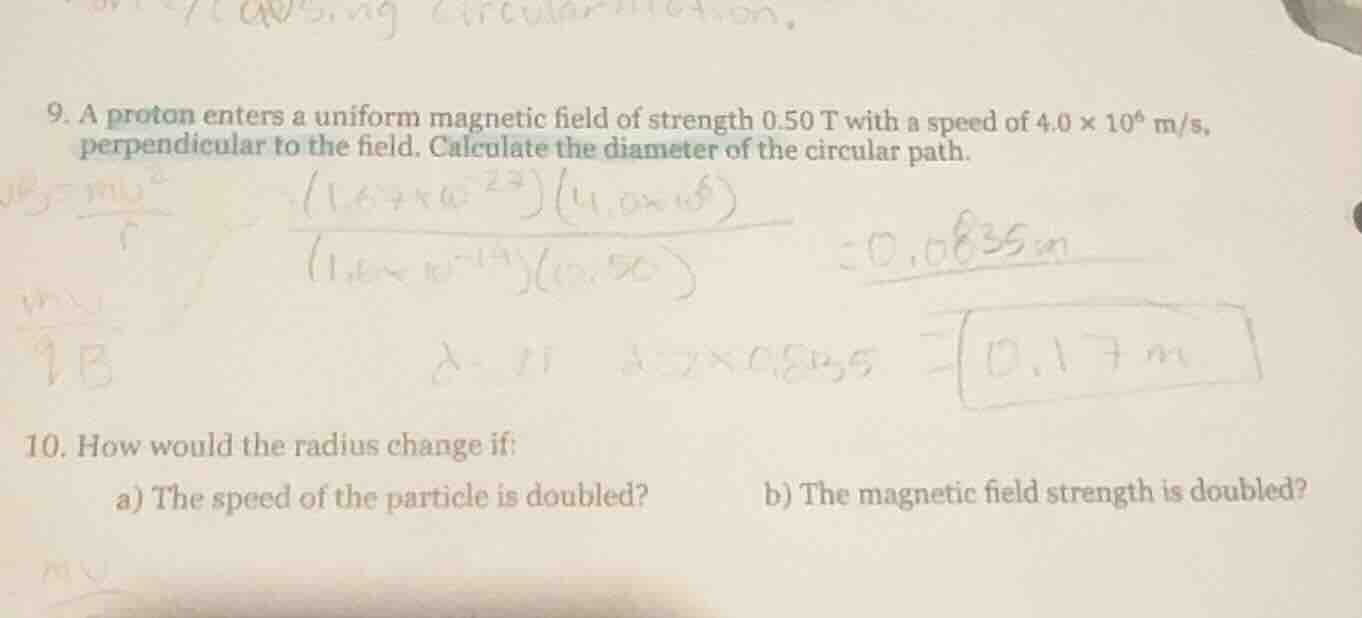
- a proton enters a uniform magnetic field of strength 0.50 t with a speed of 4.0 × 10⁶ m/s, perpendicular to the field. calculate the diameter of the circular path.
- how would the radius change if:
a) the speed of the particle is doubled? b) the magnetic field strength is doubled?
Step1: Recall radius formula
For a charged particle perpendicular to a magnetic field, the centripetal force is provided by the magnetic force:
$$r = \frac{mv}{qB}$$
where $m=1.67\times10^{-27}\ \text{kg}$ (proton mass), $q=1.6\times10^{-19}\ \text{C}$ (proton charge), $v=4.0\times10^6\ \text{m/s}$, $B=0.50\ \text{T}$
Step2: Calculate initial radius
$$r = \frac{(1.67\times10^{-27})(4.0\times10^6)}{(1.6\times10^{-19})(0.50)} = 0.0835\ \text{m}$$
Step3: Find diameter (Problem 9)
Diameter $d=2r$
$$d = 2\times0.0835 = 0.17\ \text{m}$$
Step4: Analyze speed doubling (10a)
From $r=\frac{mv}{qB}$, $r\propto v$. If $v'=2v$,
$$r' = \frac{m(2v)}{qB} = 2r$$
Radius doubles.
Step5: Analyze B doubling (10b)
From $r=\frac{mv}{qB}$, $r\propto \frac{1}{B}$. If $B'=2B$,
$$r' = \frac{mv}{q(2B)} = \frac{r}{2}$$
Radius is halved.

Snap & solve any problem in the app
Get step-by-step solutions on Sovi AI
Photo-based solutions with guided steps
Explore more problems and detailed explanations
- $0.17\ \text{m}$
- a) The radius doubles (becomes $0.17\ \text{m}$)
b) The radius is halved (becomes $0.042\ \text{m}$)