QUESTION IMAGE
Question
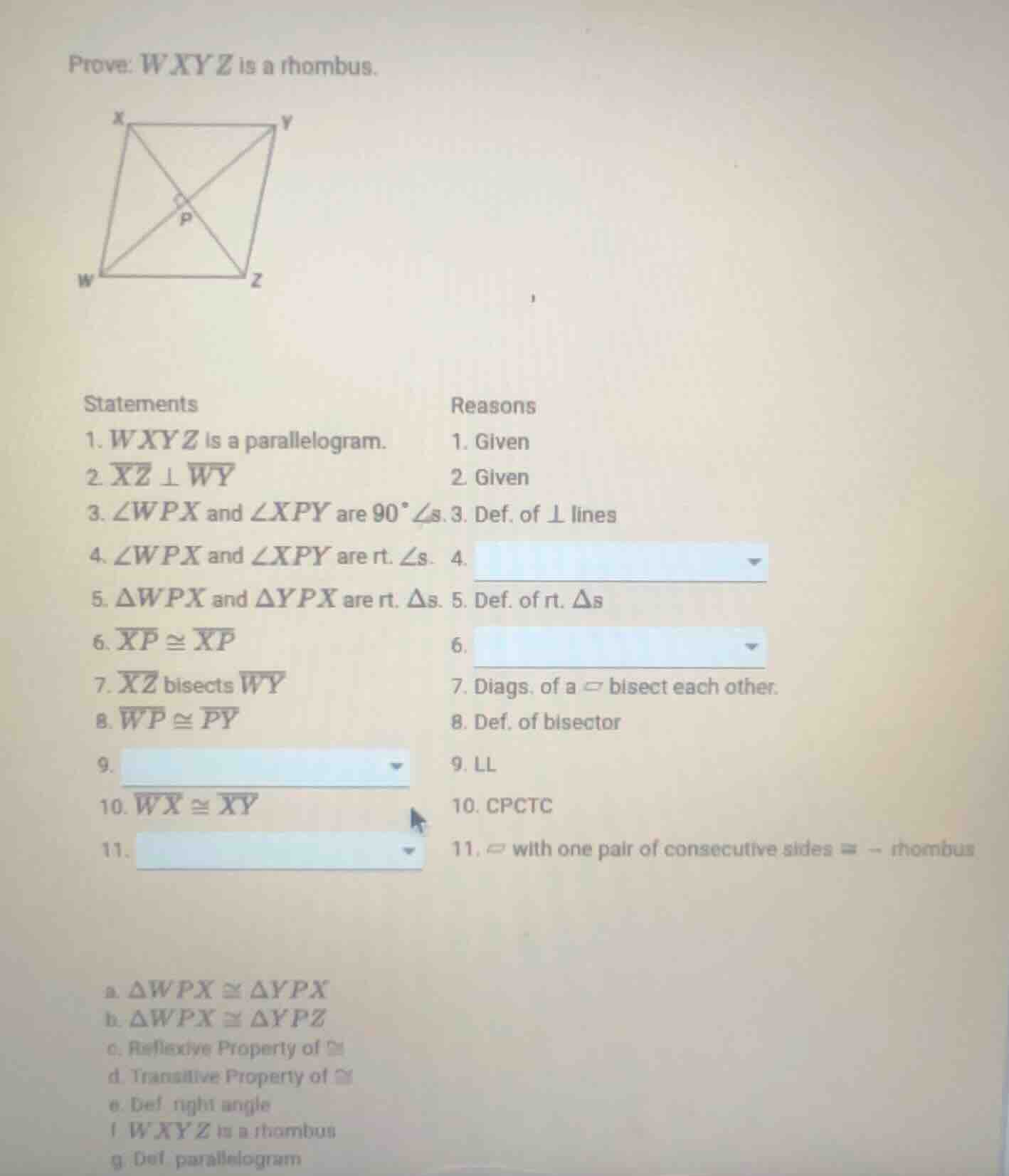
prove: wxyz is a rhombus.
statements\treasons
- wxyz is a parallelogram.\t1. given
- xz ⊥ wy\t2. given
- ∠wpx and ∠xpy are 90° ∠s.\t3. def. of ⊥ lines
- ∠wpx and ∠xpy are rt. ∠s.\t4.
- δwpx and δypx are rt. δs.\t5. def. of rt. δs
- xp ≅ xp\t6.
- xz bisects wy\t7. diags. of a ▱ bisect each other.
- wp ≅ py\t8. def. of bisector
- \t9. ll
- wx ≅ xy\t10. cpctc
- \t11. ▱ with one pair of consecutive sides ≅ -- rhombus
a. δwpx ≅ δypx
b. δwpx ≅ δypz
c. reflexive property of ≅
d. transitive property of ≅
e. def. right angle
f. wxyz is a rhombus
g. def. parallelogram
Step-by-Step Explanation for Each Blank:
Blank 4:
- Step 1: Analyze the statement and reason
Statement 3 says \( \angle WPX \) and \( \angle XPY \) are \( 90^\circ \) angles. Statement 4 rephrases them as right angles. The reason should define a right angle (since a \( 90^\circ \) angle is a right angle).
- Match with option: e. Def. right angle
Blank 6:
- Step 1: Analyze the statement and reason
Statement 6 is \( \overline{XP} \cong \overline{XP} \), which is a side congruent to itself. This is the Reflexive Property of Congruence.
- Match with option: c. Reflexive Property of \( \cong \)
Blank 9:
- Step 1: Analyze the statement and reason
Reason 9 is "LL" (Leg-Leg Congruence for right triangles). We have two right triangles \( \triangle WPX \) and \( \triangle YPX \):
- \( \overline{WP} \cong \overline{PY} \) (from step 8),
- \( \overline{XP} \cong \overline{XP} \) (from step 6),
- Both are right triangles (from step 5).
By LL, \( \triangle WPX \cong \triangle YPX \).
- Match with option: a. \( \triangle WPX \cong \triangle YPX \)
Blank 11:
- Step 1: Analyze the statement and reason
Reason 11 is " \( \parallel\text{ogram} \) with one pair of consecutive sides \( \cong \) → rhombus". We already proved \( \overline{WX} \cong \overline{XY} \) (step 10), and \( WXYZ \) is a parallelogram (step 1). So the conclusion is that \( WXYZ \) is a rhombus.
- Match with option: f. \( WXYZ \) is a rhombus
Final Answers:
- Blank 4: e. Def. right angle
- Blank 6: c. Reflexive Property of \( \cong \)
- Blank 9: a. \( \triangle WPX \cong \triangle YPX \)
- Blank 11: f. \( WXYZ \) is a rhombus
(If the question asks for each blank separately, list them as above. For example, if blank 4: e; blank 6: c; blank 9: a; blank 11: f.)

Snap & solve any problem in the app
Get step-by-step solutions on Sovi AI
Photo-based solutions with guided steps
Explore more problems and detailed explanations
Step-by-Step Explanation for Each Blank:
Blank 4:
- Step 1: Analyze the statement and reason
Statement 3 says \( \angle WPX \) and \( \angle XPY \) are \( 90^\circ \) angles. Statement 4 rephrases them as right angles. The reason should define a right angle (since a \( 90^\circ \) angle is a right angle).
- Match with option: e. Def. right angle
Blank 6:
- Step 1: Analyze the statement and reason
Statement 6 is \( \overline{XP} \cong \overline{XP} \), which is a side congruent to itself. This is the Reflexive Property of Congruence.
- Match with option: c. Reflexive Property of \( \cong \)
Blank 9:
- Step 1: Analyze the statement and reason
Reason 9 is "LL" (Leg-Leg Congruence for right triangles). We have two right triangles \( \triangle WPX \) and \( \triangle YPX \):
- \( \overline{WP} \cong \overline{PY} \) (from step 8),
- \( \overline{XP} \cong \overline{XP} \) (from step 6),
- Both are right triangles (from step 5).
By LL, \( \triangle WPX \cong \triangle YPX \).
- Match with option: a. \( \triangle WPX \cong \triangle YPX \)
Blank 11:
- Step 1: Analyze the statement and reason
Reason 11 is " \( \parallel\text{ogram} \) with one pair of consecutive sides \( \cong \) → rhombus". We already proved \( \overline{WX} \cong \overline{XY} \) (step 10), and \( WXYZ \) is a parallelogram (step 1). So the conclusion is that \( WXYZ \) is a rhombus.
- Match with option: f. \( WXYZ \) is a rhombus
Final Answers:
- Blank 4: e. Def. right angle
- Blank 6: c. Reflexive Property of \( \cong \)
- Blank 9: a. \( \triangle WPX \cong \triangle YPX \)
- Blank 11: f. \( WXYZ \) is a rhombus
(If the question asks for each blank separately, list them as above. For example, if blank 4: e; blank 6: c; blank 9: a; blank 11: f.)