QUESTION IMAGE
Question
7.3.ps-16
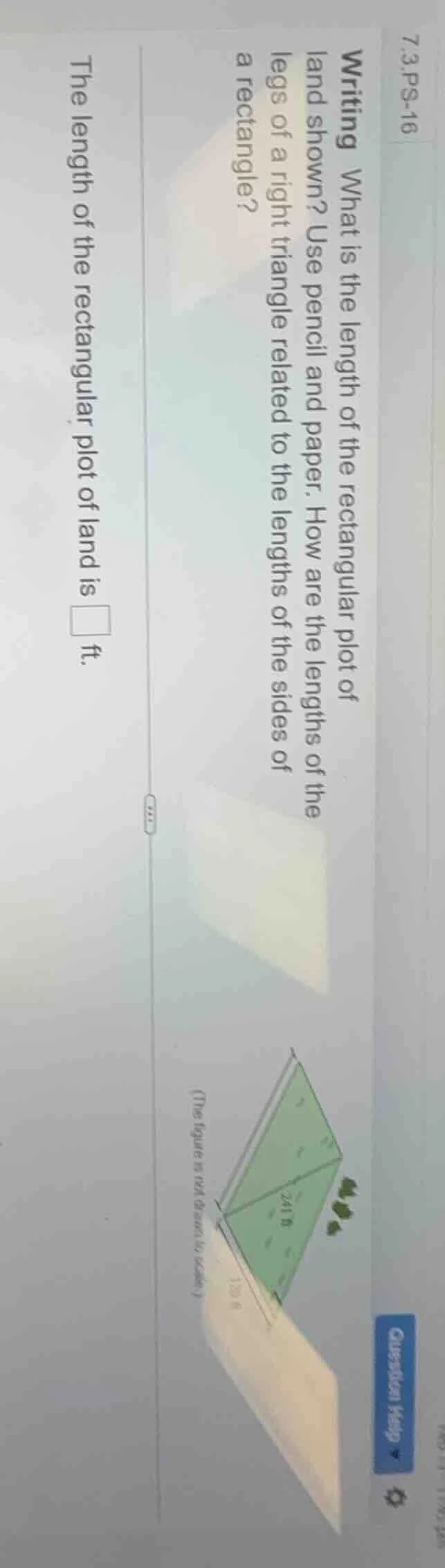
writing what is the length of the rectangular plot of
land shown? use pencil and paper. how are the lengths of the
legs of a right triangle related to the lengths of the sides of
a rectangle?
(the figure is not drawn to scale.)
the length of the rectangular plot of land is $square$ ft.
Step1: Identify triangle area relation
The rectangle is made of 2 congruent right triangles. Let the unknown side (length of rectangle) be $x$. Area of one triangle: $\frac{1}{2} \times 120 \times x$. Total area of rectangle: $120x$. Also, area of the triangle can be calculated using the given height: $\frac{1}{2} \times 240 \times x_{triangle base}$? No, correct: The rectangle's area equals 2 times the area of one right triangle. The right triangle has height 240 ft, and the base of the triangle is the length of the rectangle, while the other leg of the triangle is 120 ft. Wait, actually, the area of the rectangle is also equal to $120 \times L$, and also equal to $2 \times (\frac{1}{2} \times 120 \times L)$ no, better: The right triangle's hypotenuse is not needed, wait no: The area of the triangle can be expressed two ways: $\frac{1}{2} \times 120 \times L = \frac{1}{2} \times 240 \times 144.5$? No, wait, no—wait, the rectangle's area is $120 \times L$, and this is equal to 2 times the area of the right triangle. The right triangle has a height of 240 ft corresponding to the base that is the side of the rectangle? No, actually, the 240 ft is the length of the diagonal? No, no: The figure shows a rectangle split into two congruent right triangles, each with height 240 ft, and one leg of the triangle is 120 ft. Wait, no, let's use the Pythagorean theorem? No, wait, area of the triangle: $\text{Area} = \frac{1}{2} \times a \times b = \frac{1}{2} \times c \times h$, where $a,b$ are legs, $c$ is hypotenuse, $h$ is height to hypotenuse. Wait, no, the rectangle's sides are the legs of the right triangle? No, the rectangle is formed by two congruent right triangles, so the sides of the rectangle are the legs of the right triangle, and the diagonal of the rectangle is the hypotenuse of the triangle, with height 240 ft to the hypotenuse.
Wait, correct approach: Let the length of the rectangle be $L$. The area of the rectangle is $120 \times L$. This is equal to 2 times the area of one right triangle. The area of the right triangle is also $\frac{1}{2} \times \text{hypotenuse} \times 240$. First, find the hypotenuse of the right triangle (which is the diagonal of the rectangle): hypotenuse $c = \sqrt{120^2 + L^2}$. Then area of triangle is $\frac{1}{2} \times \sqrt{120^2 + L^2} \times 240$. And the area of the rectangle is $120L = 2 \times (\frac{1}{2} \times 240 \times \frac{120L}{\sqrt{120^2 + L^2}})$? No, simpler: The area of the right triangle is $\frac{1}{2} \times 120 \times L = \frac{1}{2} \times c \times 240$, so $120L = 240c$, so $L = 2c$? No, that can't be. Wait, no, the height to the hypotenuse of a right triangle is $\frac{ab}{c}$, where $a,b$ are legs, $c$ is hypotenuse. So $240 = \frac{120 \times L}{c}$, and $c = \sqrt{120^2 + L^2}$.
Step2: Substitute and solve for L
$240 = \frac{120L}{\sqrt{120^2 + L^2}}$
Divide both sides by 120:
$2 = \frac{L}{\sqrt{120^2 + L^2}}$
Square both sides:
$4 = \frac{L^2}{120^2 + L^2}$
Multiply both sides by $120^2 + L^2$:
$4(120^2 + L^2) = L^2$
$4 \times 14400 + 4L^2 = L^2$
$57600 = -3L^2$? That can't be, I mixed up the height. Oh! Wait, the 240 ft is one leg, and 120 ft is the height to the hypotenuse. That's the mistake. So correct: Let the legs be $L$ and 240, hypotenuse $c$. The height to hypotenuse is 120 ft. Then area of triangle: $\frac{1}{2} \times L \times 240 = \frac{1}{2} \times c \times 120$
Simplify: $240L = 120c \implies c = 2L$
Now use Pythagorean theorem:
$L^2 + 240^2 = c^2$
Substitute $c=2L$:
$L^2 + 57600 = 4L^2$
$3L^2 = 57600$
$L^2 = 19200$? No, that's not right. Wait no,…

Snap & solve any problem in the app
Get step-by-step solutions on Sovi AI
Photo-based solutions with guided steps
Explore more problems and detailed explanations
289 ft