QUESTION IMAGE
Question
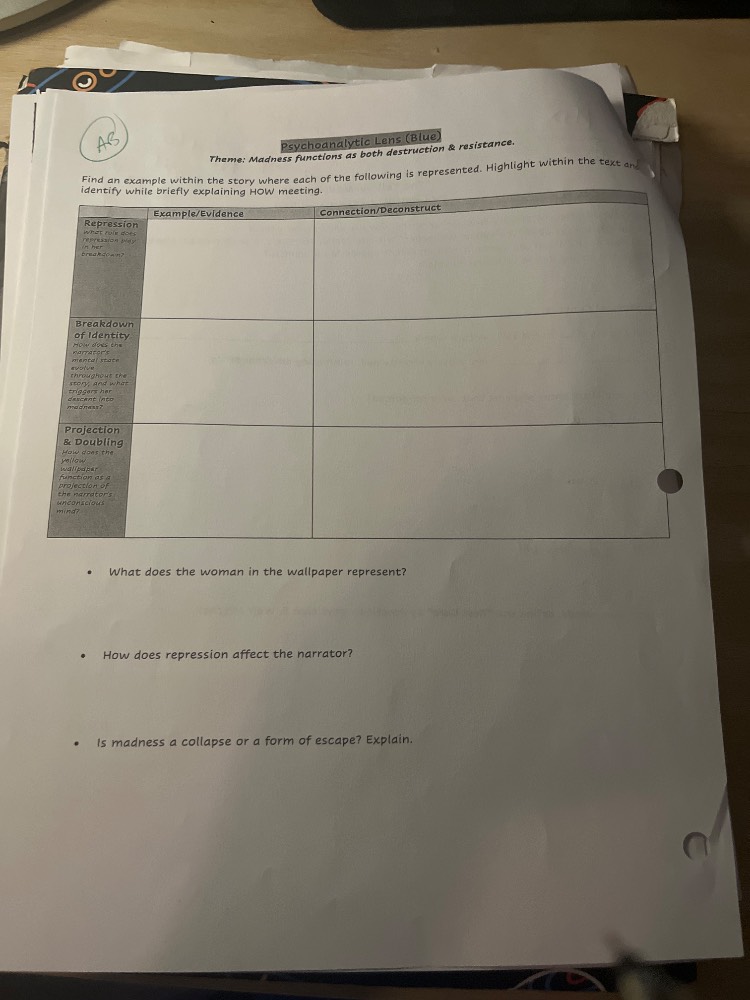
psychoanalytic lens (blue) theme: madness functions as both destruction & resistance. find an example within the story where each of the following is represented. highlight within the text and identify while briefly explaining how meeting.
| example/evidence | connection/deconstruct | |
|---|---|---|
| breakdown of identity | ||
| projection & doubling |
- what does the woman in the wallpaper represent?
- how does repression affect the narrator?
- is madness a collapse or a form of escape? explain.
Brief Explanations
All responses are rooted in psychoanalytic literary analysis of The Yellow Wallpaper:
- The table connects key psychoanalytic concepts to specific textual details, linking each concept to the story's theme of madness as destruction and resistance.
- The woman in the wallpaper is a classic psychoanalytic "double," a mirror of the narrator's repressed psyche.
- Repression's impact follows Freud's theory of unconscious conflict: unexpressed emotions manifest as pathological obsession.
- The dual nature of madness aligns with the story's core theme, framing mental distress as both a breakdown of societal norms and a radical act of self-preservation against oppression.

Snap & solve any problem in the app
Get step-by-step solutions on Sovi AI
Photo-based solutions with guided steps
Explore more problems and detailed explanations
Table Completion:
| Concept | Example/Evidence | Connection/Deconstruct |
|---|---|---|
| Breakdown of Identity | The narrator abandons her own name and goals, adopting the perspective of the woman trapped in the wallpaper. | Her loss of self is a direct result of repressed autonomy; she merges with the wallpaper figure to reclaim agency she cannot access as a "sane" wife. |
| Projection & Doubling | The narrator sees her own trapped, restless self reflected in the woman behind the wallpaper. | The wallpaper woman is her unconscious double: she projects her repressed anger, confinement, and desire for freedom onto this figure, using it to externalize her internal turmoil. |
Short Answer Questions:
- The woman in the wallpaper represents the narrator's repressed, trapped self—she embodies the narrator's unspoken anger, desire for freedom, and the psychological damage of patriarchal confinement.
- Repression strips the narrator of her creative and emotional outlet, pushing her distress into her unconscious. This builds into an obsession with the wallpaper, as her mind channels repressed feelings into a tangible, externalized symbol, worsening her psychological decline.
- Madness is both a collapse and an escape. It is a collapse because it destroys the narrator's ability to function within the constraints of her oppressive domestic role. It is an escape because her madness allows her to reject the patriarchal control of her husband; by "becoming" the wallpaper woman, she gains a sense of agency she could never access as a "sane," compliant wife.