QUESTION IMAGE
Question
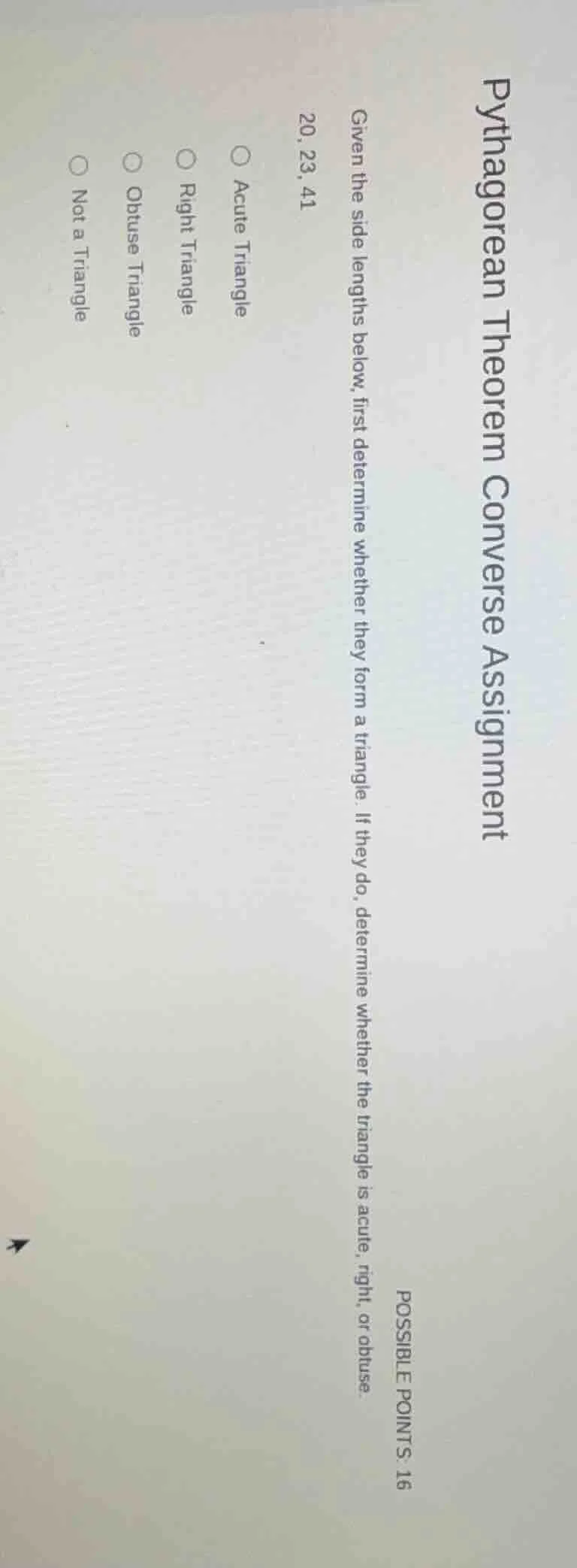
pythagorean theorem converse assignment\
possible points: 16\
given the side lengths below, first determine whether they form a triangle. if they do, determine whether the triangle is acute, right, or obtuse.\
20, 23, 41\
\bigcirc acute triangle\
\bigcirc right triangle\
\bigcirc obtuse triangle\
\bigcirc not a triangle
Step1: Check Triangle Inequality
To form a triangle, the sum of any two sides must be greater than the third side.
- \(20 + 23 = 43>41\)
- \(20 + 41 = 61>23\)
- \(23 + 41 = 64>20\)
So, it is a triangle.
Step2: Use Pythagorean Theorem Converse
Let \(a = 20\), \(b = 23\), \(c = 41\) (where \(c\) is the longest side).
Calculate \(a^{2}+b^{2}\) and \(c^{2}\):
- \(a^{2}=20^{2} = 400\)
- \(b^{2}=23^{2}=529\)
- \(a^{2}+b^{2}=400 + 529=929\)
- \(c^{2}=41^{2}=1681\)
Since \(a^{2}+b^{2}=929<1681 = c^{2}\), by the converse of the Pythagorean theorem (and the rule for obtuse triangles: if \(a^{2}+b^{2}

Snap & solve any problem in the app
Get step-by-step solutions on Sovi AI
Photo-based solutions with guided steps
Explore more problems and detailed explanations
Obtuse Triangle