QUESTION IMAGE
Question
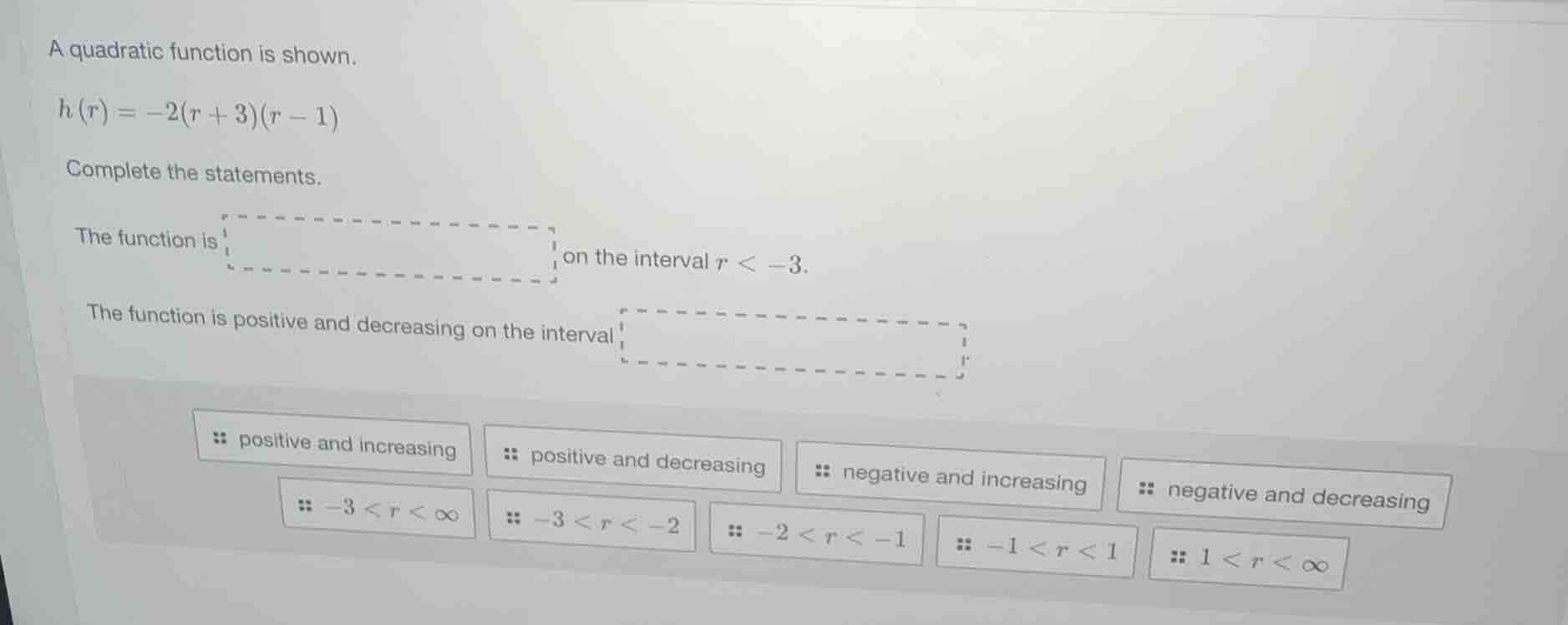
a quadratic function is shown.
$h(r) = -2(r + 3)(r - 1)$
complete the statements.
the function is
on the interval $r < -3$.
the function is positive and decreasing on the interval
Step1: Find the roots and vertex
The quadratic function is given in factored form \( h(r) = -2(r + 3)(r - 1) \). The roots are \( r=-3 \) and \( r = 1 \). The coefficient of \( r^2 \) is \( -2 \), so the parabola opens downward. The vertex (maximum point) is at the midpoint of the roots: \( r=\frac{-3 + 1}{2}=-1 \).
Step2: Analyze the interval \( r < -3 \)
For \( r < -3 \), let's pick a test point, say \( r=-4 \). Substitute into \( h(r) \): \( h(-4)=-2(-4 + 3)(-4 - 1)=-2(-1)(-5)=-10 \), which is negative. The function is decreasing before the vertex? Wait, no: since the parabola opens downward, the left side of the vertex (left of \( r=-1 \)): from \( r=-\infty \) to \( r=-1 \), the function is increasing (because it's going from \( -\infty \) up to the vertex). Wait, no: the derivative (or the slope) - the quadratic with negative leading coefficient: the axis of symmetry is \( r=-1 \). So for \( r < -1 \), the function is increasing (since moving from left to right towards the vertex, the function rises), and for \( r > -1 \), it's decreasing. But in \( r < -3 \), which is left of \( r=-3 \) (left of the left root), let's check the sign and the direction. Wait, when \( r < -3 \), both \( (r + 3) \) and \( (r - 1) \) are negative (since \( r < -3 \) implies \( r + 3 < 0 \) and \( r - 1 < 0 \)), so their product is positive, multiplied by \( -2 \) (negative) gives negative. Now, the slope: the derivative \( h'(r)=-2[(r - 1)+(r + 3)]=-2(2r + 2)=-4r - 4 \). For \( r < -3 \), \( h'(r)=-4r - 4 \). If \( r=-4 \), \( h'(-4)=16 - 4 = 12>0 \), so the function is increasing? Wait, no, earlier calculation with \( r=-4 \) gave \( h(-4)=-10 \), \( r=-5 \): \( h(-5)=-2(-5 + 3)(-5 - 1)=-2(-2)(-6)=-24 \), which is more negative. Wait, that contradicts the derivative. Wait, no, I made a mistake in the derivative. Let's recalculate the derivative: \( h(r)=-2(r + 3)(r - 1)=-2(r^2 - r + 3r - 3)=-2(r^2 + 2r - 3)=-2r^2 - 4r + 6 \). Then \( h'(r)=-4r - 4 \). For \( r < -3 \), say \( r=-4 \), \( h'(-4)=16 - 4 = 12>0 \), so the function is increasing. But the value at \( r=-4 \) is -10, \( r=-5 \) is -24, which is decreasing? Wait, no, that's a mistake. Wait, \( h(-4)=-2(-4 + 3)(-4 - 1)=-2(-1)(-5)=-10 \), \( h(-5)=-2(-5 + 3)(-5 - 1)=-2(-2)(-6)=-24 \). So as \( r \) decreases (goes from -4 to -5), \( h(r) \) decreases (from -10 to -24). But the derivative at \( r=-4 \) is positive, which means when \( r \) increases (from -5 to -4), \( h(r) \) increases (from -24 to -10). So in the interval \( r < -3 \), as \( r \) increases (moves to the right), the function increases (from more negative to less negative), but the function values are negative. So the function is negative and increasing? Wait, no, the options: the first blank options are about sign and direction. Wait, maybe I messed up. Wait, the roots are at -3 and 1, parabola opens downward. So the regions:
- \( r < -3 \): both factors \( (r + 3) \) and \( (r - 1) \) are negative, product positive, times -2: negative. The function is increasing (since moving from left to right towards the vertex at \( r=-1 \), the function rises from \( -\infty \) up to the vertex). Wait, but when \( r < -3 \), we are left of the left root. Let's take two points: \( r=-4 \) (h=-10) and \( r=-3.5 \) (h=-2(-0.5)(-4.5)=-2(2.25)=-4.5). So as \( r \) increases from -4 to -3.5, \( h(r) \) increases from -10 to -4.5 (less negative), so it's increasing. And the sign is negative. So the first blank: negative and increasing? Wait, no, the options include "negative and increasing". Wait, but let's check the next part.
St…

Snap & solve any problem in the app
Get step-by-step solutions on Sovi AI
Photo-based solutions with guided steps
Explore more problems and detailed explanations
The function is \(\boldsymbol{\text{negative and increasing}}\) on the interval \( r < -3 \).
The function is positive and decreasing on the interval \(\boldsymbol{-1 < r < 1}\).