QUESTION IMAGE
Question
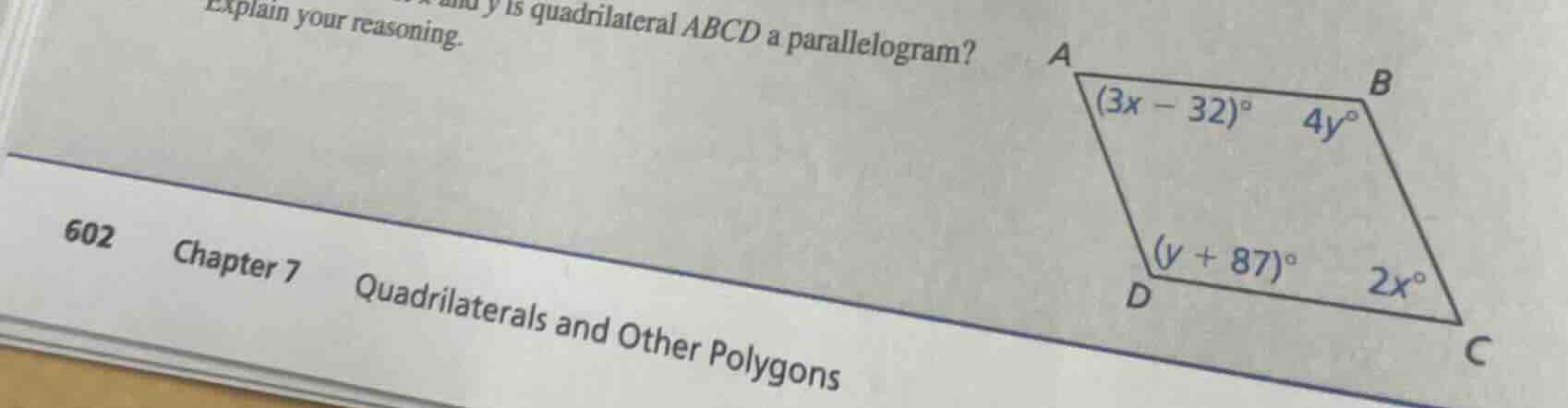
is quadrilateral (abcd) a parallelogram? explain your reasoning.
(the image shows quadrilateral (abcd) with angle (a = (3x - 32)^circ), angle (b = 4y^circ), angle (d = (y + 87)^circ), angle (c = 2x^circ))
chapter 7 quadrilaterals and other polygons
Step1: Recall parallelogram angle properties
In a parallelogram, consecutive angles are supplementary (sum to \(180^\circ\)) and opposite angles are equal. So, \(\angle A = \angle C\) and \(\angle B = \angle D\), also \(\angle A + \angle B = 180^\circ\), \(\angle B + \angle C = 180^\circ\), etc. From opposite angles: \(3x - 32 = 2x\) (since \(\angle A = \angle C\)) and \(4y = y + 87\) (since \(\angle B = \angle D\)).
Step2: Solve for \(x\)
From \(3x - 32 = 2x\), subtract \(2x\) from both sides: \(3x - 2x - 32 = 0\) \(\Rightarrow\) \(x - 32 = 0\) \(\Rightarrow\) \(x = 32\).
Step3: Solve for \(y\)
From \(4y = y + 87\), subtract \(y\) from both sides: \(4y - y = 87\) \(\Rightarrow\) \(3y = 87\) \(\Rightarrow\) \(y = \frac{87}{3} = 29\).
Step4: Verify consecutive angles
\(\angle A = 3x - 32 = 3(32) - 32 = 96 - 32 = 64^\circ\)
\(\angle B = 4y = 4(29) = 116^\circ\)
Check if \(\angle A + \angle B = 64 + 116 = 180^\circ\) (supplementary, as required for parallelogram).
Also, \(\angle D = y + 87 = 29 + 87 = 116^\circ\) (equal to \(\angle B\)), \(\angle C = 2x = 64^\circ\) (equal to \(\angle A\)).

Snap & solve any problem in the app
Get step-by-step solutions on Sovi AI
Photo-based solutions with guided steps
Explore more problems and detailed explanations
Yes, quadrilateral \(ABCD\) is a parallelogram because opposite angles are equal (\(\angle A = \angle C = 64^\circ\), \(\angle B = \angle D = 116^\circ\)) and consecutive angles are supplementary (\(64^\circ + 116^\circ = 180^\circ\)), satisfying the properties of a parallelogram. The values are \(x = 32\) and \(y = 29\).