QUESTION IMAGE
Question
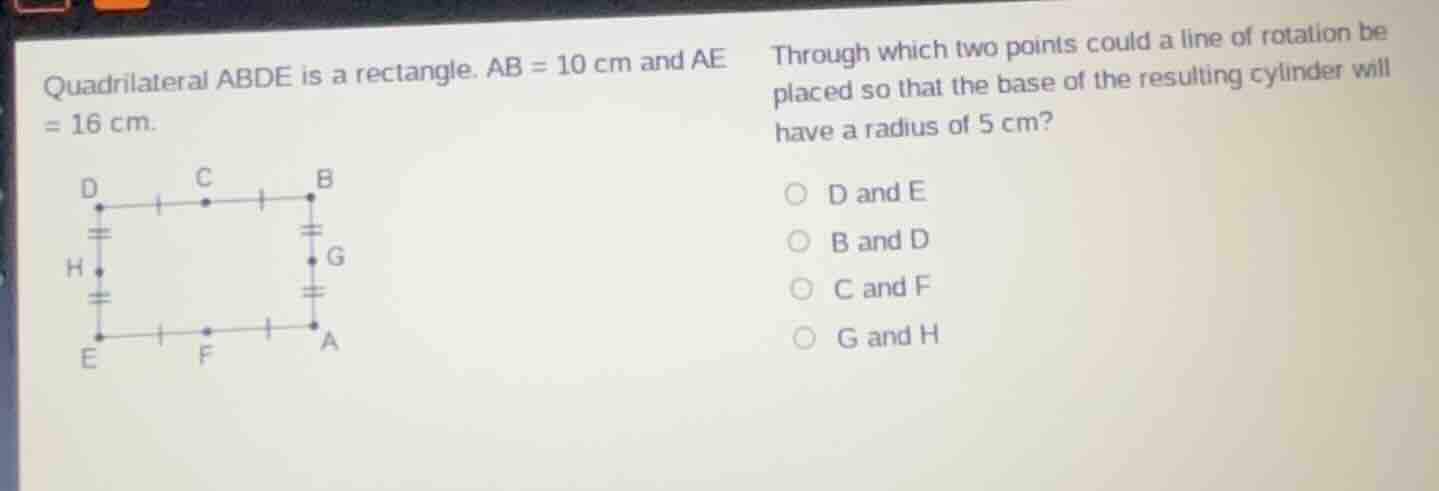
quadrilateral abde is a rectangle. ab = 10 cm and ae = 16 cm.
through which two points could a line of rotation be placed so that the base of the resulting cylinder will have a radius of 5 cm?
○ d and e
○ b and d
○ c and f
○ g and h
Step1: Recall cylinder formation by rotation
When a rectangle is rotated about a line (axis of rotation), the side perpendicular to the axis becomes the radius of the base of the cylinder. The length of the side parallel to the axis becomes the height. Given the radius of the base of the cylinder is \( 5\space\text{cm} \), we need to find the axis such that the perpendicular side to it has length \( 2\times5 = 10\space\text{cm} \) (diameter) or the side itself is \( 5\space\text{cm} \) (radius). Wait, actually, when rotating a rectangle around an axis, the radius is the distance from the axis to the opposite side.
Given \( AB = 10\space\text{cm} \) and \( ABDE \) is a rectangle. Let's analyze each option:
- Option 1: D and E. The line DE is horizontal (from the diagram). Rotating around DE, the distance from DE to AB (or AE?) Wait, no. Let's look at the diagram. ABDE is a rectangle, so AB is vertical (length 10 cm), AE is horizontal (length 16 cm). Wait, maybe AB is vertical with length 10 cm, so AB is from A (bottom) to B (top), length 10 cm. AE is from A (right) to E (left), length 16 cm. So the rectangle has length AE = 16 cm (horizontal) and height AB = 10 cm (vertical).
Now, for the radius of the cylinder to be 5 cm, the axis of rotation should be such that the distance from the axis to the opposite side is 5 cm, or the side being rotated has length related to the radius. Wait, when you rotate a rectangle around a vertical axis (parallel to AB), the radius would be the horizontal distance (AE direction). Wait, maybe better to think: if we rotate around a horizontal line (parallel to AE), then the radius would be half of AB (since AB is vertical, length 10 cm, so half is 5 cm). So the axis should be a horizontal line (parallel to AE) such that the distance from the axis to AB (or DE) is 5 cm. Looking at the diagram, points G and H: G is on AB, H is on DE, and the marks suggest they are midpoints? Wait, AB is 10 cm, so if we rotate around GH (the line through G and H), which is horizontal? Wait, no, G and H are vertical? Wait, the diagram: D---C---B (top horizontal), E---F---A (bottom horizontal), D to H to E (left vertical), B to G to A (right vertical). So GH is the vertical line through G (on AB) and H (on DE). Wait, no, maybe G and H are on the vertical sides. Wait, the options: G and H. Let's check:
If we rotate the rectangle ABDE around the line GH (which is vertical, passing through G and H), then the horizontal distance from GH to AE (or BD) would be... Wait, maybe I got the axes wrong. Let's re-express:
AB is vertical (length 10 cm), so AB is from A (y=0) to B (y=10). AE is horizontal (length 16 cm), from A (x=0) to E (x=-16). So the rectangle has corners at A(0,0), B(0,10), D(-16,10), E(-16,0).
Now, rotating around a vertical line (parallel to AB, i.e., parallel to y-axis) would create a cylinder with radius equal to the horizontal distance from the axis to the sides AE or BD. Wait, no, if we rotate around the line x = -8 (midpoint of AE, since AE is 16 cm long, from x=0 to x=-16, midpoint at x=-8), but that's not an option. Wait, the other option: rotating around a horizontal line (parallel to AE, i.e., parallel to x-axis) would create a cylinder with radius equal to the vertical distance from the axis to the top or bottom. Since AB is 10 cm (vertical), the midpoint of AB is at y=5, so a horizontal line at y=5 would be the axis, and rotating around it would give a radius of 5 cm (since the distance from y=5 to A (y=0) or B (y=10) is 5 cm). But the options are D and E, B and D, C and F, G and H.
Wait, let's loo…

Snap & solve any problem in the app
Get step-by-step solutions on Sovi AI
Photo-based solutions with guided steps
Explore more problems and detailed explanations
D. G and H