QUESTION IMAGE
Question
quadrilateral m is a scaled copy of quadrilateral l.
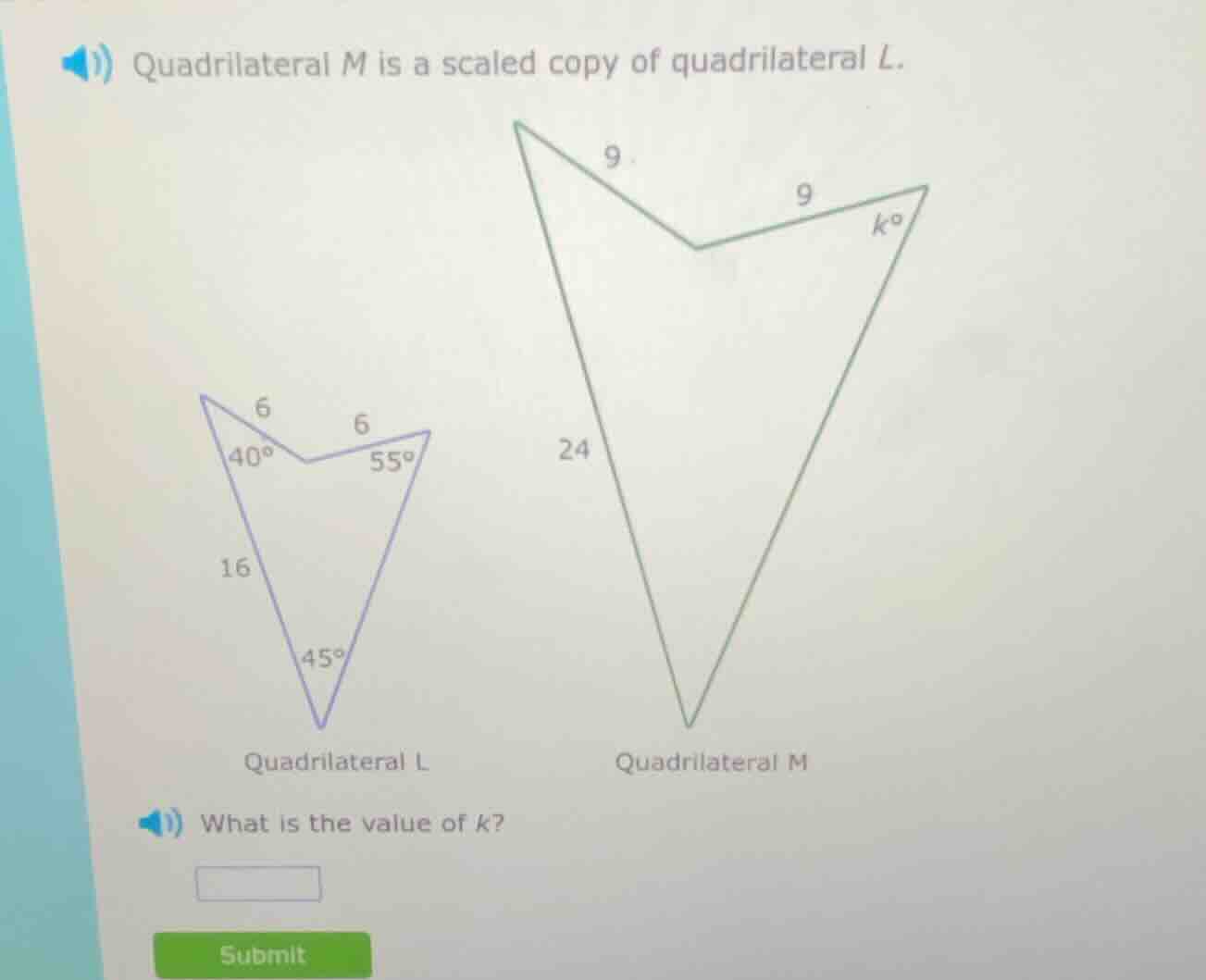
quadrilateral l has sides 6, 6, 16 and angles 40°, 55°, 45°. quadrilateral m has sides 9, 9, 24 and angle k°.
what is the value of k?
Step1: Recall scaled copy properties
Scaled copies have congruent corresponding angles. So, we need to find the corresponding angle in quadrilateral L for the angle \( k^\circ \) in quadrilateral M.
Step2: Identify corresponding angles
Looking at the sides: the sides of length 6 in L correspond to sides of length 9 in M (since \( \frac{9}{6} = 1.5 \), the scale factor). The angle adjacent to the side of length 6 (55° in L) should correspond to the angle \( k^\circ \) in M, because the sides of length 6 (in L) and 9 (in M) are corresponding sides. So, the corresponding angle to \( k^\circ \) is 55°? Wait, no, wait. Wait, let's check the angles. Wait, quadrilateral L has angles 40°, 55°, 45°, and the fourth angle. Wait, sum of interior angles of a quadrilateral is \( 360^\circ \). Let's calculate the fourth angle of L: \( 360 - 40 - 55 - 45 = 220^\circ \)? Wait, no, that can't be. Wait, no, maybe I misread the quadrilateral. Wait, looking at the diagram, quadrilateral L: the angles are 40°, 55°, 45°, and the fourth angle? Wait, no, maybe the quadrilateral is a four - sided figure, so sum of angles is \( 360^\circ \). Let's recalculate: \( 40 + 55 + 45 + x = 360 \), so \( x = 360 - 140 = 220 \)? Wait, but when we scale, the angles remain the same. So in quadrilateral M, the angle corresponding to the 55° angle in L (since the sides of length 6 in L correspond to 9 in M) should be equal. Wait, the side of length 6 in L (two sides of 6) and in M two sides of 9. So the angle between the side of length 6 and the other side (16 in L, 24 in M) – wait, 16 in L corresponds to 24 in M (since \( 24/16 = 1.5 \), same scale factor). So the angle adjacent to the side of length 6 (55° in L) should correspond to the angle \( k^\circ \) in M, because the sides are corresponding. So the angle \( k^\circ \) should be equal to 55°? Wait, no, wait, let's check the angles again. Wait, the angle labeled 55° in L is at the vertex with the side of length 6 and the side of length (let's see, the side opposite? Wait, no, in similar figures (scaled copies), corresponding angles are equal. So the angle with measure 55° in quadrilateral L corresponds to the angle \( k^\circ \) in quadrilateral M, because the sides forming those angles are corresponding sides (6 in L and 9 in M, 16 in L and 24 in M). So \( k = 55 \)? Wait, no, wait, maybe I made a mistake. Wait, let's check the angles again. Wait, the angle of 55° in L: let's see the sides. The side of length 6 (top right) and the side of length (the other side, 16? No, 16 is the left side. Wait, the top right angle in L is 55°, and in M, the top right angle is \( k^\circ \). Since M is a scaled copy of L, corresponding angles are equal. So the angle \( k^\circ \) should be equal to 55°? Wait, but let's confirm with the scale factor. The scale factor from L to M: side lengths 6 (in L) to 9 (in M) is \( 9/6 = 1.5 \), and 16 (in L) to 24 (in M) is \( 24/16 = 1.5 \), so scale factor is 1.5. Since it's a scaled copy, angles are congruent. So the angle corresponding to 55° in L is \( k^\circ \) in M, so \( k = 55 \). Wait, but wait, let's check the sum of angles. Wait, in L, angles are 40°, 55°, 45°, and the fourth angle: \( 360 - 40 - 55 - 45 = 220 \). In M, the angles should be 40°, \( k \), 45°, and 220° (scaled, so angles same). Wait, no, maybe the 55° is the corresponding angle. Wait, maybe I misidentified the angles. Wait, the angle with the side of length 6 (the two sides of 6) – in L, the angle between the two sides of 6? No, in L, the two sides of 6 are adjacent to angles 40° and 55°? Wait, the left angle…

Snap & solve any problem in the app
Get step-by-step solutions on Sovi AI
Photo-based solutions with guided steps
Explore more problems and detailed explanations
\( \boxed{55} \)