QUESTION IMAGE
Question
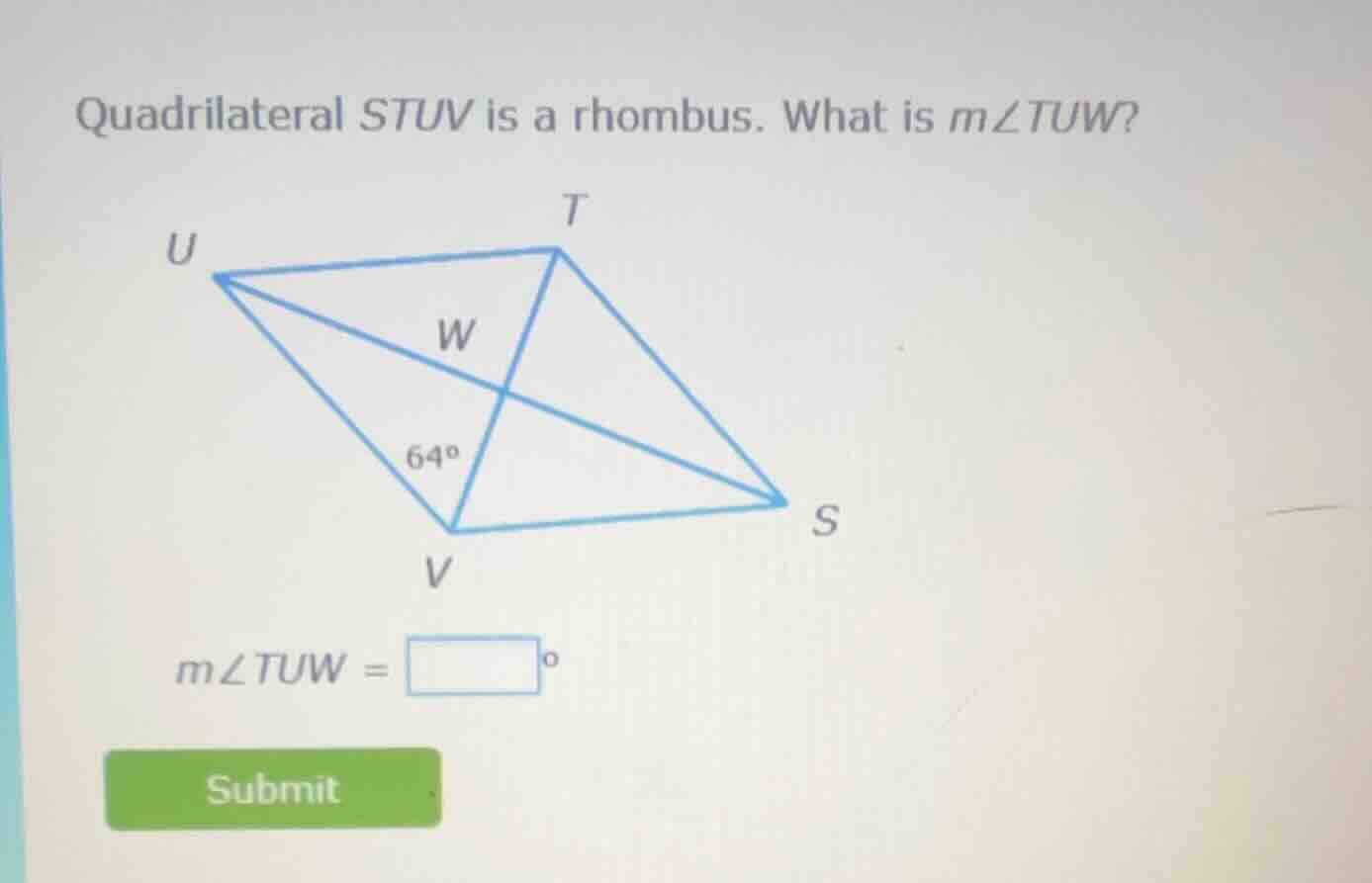
quadrilateral stuv is a rhombus. what is ( mangle tuw )?( mangle tuw = square^circ )
Step1: Recall rhombus diagonal properties
In a rhombus, diagonals bisect the angles. Also, the diagonals of a rhombus are perpendicular bisectors of each other, but here we use the angle - bisecting property. The triangle \( \triangle UVW \) has \( \angle UVW = 64^{\circ}\), and in a rhombus, the diagonal \( UT \) and \( VS \) intersect, and the triangles formed are isosceles? Wait, no, more accurately, in a rhombus, the diagonals bisect the vertex angles. Also, the triangle \( \triangle UVT \) is isosceles? Wait, actually, in a rhombus, all sides are equal, so \( UV = UT \)? No, \( UV = ST=TU = VS \)? Wait, no, sides of a rhombus are equal: \( ST = TU=UV = VS \). The diagonals of a rhombus bisect the angles and are perpendicular bisectors. Wait, the angle at \( V \) between \( UV \) and \( SV \) is \( 64^{\circ}\), and the diagonal \( UT \) bisects \( \angle TUV \). Also, in a rhombus, adjacent angles are supplementary, but here we can use the fact that the triangle formed by the diagonals: since diagonals bisect the angles, and in triangle \( UVW \), if we consider that the diagonals are perpendicular? Wait, no, the diagonals of a rhombus are perpendicular. So \( \angle UWV = 90^{\circ}\), but we have \( \angle UVW=64^{\circ}\), then in triangle \( UVW \), the sum of angles is \( 180^{\circ}\), so \( \angle VUW=180 - 90 - 64=26^{\circ}\)? Wait, no, maybe I made a mistake. Wait, in a rhombus, the diagonals bisect the angles. So the angle \( \angle TUV \) is bisected by diagonal \( UW \)? Wait, no, the diagonals are \( US \) and \( TV \)? Wait, the diagram: points \( U, T, S, V \) with diagonals intersecting at \( W \). So \( STUV \) is a rhombus, so \( UV = TU \), and diagonals \( UT \) and \( SV \) intersect at \( W \)? No, maybe diagonals are \( US \) and \( TV \). Wait, the angle given is \( \angle UVW = 64^{\circ}\). Let's recall: in a rhombus, diagonals bisect the vertex angles. So if we have angle at \( V \), \( \angle UV S=64^{\circ}\), and the diagonal \( UT \) bisects \( \angle TUV \). Also, in a rhombus, the diagonals are perpendicular. So triangle \( UVW \) is a right triangle with \( \angle UWV = 90^{\circ}\), \( \angle UVW = 64^{\circ}\), so \( \angle T UW=\angle VUW = 90 - 64 = 26^{\circ}\)? Wait, no, wait, the angle we need is \( \angle TUW \), which is equal to \( \angle VUW \) because the diagonal bisects the angle \( \angle TUV \). Wait, in a rhombus, the diagonals bisect the angles. So the diagonal \( UW \) (assuming \( W \) is the intersection of diagonals) bisects \( \angle TUV \). Also, since diagonals are perpendicular, \( \angle UWV = 90^{\circ}\). In triangle \( UVW \), angles sum to \( 180^{\circ}\), so \( \angle VUW=180 - 90 - 64 = 26^{\circ}\). Therefore, \( m\angle TUW = 26^{\circ}\).
Step2: Verify using rhombus angle - bisecting property
In a rhombus, diagonals bisect the vertex angles. The diagonal \( UT \) (or the segment \( UW \)) bisects \( \angle TUV \). Also, the diagonals of a rhombus are perpendicular, so \( \angle UWV = 90^{\circ}\). Given \( \angle UVW = 64^{\circ}\), in right - triangle \( UVW \), \( \angle VUW=90^{\circ}- 64^{\circ}=26^{\circ}\). Since \( UW \) bisects \( \angle TUV \), \( \angle TUW=\angle VUW = 26^{\circ}\).

Snap & solve any problem in the app
Get step-by-step solutions on Sovi AI
Photo-based solutions with guided steps
Explore more problems and detailed explanations
\(26\)