QUESTION IMAGE
Question
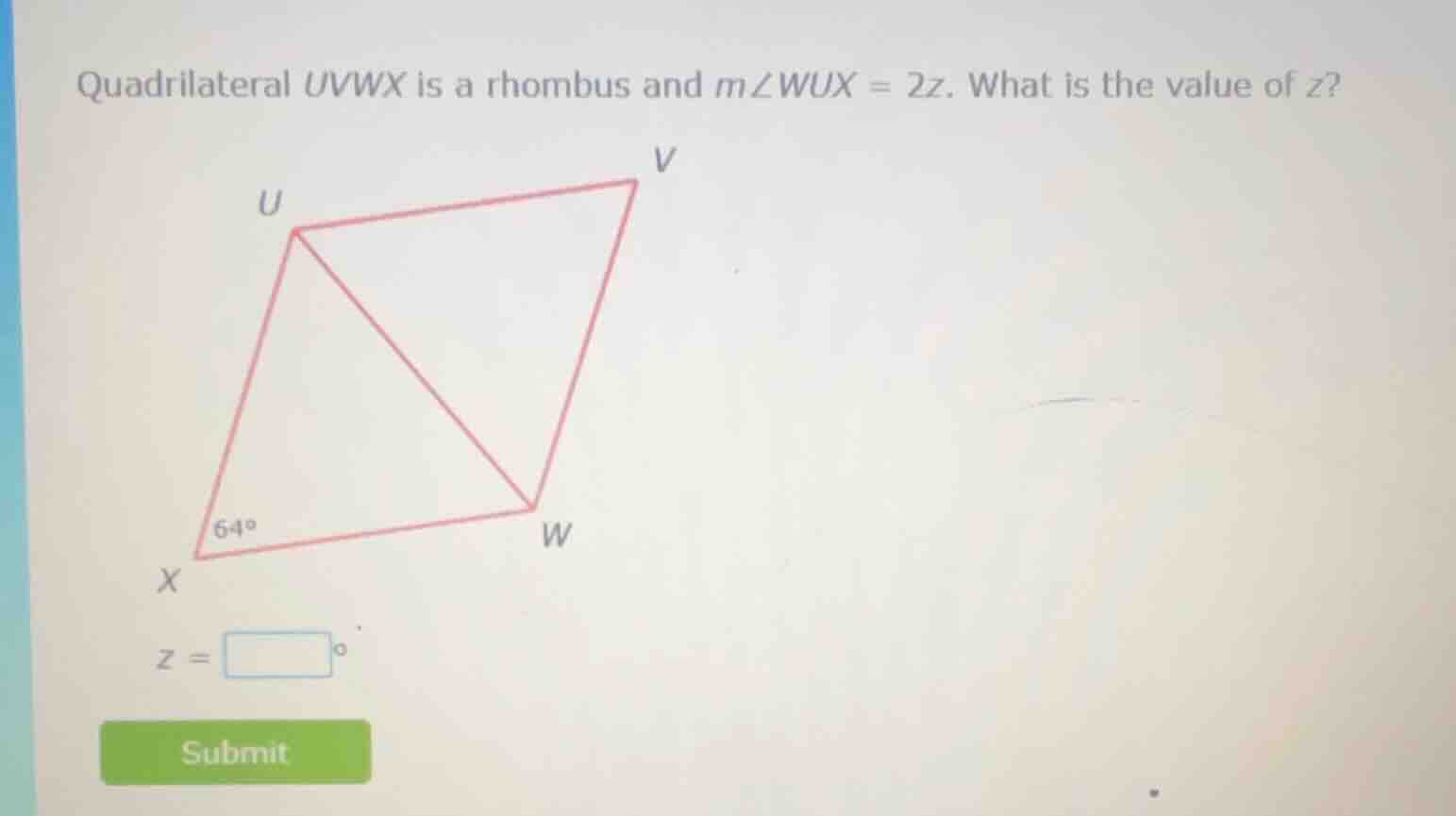
quadrilateral uvwx is a rhombus and ( mangle wux = 2z ). what is the value of ( z )?
( z = square^circ )
Step1: Recall rhombus angle properties
In a rhombus, adjacent angles are supplementary, and the diagonal bisects the angles. So, in rhombus \( UVWX \), \( \angle X = 64^\circ \), and triangle \( UXW \) has \( \angle X = 64^\circ \), \( UX = WX \) (sides of rhombus), so triangle \( UXW \) is isosceles. Also, the diagonal \( UW \) bisects \( \angle XUV \). In triangle \( UXW \), the sum of angles is \( 180^\circ \), so \( \angle WUX + \angle X + \angle UXW = 180^\circ \)? Wait, no, actually, in a rhombus, the diagonal bisects the vertex angles. So \( \angle WUX \) and the angle at \( X \): since \( UX = WX \) (sides of rhombus), triangle \( UXW \) is isosceles with \( UX = WX \), so \( \angle WUX = \angle UWX \). But also, in a rhombus, adjacent angles are supplementary? Wait, no, adjacent angles in a parallelogram (rhombus is a parallelogram) are supplementary. Wait, \( \angle X \) and \( \angle U \) are adjacent? Wait, \( \angle X = 64^\circ \), so the adjacent angle \( \angle U \) (at vertex \( U \)) would be \( 180 - 64 = 116^\circ \), but the diagonal \( UW \) bisects \( \angle U \), so \( \angle WUX = \frac{1}{2} \angle U \). Wait, maybe I made a mistake. Let's start over.
In a rhombus, all sides are equal, and the diagonals bisect the vertex angles. So in rhombus \( UVWX \), \( UX = WX \) (sides), so triangle \( UXW \) is isosceles with \( UX = WX \), so \( \angle WUX = \angle UWX \). Also, the sum of angles in a triangle is \( 180^\circ \), so in triangle \( UXW \), \( \angle X + \angle WUX + \angle UWX = 180^\circ \). We know \( \angle X = 64^\circ \), and \( \angle WUX = \angle UWX = 2z \) (wait, no, \( m\angle WUX = 2z \), so \( \angle WUX = 2z \), and \( \angle UWX = 2z \)? Wait, no, maybe the diagonal bisects the angle, so \( \angle WUX \) is half of the angle at \( U \). Wait, maybe a better approach: in a rhombus, adjacent angles are supplementary. So \( \angle X + \angle XUV = 180^\circ \). \( \angle X = 64^\circ \), so \( \angle XUV = 180 - 64 = 116^\circ \). Then the diagonal \( UW \) bisects \( \angle XUV \), so \( \angle WUX = \frac{1}{2} \angle XUV = \frac{116}{2} = 58^\circ \). But \( \angle WUX = 2z \), so \( 2z = 58^\circ \)? Wait, no, that can't be. Wait, maybe I messed up the angle. Wait, looking at the diagram, \( \angle X = 64^\circ \), and triangle \( UXW \): \( UX = WX \) (sides of rhombus), so it's isosceles, so \( \angle WUX = \angle UWX \). So \( 64 + 2z + 2z = 180 \)? Wait, no, \( \angle X = 64 \), \( \angle WUX = 2z \), \( \angle UWX = 2z \), so \( 64 + 2z + 2z = 180 \)? Then \( 64 + 4z = 180 \), \( 4z = 116 \), \( z = 29 \)? Wait, that doesn't seem right. Wait, maybe the diagonal bisects the angle, so \( \angle WUX \) is equal to \( \angle X \)? No, that can't be. Wait, maybe the angle at \( X \) is \( 64^\circ \), and since \( UX \parallel VW \) (rhombus is a parallelogram), alternate interior angles? Wait, no, let's use the property of rhombus: in a rhombus, the diagonal bisects the vertex angle. So \( \angle WUX \) is half of the angle at \( U \), and the angle at \( X \) and angle at \( U \) are adjacent, so they are supplementary. So \( \angle X + \angle U = 180^\circ \), so \( \angle U = 180 - 64 = 116^\circ \). Then the diagonal \( UW \) bisects \( \angle U \), so \( \angle WUX = \frac{1}{2} \times 116 = 58^\circ \). But \( \angle WUX = 2z \), so \( 2z = 58 \), so \( z = 29 \)? Wait, but that contradicts the triangle sum. Wait, maybe I made a mistake in the triangle. Let's look at the diagram: the angle at \( X \) is \( 64^\circ \), and the triangle is \( UXW \), with \( U \) connected to…

Snap & solve any problem in the app
Get step-by-step solutions on Sovi AI
Photo-based solutions with guided steps
Explore more problems and detailed explanations
\( 29 \)