QUESTION IMAGE
Question
question 1-1
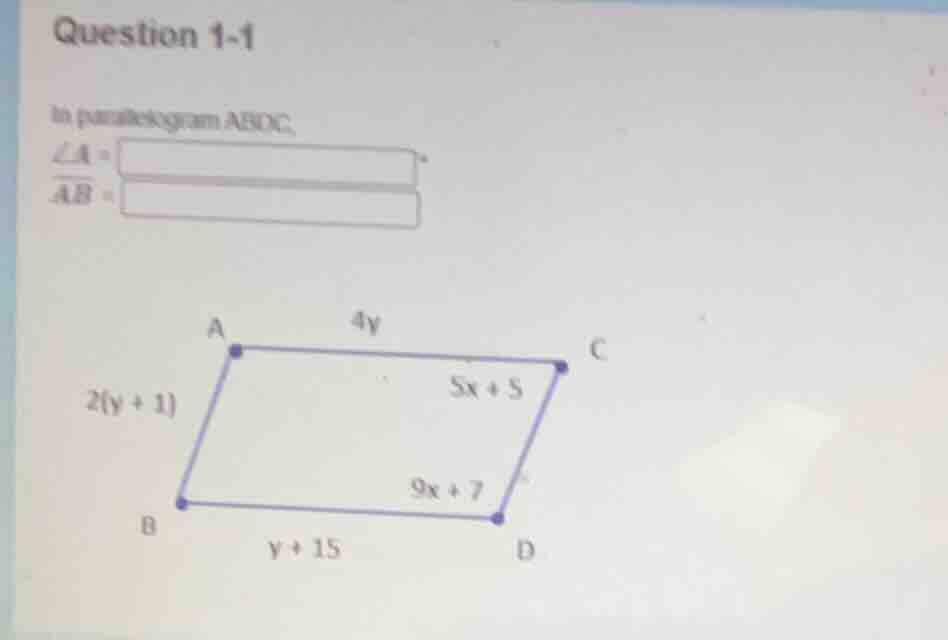
in parallelogram abcd,
$\angle a =$
$\overline{ab} =$
Step1: Solve for x (opposite sides equal)
In a parallelogram, opposite sides are equal, so $5x + 5 = 9x + 7$.
Rearrange terms: $5 - 7 = 9x - 5x$
$-2 = 4x$
$x = \frac{-2}{4} = -\frac{1}{2}$
Step2: Solve for y (opposite sides equal)
Opposite sides $AB$ and $CD$ (wait, correction: $AC$ and $BD$ are opposite): $4y = y + 15$
Rearrange terms: $4y - y = 15$
$3y = 15$
$y = 5$
Step3: Calculate $\angle A$ (supplementary to adjacent)
Adjacent angles in a parallelogram are supplementary. First find side $AD = 5x+5 = 5(-\frac{1}{2})+5 = \frac{5}{2}$, $AB=2(y+1)=2(5+1)=12$. Correction: adjacent angles: $\angle A + \angle D = 180$, but actually, we use the fact that adjacent angles are supplementary, but we can use the side expressions to confirm the angle? No, wait, in parallelogram, adjacent angles are supplementary, but $\angle A$ and the angle next to it (with side $9x+7$) are supplementary. Wait no, actually, the labels: $ABDC$ is parallelogram, so $AB \parallel CD$, $AC \parallel BD$. So $\angle A$ is adjacent to $\angle C$? No, $\angle A$ and $\angle B$ are supplementary. The length $AB=2(y+1)$, $BD=y+15$, $AC=4y$, $AD=5x+5=9x+7$. We found $y=5$, so $AB=2(5+1)=12$. For $\angle A$: adjacent angles sum to 180, but wait, no, actually, in parallelogram, opposite angles are equal, adjacent are supplementary. But we can use the fact that the angle at $A$ and angle at $D$ are supplementary, but we can calculate the measure: wait, no, actually, the problem likely assumes that the expressions for the sides let us find y, then $\angle A$ is equal to the opposite angle, but adjacent to the angle with side $9x+7$. Wait no, correction: in parallelogram, consecutive angles are supplementary. We have $AD = 5x+5 = 5(-0.5)+5=2.5$, $AB=12$. But actually, the angle $\angle A$: since $AB \parallel CD$, $\angle A + \angle C = 180$? No, no, $\angle A$ and $\angle B$ are consecutive. Wait, no, the key is that in parallelogram, opposite sides equal, we found y=5, so $AB=2(y+1)=12$. For $\angle A$: the angle at $A$ is equal to the angle at $D$? No, no, opposite angles are equal, consecutive are supplementary. Wait, the expression for the angle? Wait no, the problem says $\angle A$ and $\overline{AB}$. We found $\overline{AB}=12$. For $\angle A$: since $AC \parallel BD$, $\angle A$ and $\angle ABD$ are supplementary? No, wait, no, the angle at $A$: the side $AB=2(y+1)$, $AC=4y=20$. The angle $\angle A$: consecutive angle is the one with side $AD=5x+5=2.5$, so $\angle A + \angle D = 180$, but $\angle D$ is equal to $\angle B$? No, wait, I made a mistake: the problem's parallelogram is $ABDC$, so vertices are $A, B, D, C$. So sides: $AB$, $BD$, $DC$, $CA$. So $AB \parallel DC$, $BD \parallel CA$. Therefore, $AB = DC$, $BD=CA$. So $AB=2(y+1)=DC=5x+5$, $BD=y+15=CA=4y$. That's the correct pair!
Step1 (corrected): Solve for y (BD=CA)
$y+15=4y$
$15=3y$
$y=5$
Step2 (corrected): Solve for x (AB=DC)
$2(y+1)=5x+5$
Substitute $y=5$: $2(5+1)=5x+5$
$12=5x+5$
$5x=12-5=7$
$x=\frac{7}{5}=1.4$
Step3: Calculate $\overline{AB}$
$\overline{AB}=2(y+1)=2(5+1)=12$
Step4: Calculate $\angle A$
In parallelogram, consecutive angles are supplementary. $\angle A$ is consecutive to $\angle B$, and since $BD \parallel CA$, $\angle A + \angle B = 180$. But wait, no, actually, the angle $\angle A$: since opposite angles are equal, and consecutive are supplementary. But we can find that $\angle A$ is equal to the angle opposite to it, but we can use the fact that the side $AD$? No, wait, no, the problem must mean that $\angle A$ is equal to the opposite angle, but actually,…

Snap & solve any problem in the app
Get step-by-step solutions on Sovi AI
Photo-based solutions with guided steps
Explore more problems and detailed explanations
$\angle A = 115^\circ$, $\overline{AB}=12$