QUESTION IMAGE
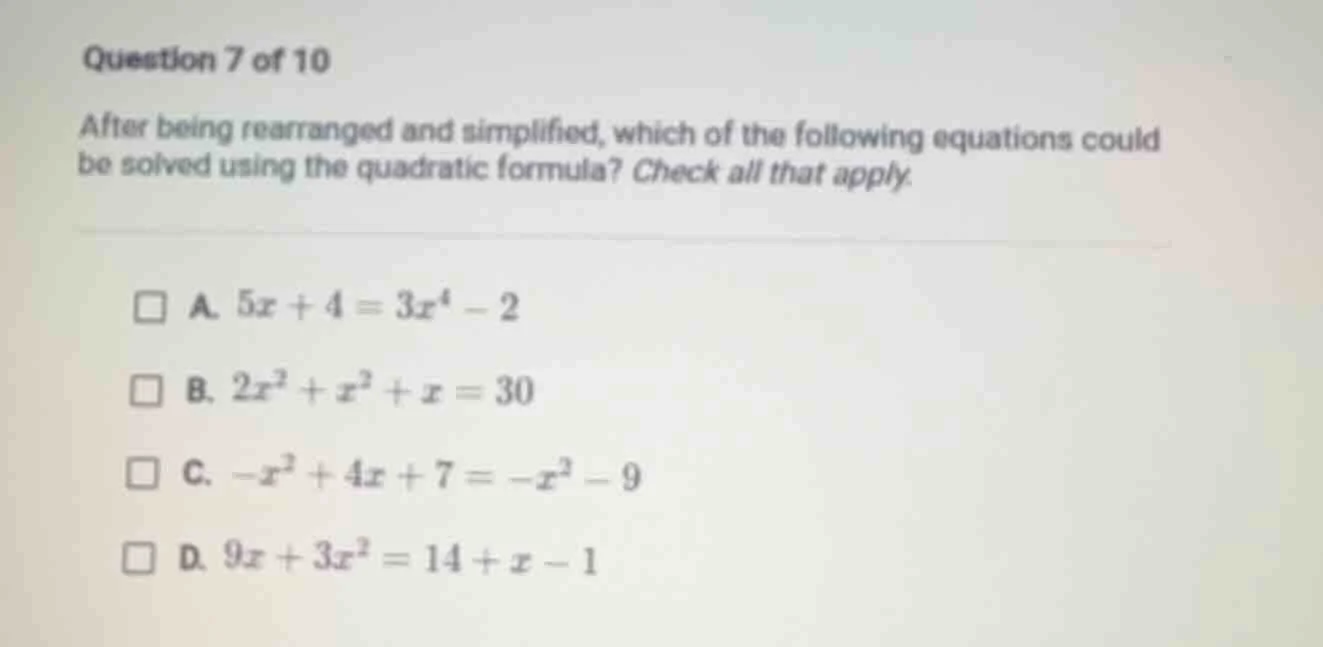
Question
question 7 of 10
after being rearranged and simplified, which of the following equations could
be solved using the quadratic formula? check all that apply.
a. $5x + 4 = 3x^4 - 2$
b. $2x^2 + x^2 + x = 30$
c. $-x^2 + 4x + 7 = -x^2 - 9$
d. $9x + 3x^2 = 14 + x - 1$
Step1: Recall quadratic equation form
A quadratic equation is of the form \(ax^2 + bx + c = 0\), where \(a
eq0\). We need to check each option after rearranging.
Step2: Analyze Option A
Equation: \(5x + 4 = 3x^4 - 2\)
Rearrange: \(3x^4 - 5x - 6 = 0\). The highest power of \(x\) is 4, so it's a quartic (degree 4) equation, not quadratic.
Step3: Analyze Option B
Equation: \(2x^2 + x^2 + x = 30\)
Combine like terms: \(3x^2 + x - 30 = 0\). This is in the form \(ax^2+bx + c = 0\) with \(a = 3
eq0\), so it's a quadratic equation.
Step4: Analyze Option C
Equation: \(-x^2 + 4x + 7 = -x^2 - 9\)
Add \(x^2\) to both sides: \(4x + 7 = -9\)
Rearrange: \(4x + 16 = 0\). The highest power of \(x\) is 1, so it's a linear equation, not quadratic.
Step5: Analyze Option D
Equation: \(9x + 3x^2 = 14 + x - 1\)
Simplify right side: \(9x + 3x^2 = x + 13\)
Subtract \(x\) and 13 from both sides: \(3x^2 + 8x - 13 = 0\). This is in the form \(ax^2+bx + c = 0\) with \(a = 3
eq0\), so it's a quadratic equation.

Snap & solve any problem in the app
Get step-by-step solutions on Sovi AI
Photo-based solutions with guided steps
Explore more problems and detailed explanations
B. \(2x^2 + x^2 + x = 30\)
D. \(9x + 3x^2 = 14 + x - 1\)