QUESTION IMAGE
Question
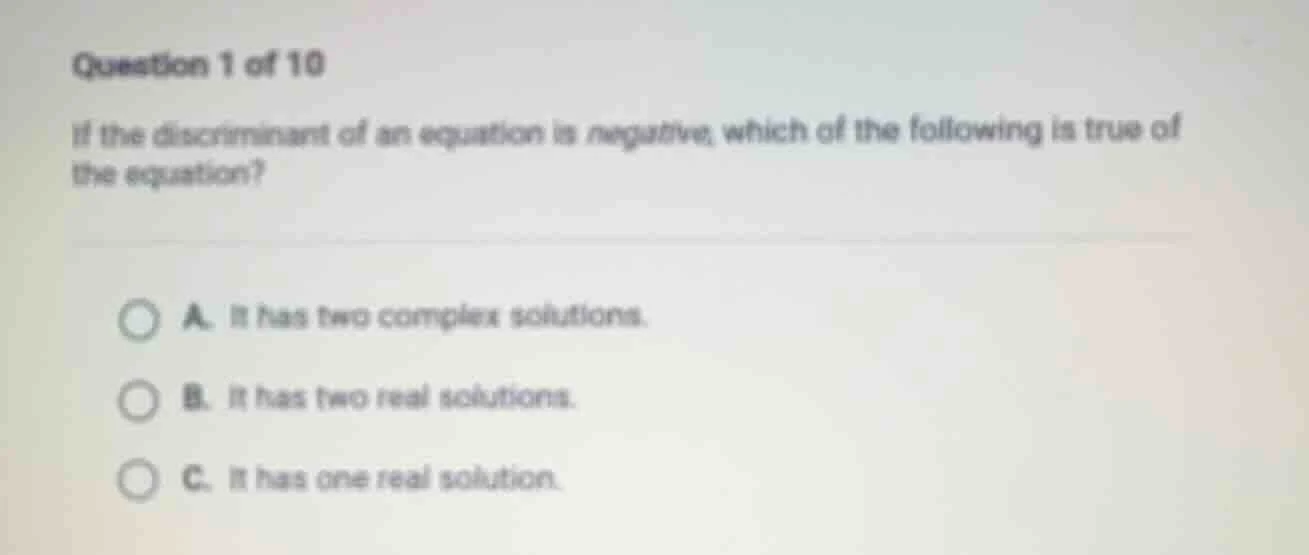
question 1 of 10
if the discriminant of an equation is negative, which of the following is true of
the equation?
a. it has two complex solutions.
b. it has two real solutions.
c. it has one real solution.
Brief Explanations
For a quadratic equation \( ax^{2}+bx + c = 0 \) (where \( a
eq0 \)), the discriminant is given by \( D=b^{2}-4ac \). The nature of the roots is determined by the discriminant:
- If \( D>0 \), the equation has two distinct real roots.
- If \( D = 0 \), the equation has one real root (a repeated root).
- If \( D<0 \) (negative discriminant), the roots are complex numbers (specifically, they are complex conjugates of the form \( m+ni \) and \( m - ni \)). So, a negative discriminant implies the equation has two complex solutions.

Snap & solve any problem in the app
Get step-by-step solutions on Sovi AI
Photo-based solutions with guided steps
Explore more problems and detailed explanations
A. It has two complex solutions.