QUESTION IMAGE
Question
question #10
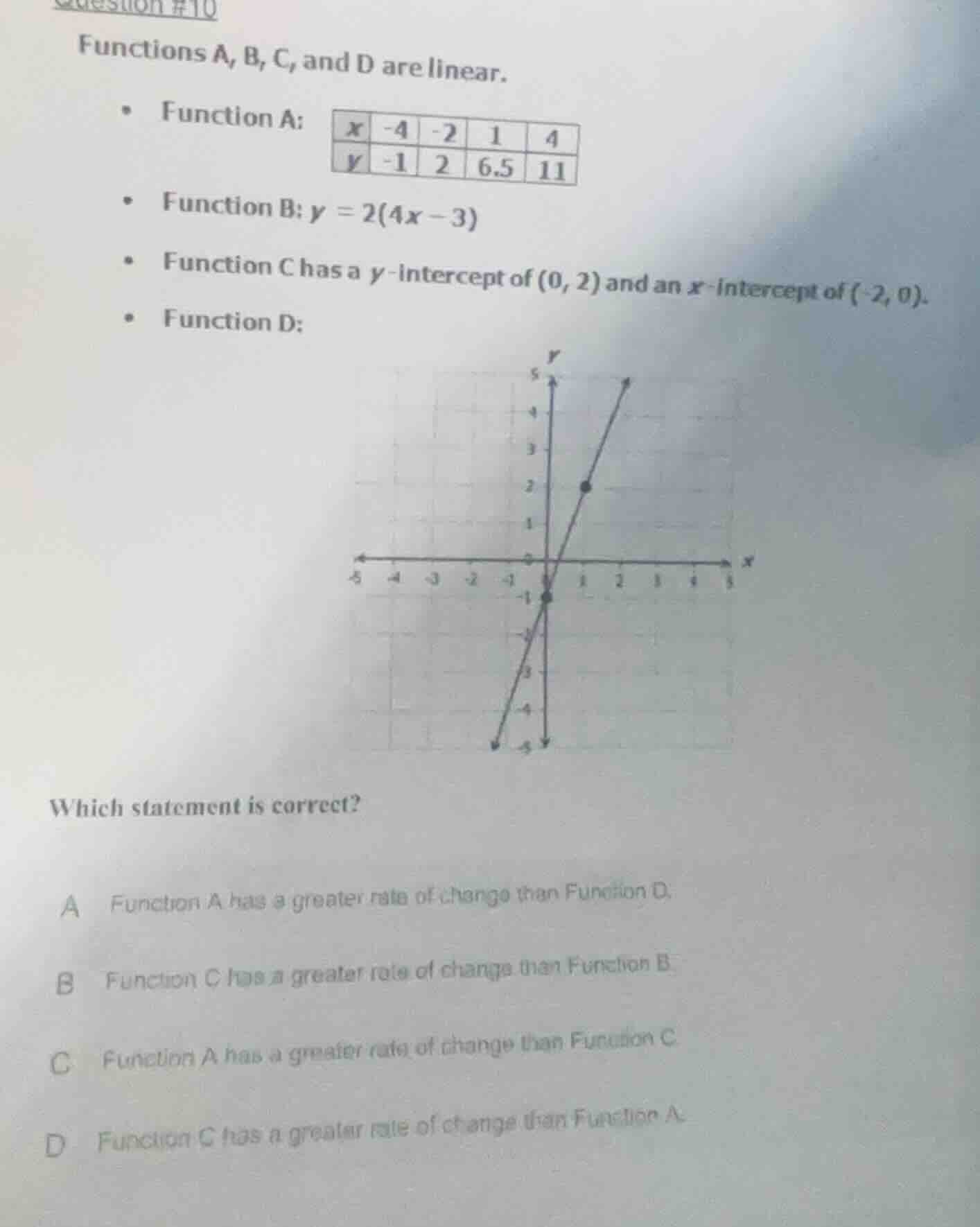
functions a, b, c, and d are linear.
- function a:
| x | -4 | -2 | 1 | 4 |
| y | -1 | 2 | 6.5 | 11 |
- function b: $y = 2(4x - 3)$
- function c has a $y$-intercept of $(0, 2)$ and an $x$-intercept of $(-2, 0)$.
- function d: graph of a line
which statement is correct?
a function a has a greater rate of change than function d.
b function c has a greater rate of change than function b.
c function a has a greater rate of change than function c.
d function c has a greater rate of change than function a.
Step1: Find slope of Function A
Use two points from Function A's table, e.g., \((-4, -1)\) and \((-2, 2)\).
Slope formula: \(m = \frac{y_2 - y_1}{x_2 - x_1}\)
\(m_A = \frac{2 - (-1)}{-2 - (-4)} = \frac{3}{2} = 1.5\)
Step2: Find slope of Function B
Simplify \(y = 2(4x - 3) = 8x - 6\).
Slope \(m_B = 8\) (from \(y = mx + b\)).
Step3: Find slope of Function C
Use intercepts \((0, 2)\) (y-intercept) and \((-2, 0)\) (x-intercept).
\(m_C = \frac{2 - 0}{0 - (-2)} = \frac{2}{2} = 1\)
Step4: Find slope of Function D
From the graph, points \((0, -1)\) and \((1, 2)\) (visible).
\(m_D = \frac{2 - (-1)}{1 - 0} = \frac{3}{1} = 3\)
Step5: Analyze options
- Option A: \(m_A = 1.5\), \(m_D = 3\) → \(1.5 < 3\) (False).
- Option B: \(m_C = 1\), \(m_B = 8\) → \(1 < 8\) (False).
- Option C: \(m_A = 1.5\), \(m_C = 1\) → \(1.5 > 1\) (True).
- Option D: \(m_C = 1\), \(m_A = 1.5\) → \(1 < 1.5\) (False).

Snap & solve any problem in the app
Get step-by-step solutions on Sovi AI
Photo-based solutions with guided steps
Explore more problems and detailed explanations
C. Function A has a greater rate of change than Function C.