QUESTION IMAGE
Question
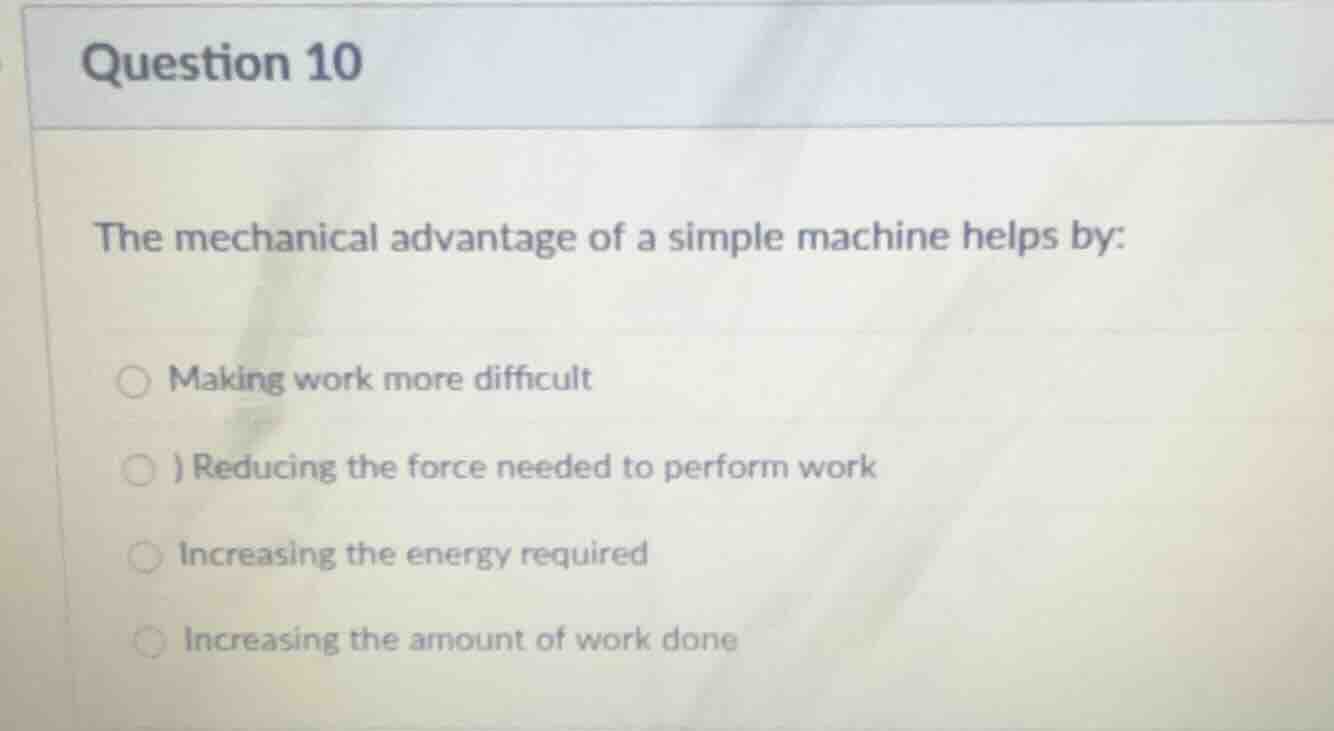
question 10
the mechanical advantage of a simple machine helps by:
making work more difficult
) reducing the force needed to perform work
increasing the energy required
increasing the amount of work done
Brief Explanations
- A simple machine's mechanical advantage (MA) relates to work ($W = Fd$, where $F$ is force, $d$ is distance) and energy (work - energy principle: work done equals energy transferred, and energy is conserved in ideal machines).
- "Making work more difficult" is incorrect because simple machines are designed to assist with work.
- "Increasing the energy required" is wrong as energy is conserved (or work input ≈ work output in ideal cases; real machines have efficiency losses but don't increase total energy needed for a task).
- "Increasing the amount of work done" is false because work done on an object (to move it, for example) depends on the force and distance, and simple machines don't create work—they trade force for distance (or vice versa).
- "Reducing the force needed to perform work" is correct. For example, a lever with a long effort arm reduces the force needed to lift a load (at the expense of moving the effort over a longer distance), so MA allows less force to do the same work (since $W = F_{input}d_{input} = F_{output}d_{output}$; if $d_{input} > d_{output}$, then $F_{input} < F_{output}$).

Snap & solve any problem in the app
Get step-by-step solutions on Sovi AI
Photo-based solutions with guided steps
Explore more problems and detailed explanations
) Reducing the force needed to perform work