QUESTION IMAGE
Question
question 10 (multiple choice worth 6 points) (06.04r mc)
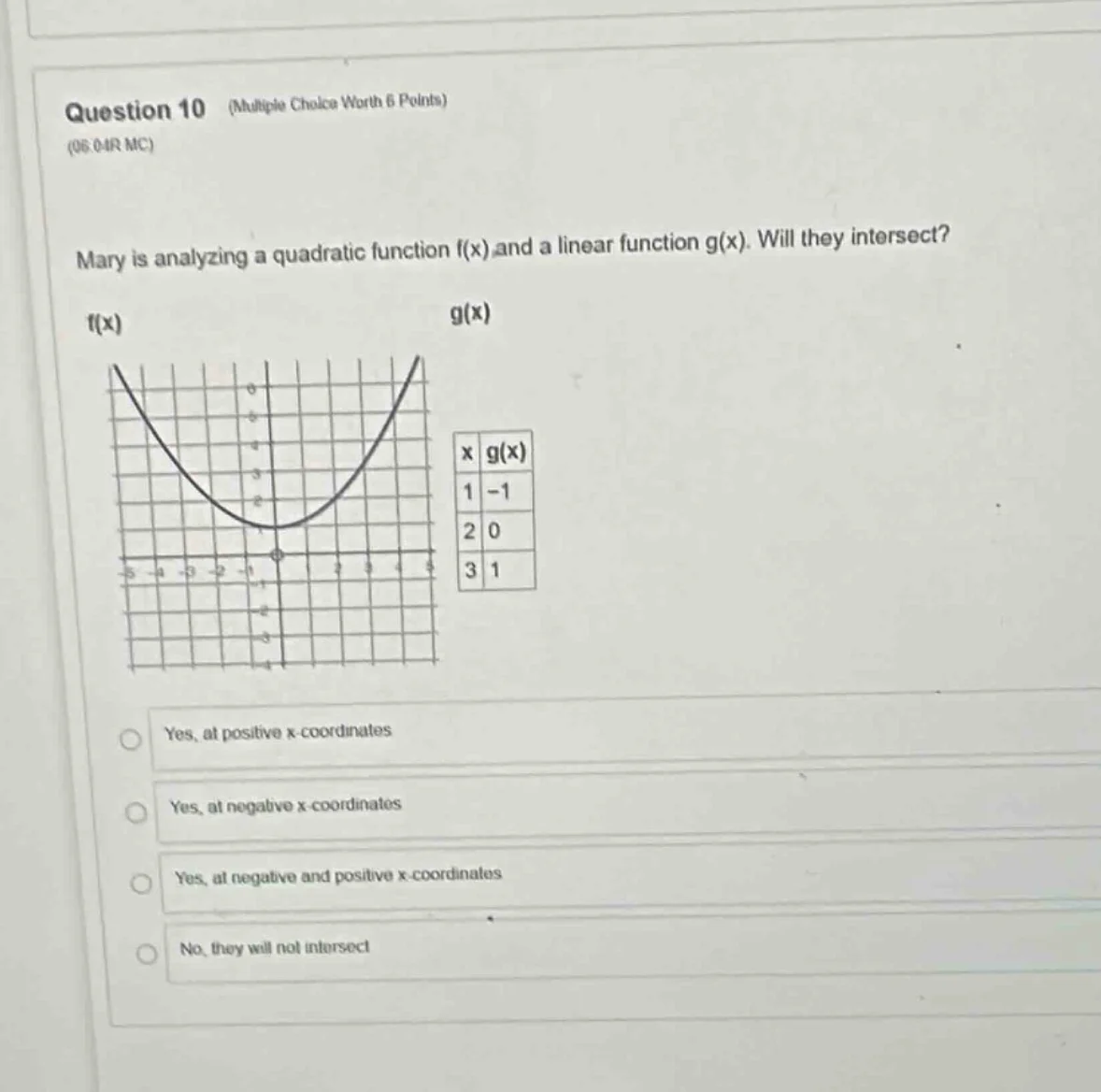
mary is analyzing a quadratic function f(x) and a linear function g(x). will they intersect?
f(x)
g(x)
| x | g(x) |
| 1 | -1 |
| 2 | 0 |
| 3 | 1 |
yes, at positive x-coordinates
yes, at negative x-coordinates
yes, at negative and positive x-coordinates
no, they will not intersect
Step1: Find quadratic function f(x)
The parabola has vertex $(0,0)$ and passes through $(2,4)$. Use vertex form $f(x)=ax^2$. Substitute $(2,4)$:
$4=a(2)^2 \implies 4=4a \implies a=1$. So $f(x)=x^2$.
Step2: Find linear function g(x)
Use points $(1,-1)$ and $(2,0)$. Slope $m=\frac{0-(-1)}{2-1}=1$. Use point-slope form $y-y_1=m(x-x_1)$ with $(2,0)$:
$g(x)-0=1(x-2) \implies g(x)=x-2$.
Step3: Find intersection points
Set $f(x)=g(x)$:
$x^2=x-2 \implies x^2 - x + 2=0$.
Step4: Check discriminant
Discriminant $D=b^2-4ac$ for $ax^2+bx+c=0$:
$D=(-1)^2-4(1)(2)=1-8=-7$.
Step5: Interpret discriminant
Since $D<0$, no real solutions exist.

Snap & solve any problem in the app
Get step-by-step solutions on Sovi AI
Photo-based solutions with guided steps
Explore more problems and detailed explanations
No, they will not intersect