QUESTION IMAGE
Question
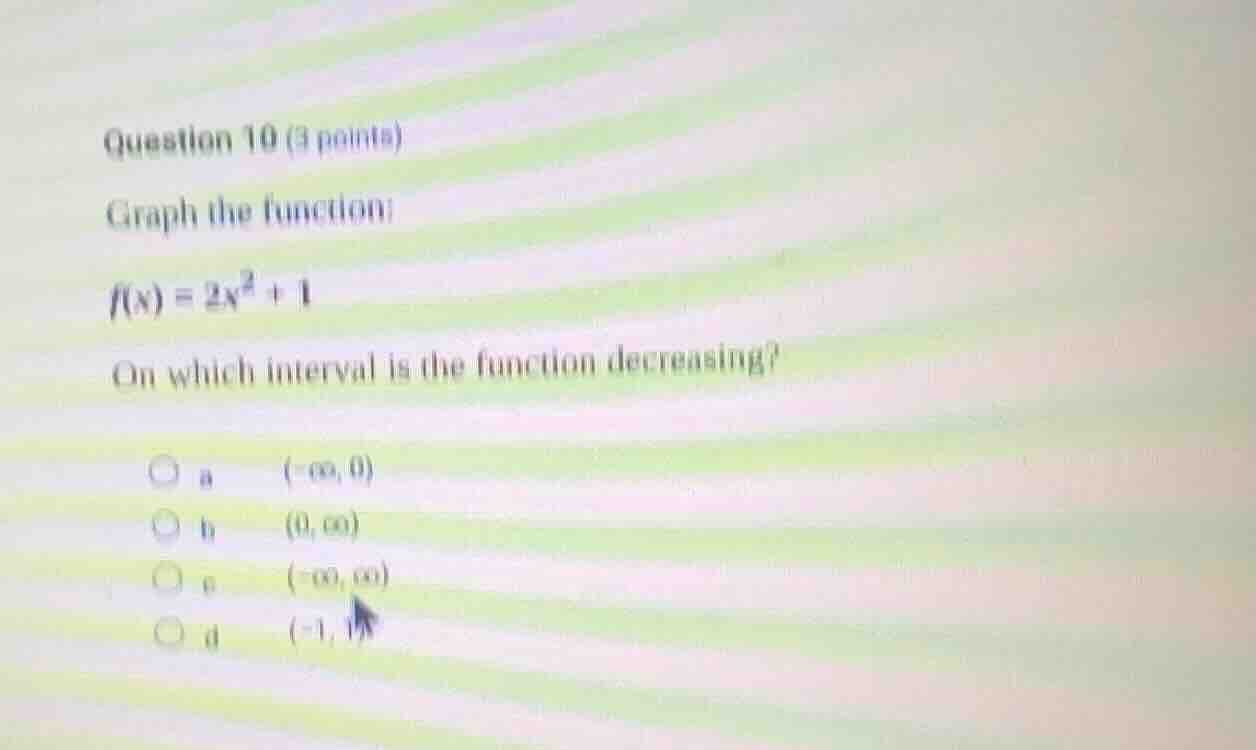
question 10 (3 points)
graph the function:
$f(x) = 2x^2 + 1$
on which interval is the function decreasing?
a $(-infty, 0)$
b $(0, infty)$
c $(-infty, infty)$
d $(-1, 1)$
Step1: Identify the function type
The function \( f(x) = 2x^2 + 1 \) is a quadratic function. The general form of a quadratic function is \( f(x)=ax^2 + bx + c \), where \( a = 2 \), \( b = 0 \), \( c = 1 \). Since \( a>0 \), the parabola opens upwards.
Step2: Find the vertex and axis of symmetry
For a quadratic function \( f(x)=ax^2+bx + c \), the axis of symmetry is given by \( x = -\frac{b}{2a} \). Here, \( b = 0 \) and \( a=2 \), so the axis of symmetry is \( x = 0 \) (the y - axis). The vertex of the parabola is at \( (0,f(0)) \). Substituting \( x = 0 \) into \( f(x) \), we get \( f(0)=2(0)^2 + 1=1 \), so the vertex is \( (0,1) \).
Step3: Determine the decreasing interval
For a parabola that opens upwards ( \( a>0 \) ), the function is decreasing to the left of the axis of symmetry and increasing to the right of the axis of symmetry. The axis of symmetry is \( x = 0 \), so the function is decreasing on the interval \( (-\infty,0) \).

Snap & solve any problem in the app
Get step-by-step solutions on Sovi AI
Photo-based solutions with guided steps
Explore more problems and detailed explanations
a. \((-\infty, 0)\)