QUESTION IMAGE
Question
question 10 (5 points)
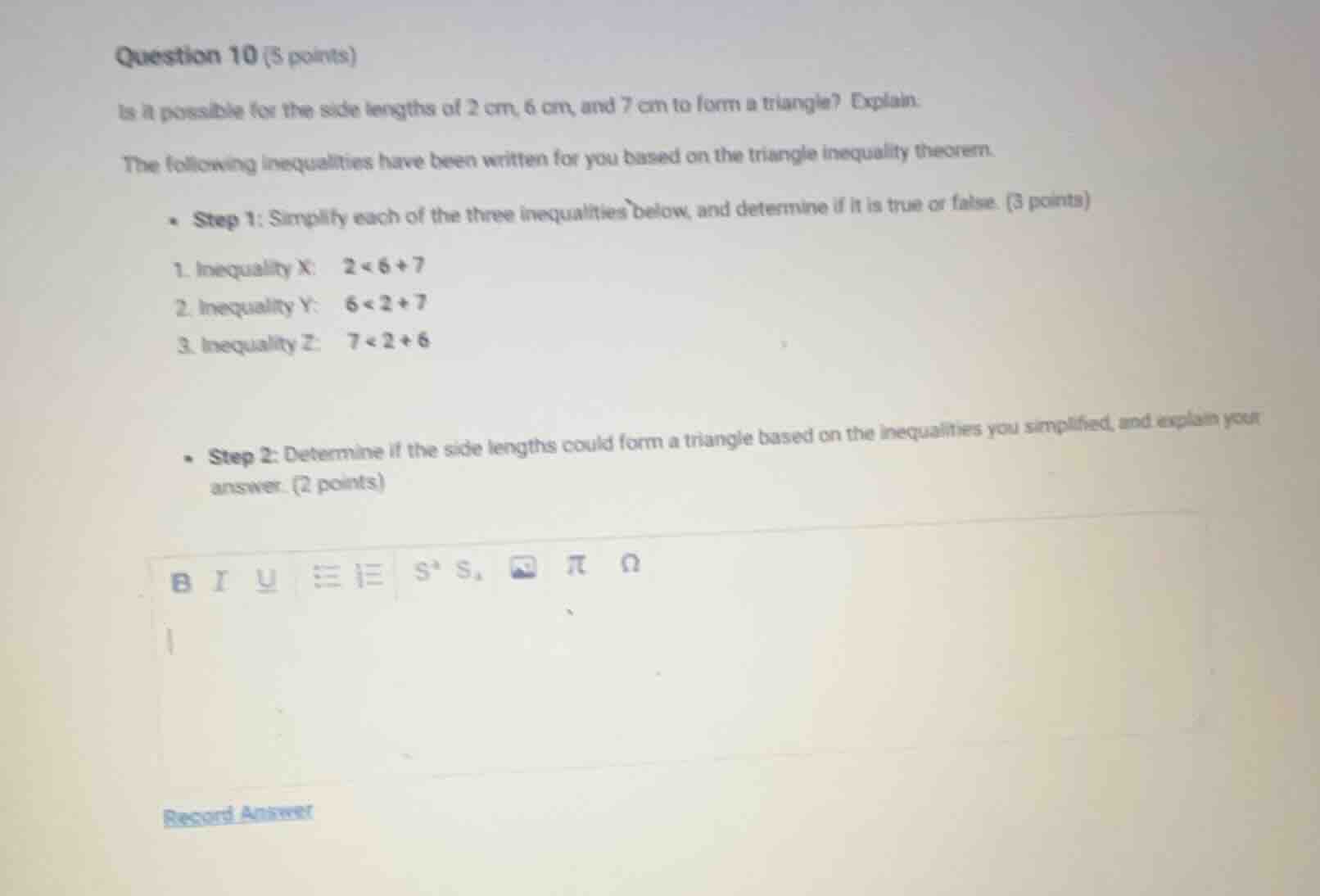
is it possible for the side lengths of 2 cm, 6 cm, and 7 cm to form a triangle? explain.
the following inequalities have been written for you based on the triangle inequality theorem.
- step 1: simplify each of the three inequalities below, and determine if it is true or false. (3 points)
- inequality x: 2 < 6 + 7
- inequality y: 6 < 2 + 7
- inequality z: 7 < 2 + 6
- step 2: determine if the side lengths could form a triangle based on the inequalities you simplified, and explain your answer. (2 points)
Step1: Simplify Inequality X
Simplify \(6 + 7\) first. \(6+7 = 13\), so the inequality becomes \(2<13\), which is true.
Step2: Simplify Inequality Y
Simplify \(2 + 7\) first. \(2+7 = 9\), so the inequality becomes \(6<9\), which is true.
Step3: Simplify Inequality Z
Simplify \(2 + 6\) first. \(2+6 = 8\), so the inequality becomes \(7<8\), which is true.
Step4: Determine triangle formation
The triangle inequality theorem states that for three side lengths \(a\), \(b\), \(c\) to form a triangle, the sum of any two sides must be greater than the third side. Since all three inequalities (checking each side against the sum of the other two) are true, the side lengths can form a triangle.

Snap & solve any problem in the app
Get step-by-step solutions on Sovi AI
Photo-based solutions with guided steps
Explore more problems and detailed explanations
Step 1:
- Inequality X: \(2<6 + 7\) simplifies to \(2<13\), which is true.
- Inequality Y: \(6<2 + 7\) simplifies to \(6<9\), which is true.
- Inequality Z: \(7<2 + 6\) simplifies to \(7<8\), which is true.
Step 2:
Yes, the side lengths of 2 cm, 6 cm, and 7 cm can form a triangle. This is because all three inequalities derived from the triangle inequality theorem are true, meaning the sum of any two side lengths is greater than the third side length.