QUESTION IMAGE
Question
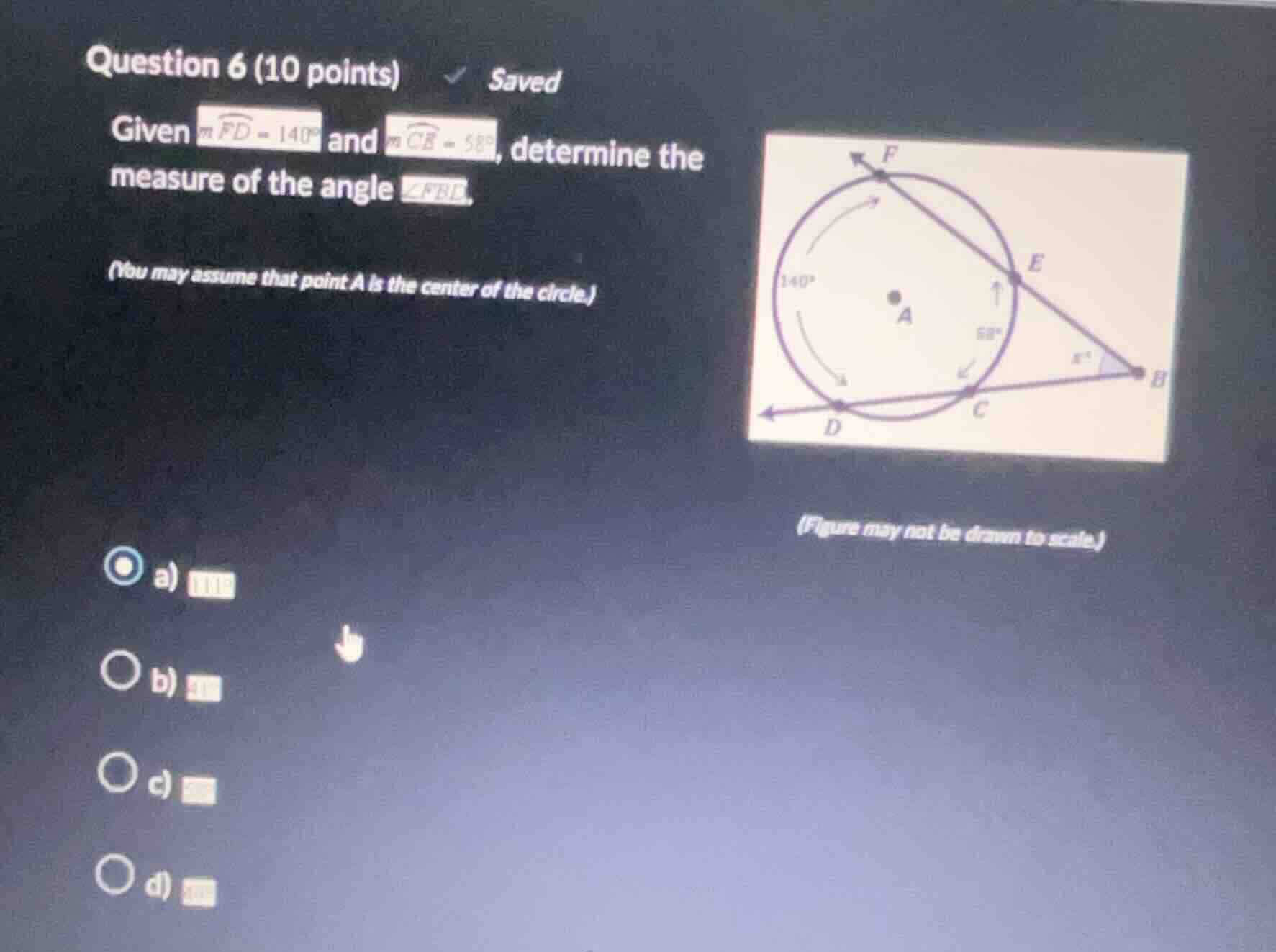
question 6 (10 points) saved given ( moverarc{fd} = 140^circ ) and ( moverarc{ce} = 58^circ ), determine the measure of the angle ( angle fbd ). (you may assume that point ( a ) is the center of the circle.) a) b) c) d)
Step1: Find the measure of arc \( \overarc{DC} \)
The total circumference of a circle is \( 360^\circ \). We know \( m\overarc{FD} = 140^\circ \) and \( m\overarc{CE} = 58^\circ \), but we first need to find the measure of the remaining arc. Wait, actually, since \( A \) is the center, the sum of arcs around the circle is \( 360^\circ \). But maybe we can use the property of the angle formed by two secants outside the circle. The formula for the measure of an angle formed by two secants outside the circle is \( \frac{1}{2}(\text{measure of the larger arc} - \text{measure of the smaller arc}) \).
First, let's find the measure of arc \( \overarc{FD} \) and the arc opposite to it? Wait, no. Wait, the angle \( \angle FBD \) is formed by two secants \( BF \) and \( BD \) intersecting at \( B \) outside the circle. The two intercepted arcs are \( \overarc{FD} \) and \( \overarc{EC} \)? Wait, no, let's check the diagram. Wait, the arcs given are \( \overarc{FD} = 140^\circ \) and \( \overarc{CE} = 58^\circ \). Wait, maybe the other arc \( \overarc{DC} \) and \( \overarc{FE} \)? Wait, no, let's recall the formula: the measure of an angle formed outside the circle by two secants is half the difference of the measures of the intercepted arcs. So, \( m\angle FBD = \frac{1}{2}(m\overarc{FD} - m\overarc{EC}) \)? Wait, no, that might not be right. Wait, maybe the larger arc and the smaller arc. Wait, the total circle is \( 360^\circ \), so the arc opposite to \( \overarc{FD} \) would be \( 360^\circ - 140^\circ = 220^\circ \)? No, that's not correct. Wait, maybe I made a mistake. Wait, let's re-examine.
Wait, the angle \( \angle FBD \) is formed by two secants: \( BF \) (passing through \( E \)) and \( BD \) (passing through \( C \)). So the intercepted arcs are \( \overarc{FD} \) and \( \overarc{EC} \)? Wait, no, the formula is \( m\angle = \frac{1}{2}(\text{measure of the far arc} - \text{measure of the near arc}) \). So the far arc is \( \overarc{FD} \) and the near arc is \( \overarc{EC} \)? Wait, no, maybe the other way. Wait, let's calculate the measure of the arc that's not \( \overarc{FD} \). Wait, the circle is \( 360^\circ \), so the arc \( \overarc{FD} = 140^\circ \), so the remaining arc (the rest of the circle) is \( 360^\circ - 140^\circ = 220^\circ \). But then, the arc \( \overarc{CE} = 58^\circ \), so maybe the arc \( \overarc{DC} \) and \( \overarc{FE} \) sum up to \( 220^\circ - 58^\circ = 162^\circ \)? No, this is confusing. Wait, maybe the correct approach is:
The measure of an angle formed outside the circle by two secants is \( \frac{1}{2}( \text{measure of the major arc} - \text{measure of the minor arc} ) \). So here, the two intercepted arcs are \( \overarc{FD} \) and \( \overarc{EC} \)? Wait, no, let's check the diagram again. Wait, the arcs are \( \overarc{FD} = 140^\circ \) and \( \overarc{CE} = 58^\circ \). Wait, maybe the angle \( \angle FBD \) intercepts arc \( \overarc{FD} \) and arc \( \overarc{EC} \). Wait, no, let's use the formula correctly.
Wait, the formula for the angle formed outside the circle: \( m\angle = \frac{1}{2}( \text{measure of the larger intercepted arc} - \text{measure of the smaller intercepted arc} ) \). So in this case, the two intercepted arcs are \( \overarc{FD} \) and \( \overarc{EC} \)? Wait, no, maybe the arc \( \overarc{FD} \) and the arc \( \overarc{EC} \) are the two arcs. Wait, let's calculate the difference. Wait, \( 140^\circ - 58^\circ = 82^\circ \), then half of that is \( 41^\circ \)? No, that's not one of the options. Wait, maybe I got the arcs wrong. Wait, the other arc…

Snap & solve any problem in the app
Get step-by-step solutions on Sovi AI
Photo-based solutions with guided steps
Explore more problems and detailed explanations
d) 41