QUESTION IMAGE
Question
question 1 of 10
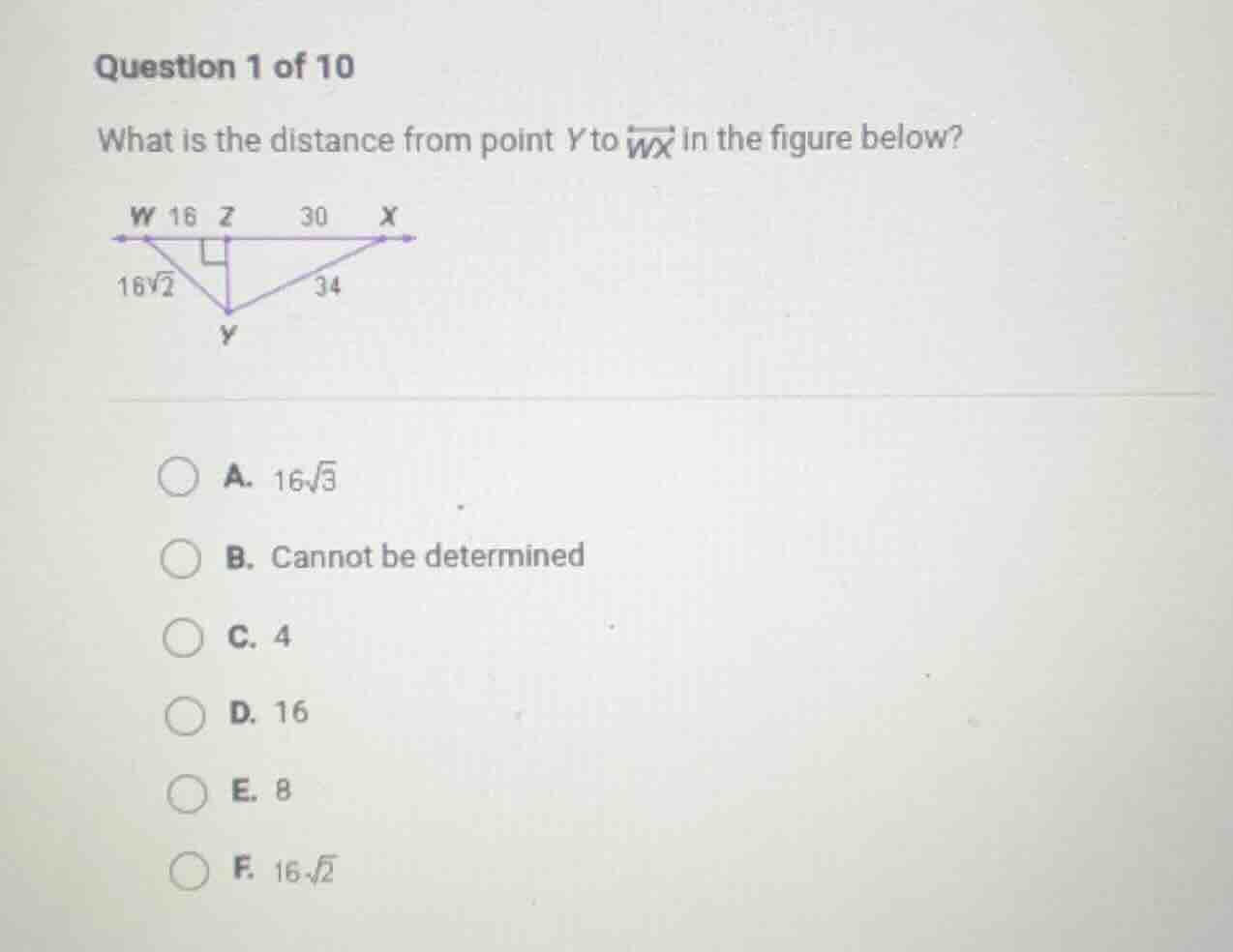
what is the distance from point y to \\(\overleftrightarrow{wx}\\) in the figure below?
a. \\(16\sqrt{3}\\)
b. cannot be determined
c. 4
d. 16
e. 8
f. \\(16\sqrt{2}\\)
Step1: Identify the right triangle
In triangle \( WYZ \), \( WZ = 16 \), \( WY = 16\sqrt{2} \), and \( YZ \) is the distance from \( Y \) to \( \overleftrightarrow{WX} \) (let's call it \( h \)). This is a right triangle with \( \angle YZW = 90^\circ \).
Step2: Apply Pythagorean theorem
The Pythagorean theorem states that in a right triangle, \( a^2 + b^2 = c^2 \), where \( c \) is the hypotenuse. Here, \( WY \) is the hypotenuse, \( WZ \) is one leg, and \( YZ \) is the other leg. So:
\[
WZ^2 + YZ^2 = WY^2
\]
Substitute \( WZ = 16 \) and \( WY = 16\sqrt{2} \):
\[
16^2 + h^2 = (16\sqrt{2})^2
\]
Step3: Solve for \( h \)
Calculate each term:
\( 16^2 = 256 \)
\( (16\sqrt{2})^2 = 16^2 \times (\sqrt{2})^2 = 256 \times 2 = 512 \)
Now the equation becomes:
\[
256 + h^2 = 512
\]
Subtract 256 from both sides:
\[
h^2 = 512 - 256 = 256
\]
Take the square root of both sides:
\[
h = \sqrt{256} = 16
\]
We can also verify with triangle \( YZX \): \( XZ = 30 \), \( XY = 34 \), and if \( YZ = 16 \), then \( 16^2 + 30^2 = 256 + 900 = 1156 \), and \( 34^2 = 1156 \), which confirms it's a right triangle too. So the distance from \( Y \) to \( \overleftrightarrow{WX} \) is 16.

Snap & solve any problem in the app
Get step-by-step solutions on Sovi AI
Photo-based solutions with guided steps
Explore more problems and detailed explanations
D. 16