QUESTION IMAGE
Question
question 1 of 10
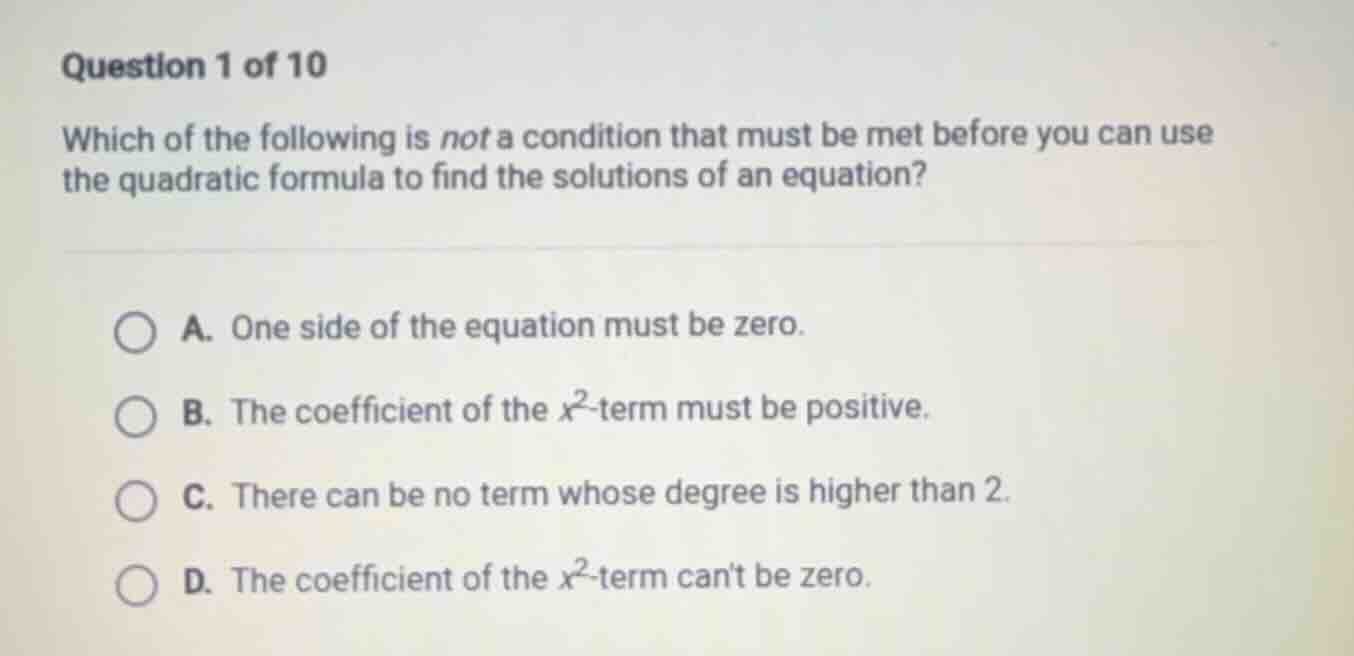
which of the following is not a condition that must be met before you can use
the quadratic formula to find the solutions of an equation?
a. one side of the equation must be zero.
b. the coefficient of the (x^2)-term must be positive.
c. there can be no term whose degree is higher than 2.
d. the coefficient of the (x^2)-term cant be zero.
To use the quadratic formula \( x=\frac{-b\pm\sqrt{b^{2}-4ac}}{2a} \) for a quadratic equation (in the form \( ax^{2}+bx + c = 0 \), \( a
eq0 \)):
- Option A: The equation must be set to zero (standard form \( ax^{2}+bx + c = 0 \)), so this is a required condition.
- Option B: The coefficient \( a \) (of \( x^{2} \)) can be negative (e.g., \( -2x^{2}+3x - 1 = 0 \) can still use the quadratic formula). The sign of \( a \) doesn't affect the ability to use the formula, only that \( a
eq0 \). So this is not a required condition.
- Option C: The equation must be quadratic (degree 2), so no term with degree higher than 2 is required, this is a condition.
- Option D: If \( a = 0 \), the equation becomes linear (\( bx + c = 0 \)), so \( a
eq0 \) is a condition.

Snap & solve any problem in the app
Get step-by-step solutions on Sovi AI
Photo-based solutions with guided steps
Explore more problems and detailed explanations
B. The coefficient of the \( x^{2} \)-term must be positive.