QUESTION IMAGE
Question
question 13 of 40
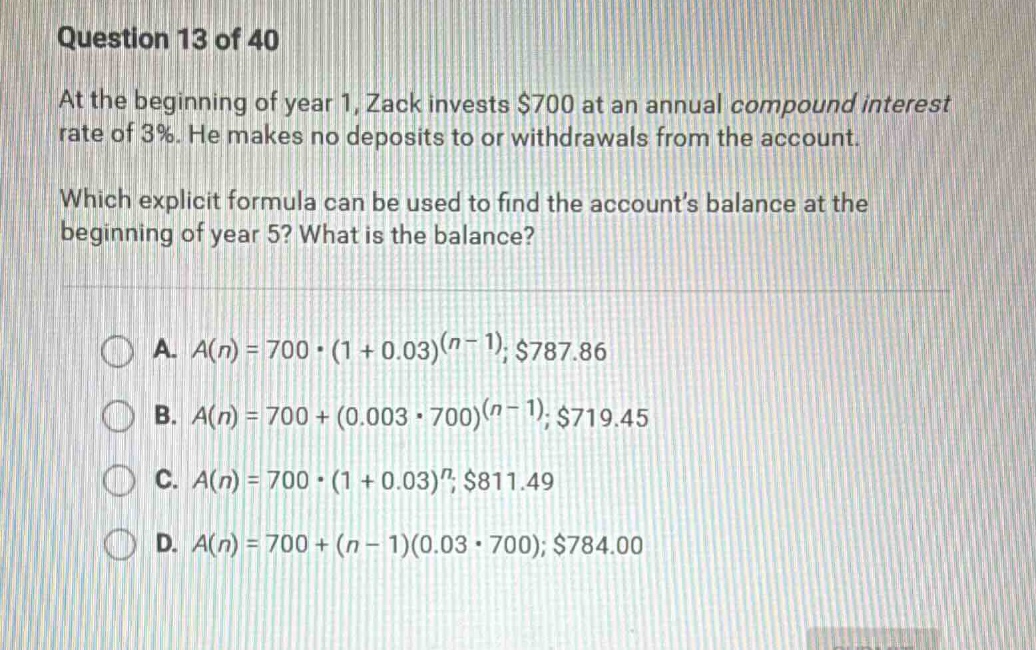
at the beginning of year 1, zack invests $700 at an annual compound interest rate of 3%. he makes no deposits to or withdrawals from the account.
which explicit formula can be used to find the account’s balance at the beginning of year 5? what is the balance?
a. $a(n) = 700 \cdot (1 + 0.03)^{(n - 1)}$; $\\$787.86$
b. $a(n) = 700 + (0.003 \cdot 700)^{(n - 1)}$; $\\$719.45$
c. $a(n) = 700 \cdot (1 + 0.03)^n$; $\\$811.49$
d. $a(n) = 700 + (n - 1)(0.03 \cdot 700)$; $\\$784.00$
Step1: Recall compound interest formula for discrete time
The formula for compound interest when compounded annually, and we want the amount at the beginning of year \( n \) (where the first investment is at the beginning of year 1) is a geometric sequence. The general form for a geometric sequence is \( A(n)=a\cdot r^{(n - 1)} \), where \( a \) is the initial amount, \( r \) is the common ratio (1 + interest rate), and \( n \) is the number of years. Here, the initial investment \( a = 700 \), the annual interest rate \( r=1 + 0.03=1.03 \), and we want the amount at the beginning of year 5, so \( n = 5 \).
Step2: Analyze each option
- Option A: The formula is \( A(n)=700\cdot(1 + 0.03)^{(n - 1)} \). Let's check for \( n = 5 \): \( A(5)=700\cdot(1.03)^{4} \). Calculate \( 1.03^{4}=1.03\times1.03\times1.03\times1.03 = 1.12550881 \). Then \( 700\times1.12550881\approx787.86 \).
- Option B: The formula is \( A(n)=700+(0.003\cdot700)^{(n - 1)} \). The interest rate here is wrong (0.003 instead of 0.03), so this is incorrect.
- Option C: The formula is \( A(n)=700\cdot(1 + 0.03)^{n} \). For \( n = 5 \), this would be \( 700\cdot(1.03)^{5}\approx700\times1.159274\approx811.49 \), but this formula is for the amount at the end of year \( n \), not the beginning. Since the investment is at the beginning of year 1, the beginning of year 5 is 4 compounding periods (from beginning of year 1 to beginning of year 5 is 4 years of compounding), so the exponent should be \( n - 1 \), not \( n \).
- Option D: This is the formula for simple interest \( A = P+(n - 1)I \), where \( I \) is the annual interest. But the problem is about compound interest, so this is incorrect.

Snap & solve any problem in the app
Get step-by-step solutions on Sovi AI
Photo-based solutions with guided steps
Explore more problems and detailed explanations
A. \( A(n) = 700\cdot(1 + 0.03)^{(n - 1)} \); \$787.86