QUESTION IMAGE
Question
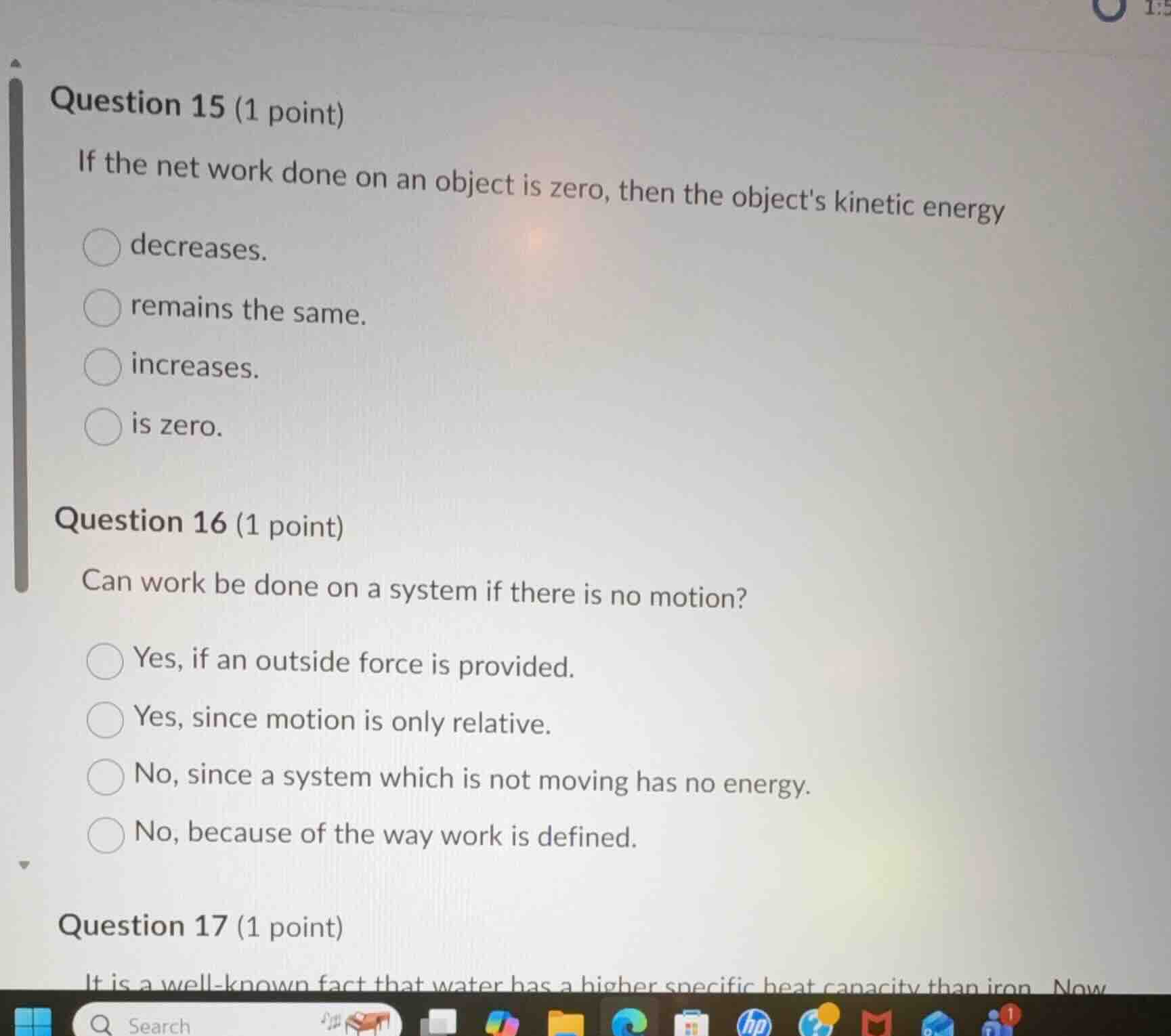
question 15 (1 point)
if the net work done on an object is zero, then the objects kinetic energy
decreases.
remains the same.
increases.
is zero.
question 16 (1 point)
can work be done on a system if there is no motion?
yes, if an outside force is provided.
yes, since motion is only relative.
no, since a system which is not moving has no energy.
no, because of the way work is defined.
question 17 (1 point)
it is a well - known fact that water has a higher specific heat capacity than iron. now
Question 15
The work - energy theorem states that the net work done on an object, \(W_{net}\), is equal to the change in the object's kinetic energy, \(\Delta KE\). Mathematically, \(W_{net}=\Delta KE = KE_{final}-KE_{initial}\). If the net work done on an object (\(W_{net} = 0\)), then \(KE_{final}-KE_{initial}=0\), which means \(KE_{final}=KE_{initial}\). So the object's kinetic energy remains the same.
Work is defined as the product of the force applied (\(F\)) and the displacement (\(d\)) of the object in the direction of the force, \(W = F\times d\times\cos\theta\) (where \(\theta\) is the angle between the force and displacement vectors). If there is no motion, then the displacement \(d = 0\). Substituting \(d = 0\) into the work formula, we get \(W=0\). So work cannot be done on a system if there is no motion, because of the way work is defined.

Snap & solve any problem in the app
Get step-by-step solutions on Sovi AI
Photo-based solutions with guided steps
Explore more problems and detailed explanations
B. remains the same.