QUESTION IMAGE
Question
question 1 (15 points)
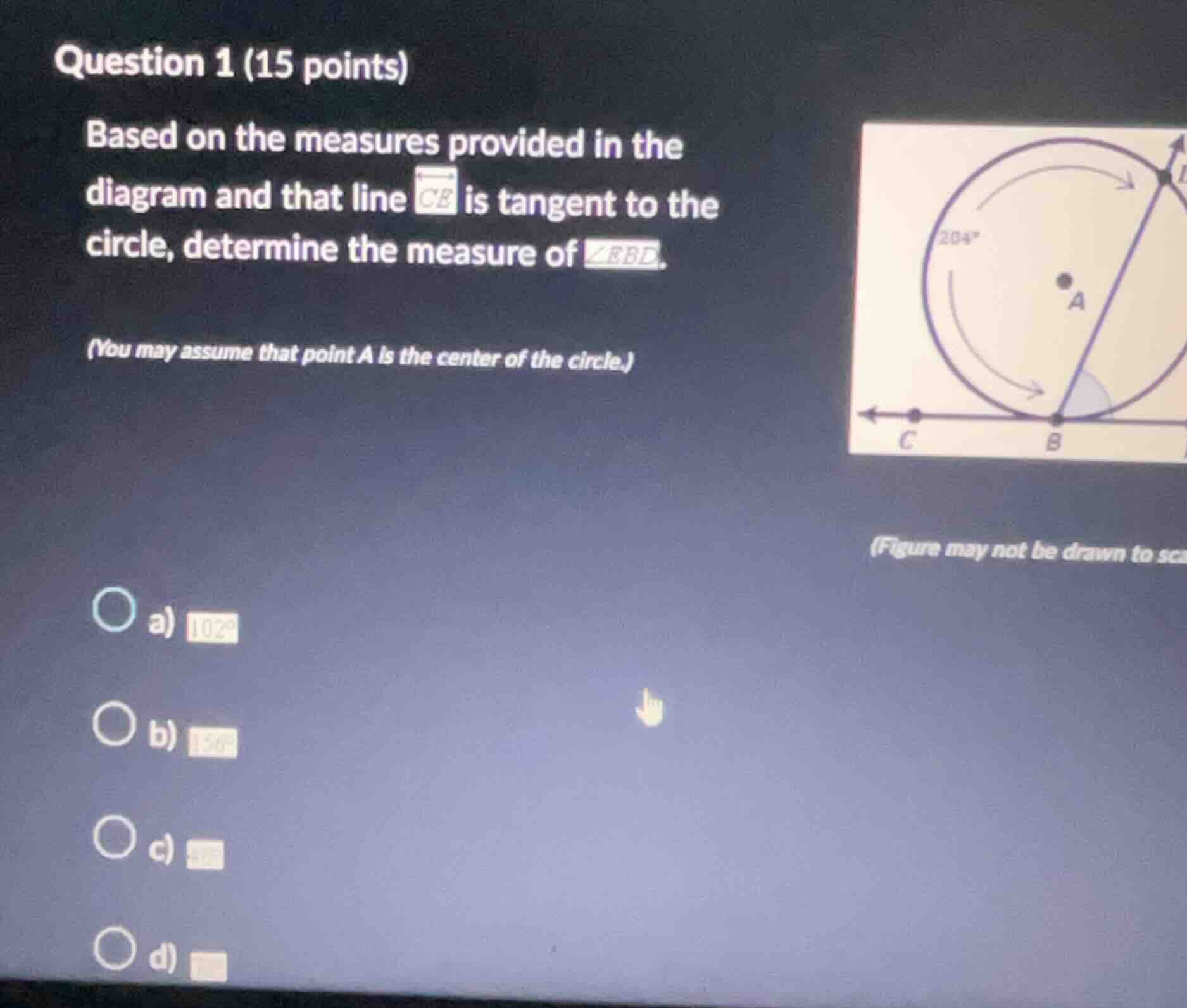
based on the measures provided in the
diagram and that line \\( \overleftrightarrow{cb} \\) is tangent to the
circle, determine the measure of \\( \angle ebd \\).
(you may assume that point a is the center of the circle.)
(figure may not be drawn to sca
a) \\( 102^\circ \\)
b)
c)
d)
Step1: Find the central angle
The total degrees in a circle is \(360^\circ\). Given the arc measure is \(204^\circ\), the adjacent central angle (for the smaller arc) is \(360^\circ - 204^\circ= 156^\circ\)? Wait, no, wait. Wait, the tangent is at \(B\), and \(AB\) is the radius, so \(AB\perp CE\) (tangent is perpendicular to radius). Wait, maybe first find the inscribed angle or the angle related to the arc. Wait, the arc given is \(204^\circ\), so the minor arc \(BD\) (wait, no, the arc opposite? Wait, the central angle for the arc not \(204^\circ\) is \(360 - 204 = 156^\circ\)? Wait, no, maybe the arc \(BD\) (the minor arc) is \(360 - 204 = 156^\circ\)? Wait, no, the tangent at \(B\), so \(AB\) is radius, so \(AB\perp CE\), so \(\angle CBA = 90^\circ\). Wait, maybe another approach: the measure of an angle formed by a tangent and a chord is half the measure of the intercepted arc. Wait, \(\angle EBD\) is formed by tangent \(CE\) and chord \(BD\), so the measure of \(\angle EBD\) is half the measure of the intercepted arc \(BD\). Wait, first find the measure of arc \(BD\). The total circle is \(360^\circ\), so arc \(BD\) (the one not \(204^\circ\)) is \(360 - 204 = 156^\circ\)? Wait, no, wait, maybe the arc \(BD\) is \(204^\circ\)? No, that can't be. Wait, no, the angle formed by tangent and chord is half the intercepted arc. Wait, let's recall: the measure of an angle formed by a tangent and a chord is equal to half the measure of the intercepted arc. So \(\angle EBD=\frac{1}{2}\times\) measure of arc \(BD\) (the arc that is intercepted, i.e., the arc that is opposite the angle, not containing the tangent side). Wait, the arc given is \(204^\circ\), so the other arc (minor arc \(BD\)) is \(360 - 204 = 156^\circ\)? No, wait, no, maybe the arc \(BD\) is \(204^\circ\)? Wait, no, the angle between tangent and chord is half the intercepted arc. Wait, let's check: if the arc is \(204^\circ\), then half of that is \(102^\circ\). Oh! Wait, maybe the intercepted arc is \(204^\circ\)? Wait, no, the angle formed by tangent and chord is half the measure of its intercepted arc. So if the arc is \(204^\circ\), then \(\angle EBD=\frac{1}{2}\times204^\circ = 102^\circ\). Ah, that makes sense. So step by step:
Step1: Recall the tangent - chord angle theorem
The measure of an angle formed by a tangent and a chord is half the measure of the intercepted arc.
Step2: Identify the intercepted arc
The angle \(\angle EBD\) is formed by tangent \(CE\) and chord \(BD\), so the intercepted arc is arc \(BD\) (the arc that is "cut off" by the chord \(BD\) and the tangent \(CE\)). The measure of arc \(BD\) is given as \(204^\circ\) (from the diagram).
Step3: Calculate the angle
Using the theorem, \(\angle EBD=\frac{1}{2}\times204^\circ = 102^\circ\).

Snap & solve any problem in the app
Get step-by-step solutions on Sovi AI
Photo-based solutions with guided steps
Explore more problems and detailed explanations
a) \(102^\circ\)