QUESTION IMAGE
Question
question 18 of 20
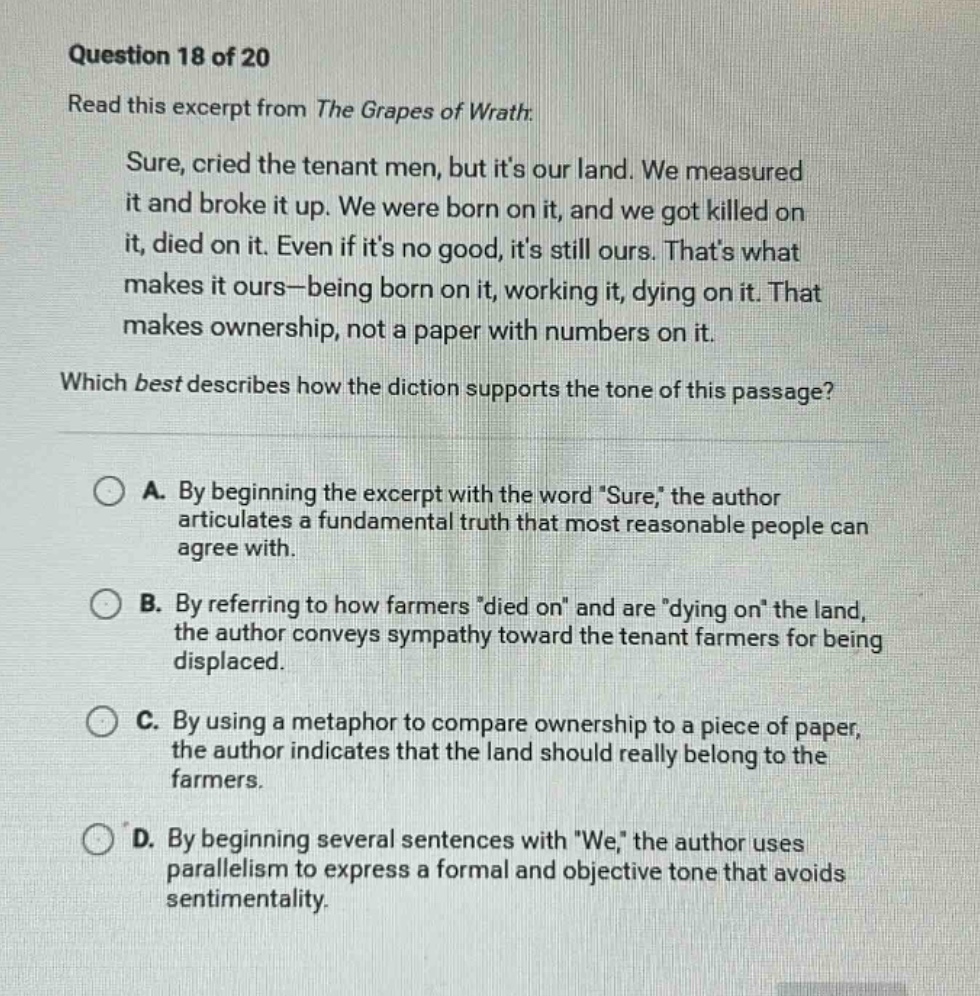
read this excerpt from the grapes of wrath:
sure, cried the tenant men, but its our land. we measured
it and broke it up. we were born on it, and we got killed on
it, died on it. even if its no good, its still ours. thats what
makes it ours-being born on it, working it, dying on it. that
makes ownership, not a paper with numbers on it.
which best describes how the diction supports the tone of this passage?
a. by beginning the excerpt with the word \sure,\ the author
articulates a fundamental truth that most reasonable people can
agree with.
b. by referring to how farmers \died on\ and are \dying on\ the land,
the author conveys sympathy toward the tenant farmers for being
displaced.
c. by using a metaphor to compare ownership to a piece of paper,
the author indicates that the land should really belong to the
farmers.
d. by beginning several sentences with \we,\ the author uses
parallelism to express a formal and objective tone that avoids
sentimentality.
- Option A: "Sure" here is a passionate, defensive exclamation, not a statement of universal agreed truth, so this is incorrect.
- Option B: The phrases "died on it, died on it" highlight the deep, lifelong connection of the farmers to the land, and their displacement from this meaningful space evokes reader sympathy, matching the passage's tone.
- Option C: The passage contrasts ownership as lived experience against a "paper with numbers," not a metaphor equating ownership to the paper, so this is wrong.
- Option D: The repeated "We" creates a personal, passionate, collective tone, not a formal, objective one, so this is incorrect.

Snap & solve any problem in the app
Get step-by-step solutions on Sovi AI
Photo-based solutions with guided steps
Explore more problems and detailed explanations
B. By referring to how farmers "died on" and are "dying on" the land, the author conveys sympathy toward the tenant farmers for being displaced.