QUESTION IMAGE
Question
question 2 of 20
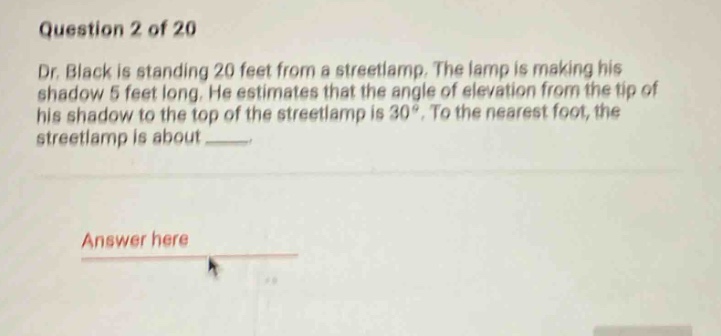
dr. black is standing 20 feet from a streetlamp. the lamp is making his
shadow 5 feet long. he estimates that the angle of elevation from the tip of
his shadow to the top of the streetlamp is 30°, to the nearest foot, the
streetlamp is about ______.
answer here
Step1: Find the total distance from the tip of the shadow to the base of the streetlamp.
The distance from Dr. Black to the streetlamp is 20 feet, and his shadow is 5 feet long. So the total distance \( d \) from the tip of the shadow to the base of the streetlamp is \( 20 + 5 = 25 \) feet.
Step2: Use the tangent function to find the height of the streetlamp.
We know that the angle of elevation \( \theta = 30^\circ \), and for a right triangle, \( \tan\theta=\frac{\text{opposite}}{\text{adjacent}} \). Let \( h \) be the height of the streetlamp (opposite side), and the adjacent side is the distance we found in Step1 (\( 25 \) feet). So \( \tan(30^\circ)=\frac{h}{25} \). Since \( \tan(30^\circ)=\frac{1}{\sqrt{3}}\approx\frac{1}{1.732} \), we can solve for \( h \): \( h = 25\times\tan(30^\circ)=25\times\frac{1}{\sqrt{3}}\approx\frac{25}{1.732}\approx14.43 \). Rounding to the nearest foot, \( h\approx14 \). Wait, wait, maybe I made a mistake. Wait, no, let's check again. Wait, the angle of elevation is from the tip of the shadow to the top of the streetlamp. So the adjacent side is the distance from tip of shadow to base of lamp, which is \( 20 + 5 = 25 \) feet. Then \( \tan(30^\circ)=\frac{h}{25} \), so \( h = 25\times\tan(30^\circ) \). \( \tan(30^\circ)=\frac{\sqrt{3}}{3}\approx0.577 \), so \( 25\times0.577\approx14.425 \), which is approximately 14? Wait, but maybe I messed up the distance. Wait, no, let's re - examine. Wait, Dr. Black is standing 20 feet from the streetlamp, shadow is 5 feet long. So the tip of the shadow is 5 feet from Dr. Black, so from tip of shadow to streetlamp base is 20 + 5 = 25 feet. Then the height \( h \) of the streetlamp, with angle of elevation 30 degrees, so \( \tan(30^\circ)=\frac{h}{25} \), so \( h = 25\times\frac{1}{\sqrt{3}}\approx14.43 \), which is approximately 14? Wait, but maybe I should use \( \tan(30^\circ)=\frac{1}{\sqrt{3}}\approx0.577 \), so 250.577 is about 14.4, which is 14 when rounded to nearest foot. But wait, maybe I made a mistake in the setup. Wait, another way: Let's consider the right triangle where the angle of elevation is 30 degrees, the adjacent side is the distance from tip of shadow to base of lamp (25 ft), and opposite side is height of lamp (h). So \( \tan(30^\circ)=\frac{h}{25} \), so \( h = 25\times\tan(30^\circ) \). Let's calculate \( \tan(30^\circ)=\frac{\sqrt{3}}{3}\approx0.577 \), so 250.577 = 14.425, so approximately 14. But wait, maybe the problem is using \( \tan(30^\circ)=\frac{1}{\sqrt{3}}\approx0.577 \), so the height is approximately 14 feet. Wait, but let's check with another approach. Alternatively, maybe I should use the 30 - 60 - 90 triangle ratios. In a 30 - 60 - 90 triangle, the sides are in the ratio \( 1:\sqrt{3}:2 \), where the side opposite 30 degrees is the shortest side. If the adjacent side (the side adjacent to 30 degrees) is 25, then the opposite side (height) is \( \frac{25}{\sqrt{3}}\approx14.43 \), which is 14 when rounded to nearest foot. Wait, but maybe the answer is 14? Wait, no, wait, maybe I miscalculated. Wait, 25 divided by 1.732 (since \( \sqrt{3}\approx1.732 \)) is approximately 14.43, which is 14 when rounded to the nearest foot. So the height of the streetlamp is approximately 14 feet.
Wait, but let's check again. Wait, maybe the distance is 20 + 5 = 25 feet. Then \( \tan(30^\circ)=\frac{h}{25} \), so \( h = 25\times\tan(30^\circ) \). Let's compute \( \tan(30^\circ)\approx0.577 \), so 25*0.577 = 14.425, which is 14 when rounded to the nearest foot. So the height of the streetlamp is approximately 14 feet.

Snap & solve any problem in the app
Get step-by-step solutions on Sovi AI
Photo-based solutions with guided steps
Explore more problems and detailed explanations
14