QUESTION IMAGE
Question
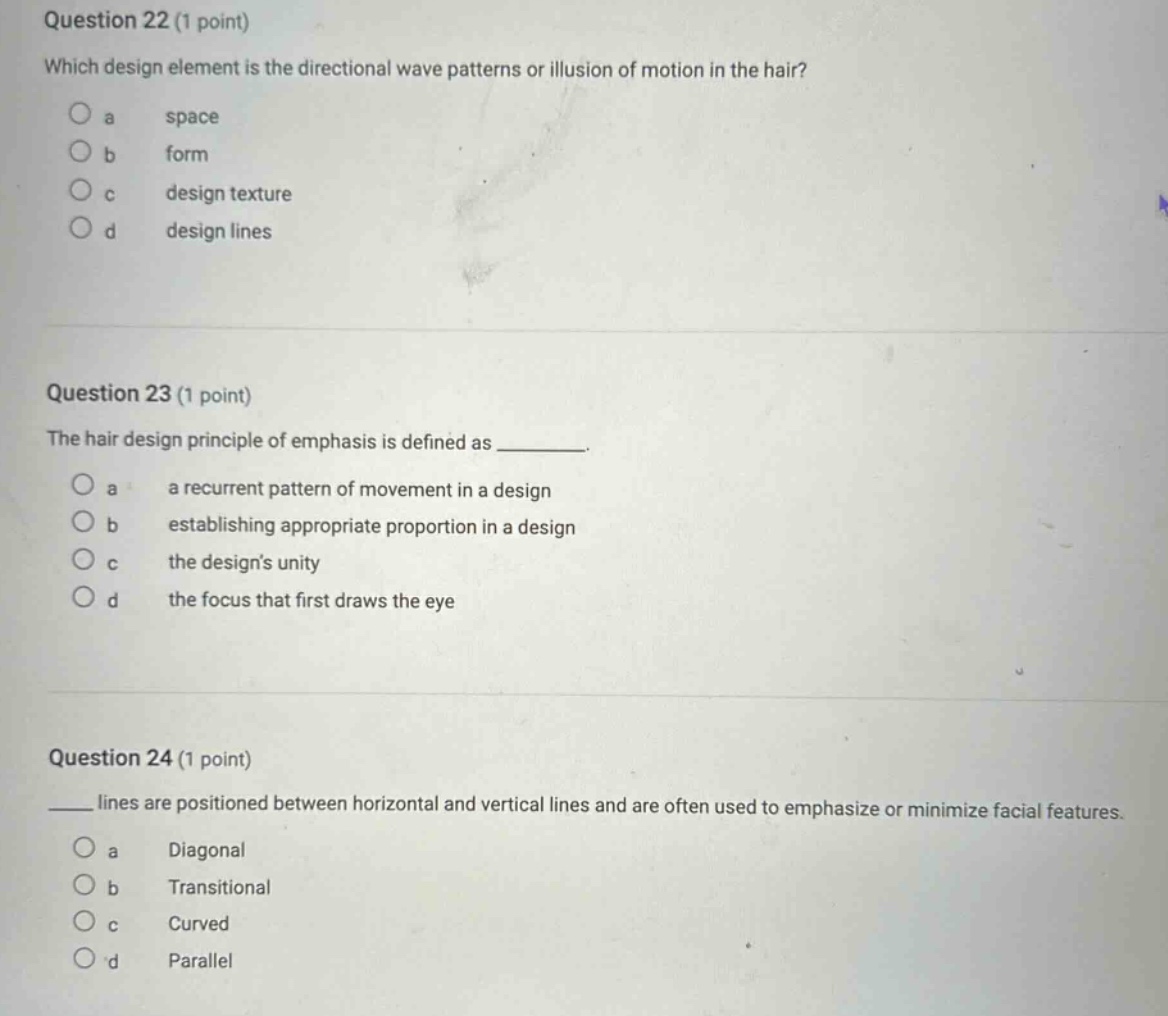
question 22 (1 point)
which design element is the directional wave patterns or illusion of motion in the hair?
○ a space
○ b form
○ c design texture
○ d design lines
question 23 (1 point)
the hair design principle of emphasis is defined as ______.
○ a a recurrent pattern of movement in a design
○ b establishing appropriate proportion in a design
○ c the design’s unity
○ d the focus that first draws the eye
question 24 (1 point)
____ lines are positioned between horizontal and vertical lines and are often used to emphasize or minimize facial features.
○ a diagonal
○ b transitional
○ c curved
○ d parallel
Question 22
To determine the design element for directional wave patterns or illusion of motion in hair, we analyze each option:
- Option a (space) relates to area/volume, not motion.
- Option b (form) refers to shape, not directional motion.
- Option c (design texture) involves surface quality, not directional patterns.
- Option d (design lines) can create directional wave patterns or the illusion of motion, as lines guide the eye and suggest movement.
To define the hair design principle of emphasis:
- Option a (recurrent pattern of movement) describes rhythm, not emphasis.
- Option b (establishing appropriate proportion) describes proportion, not emphasis.
- Option c (the design’s unity) describes unity, not emphasis.
- Option d (the focus that first draws the eye) matches the definition of emphasis, as emphasis creates a focal point.
To identify the lines between horizontal and vertical for emphasizing/minimizing facial features:
- Option a (Diagonal) is at an angle but not between horizontal/vertical in the transitional sense.
- Option b (Transitional) lines are positioned between horizontal and vertical, used to adjust facial feature perception.
- Option c (Curved) lines are rounded, not between horizontal/vertical.
- Option d (Parallel) lines run alongside each other, not between horizontal/vertical.

Snap & solve any problem in the app
Get step-by-step solutions on Sovi AI
Photo-based solutions with guided steps
Explore more problems and detailed explanations
d. design lines