QUESTION IMAGE
Question
question 23 of 25
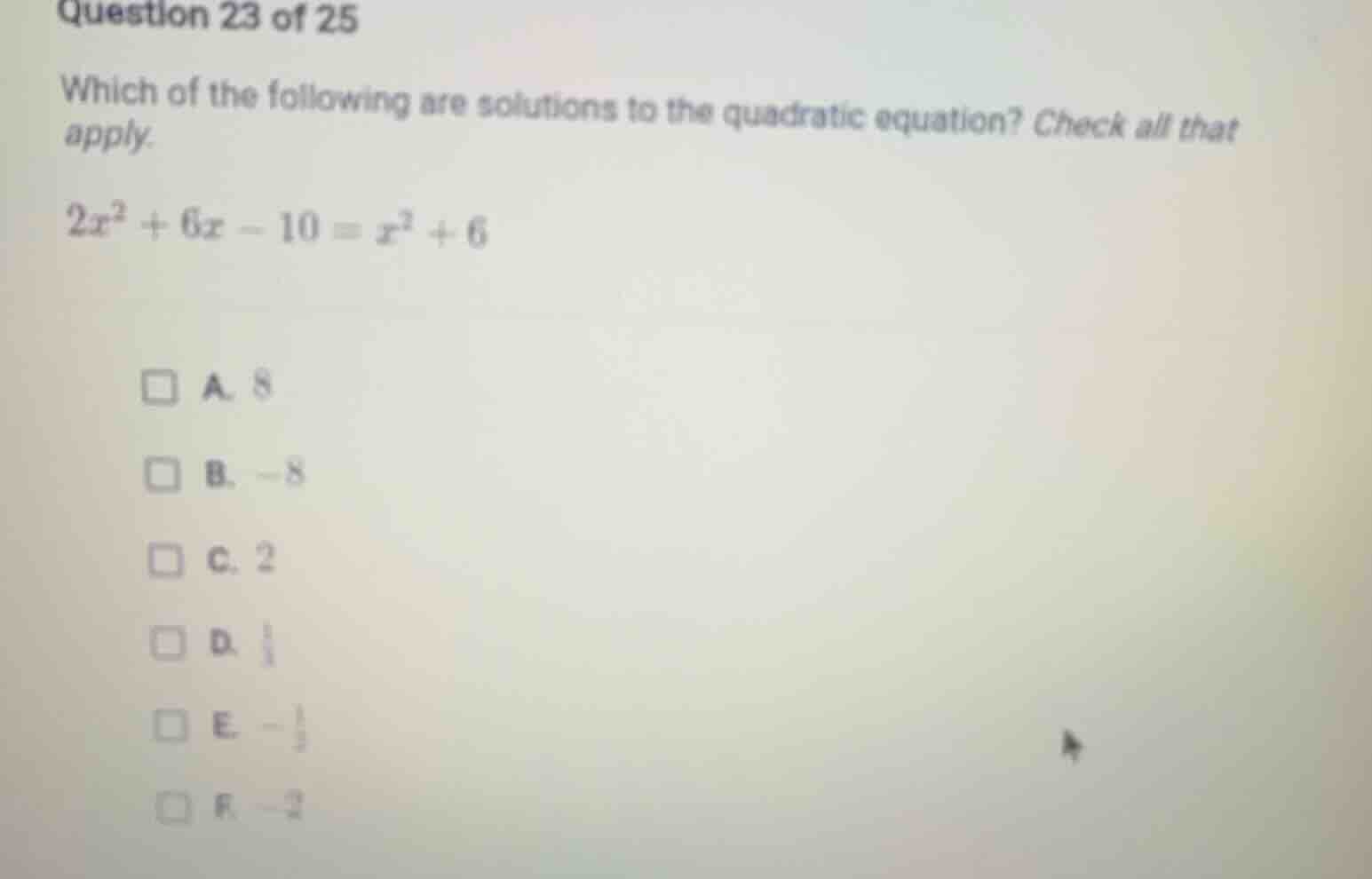
which of the following are solutions to the quadratic equation? check all that apply.
$2x^2 + 6x - 10 = x^2 + 6$
a. 8
b. -8
c. 2
d. $\frac{1}{4}$
e. $-\frac{1}{4}$
f. -2
Step1: Simplify the equation
Subtract \(x^{2}+6\) from both sides of the equation \(2x^{2}+6x - 10=x^{2}+6\) to get:
\(2x^{2}+6x - 10-(x^{2}+6)=x^{2}+6-(x^{2}+6)\)
Simplify the left - hand side and the right - hand side:
\(2x^{2}+6x - 10 - x^{2}-6 = 0\)
\(x^{2}+6x-16 = 0\)
Step2: Factor the quadratic equation
We need to find two numbers that multiply to \(- 16\) and add up to \(6\). The numbers are \(8\) and \(-2\) since \(8\times(-2)=-16\) and \(8+( - 2)=6\).
So, the factored form of the quadratic equation \(x^{2}+6x - 16 = 0\) is \((x + 8)(x-2)=0\)
Step3: Solve for x
Set each factor equal to zero:
- If \(x + 8=0\), then \(x=-8\)
- If \(x - 2=0\), then \(x = 2\)

Snap & solve any problem in the app
Get step-by-step solutions on Sovi AI
Photo-based solutions with guided steps
Explore more problems and detailed explanations
B. \(-8\), C. \(2\)