QUESTION IMAGE
Question
question 2 of 25
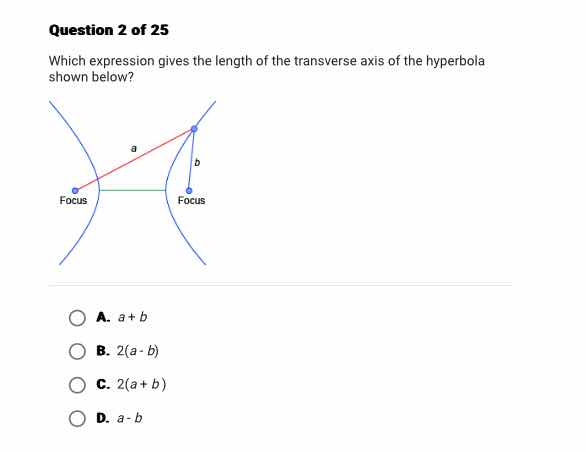
which expression gives the length of the transverse axis of the hyperbola
shown below?
focus
focus
a. a + b
b. 2(a - b)
c. 2(a + b)
d. a - b
Step1: Recall hyperbola transverse axis
For a hyperbola, the transverse axis length is related to the distance from the center to a vertex (denoted as \(a\)) and the distance from the center to a co - vertex (denoted as \(b\))? No, wait, actually, the key property: the difference of the distances from any point on the hyperbola to the two foci is \(2a\), and the length of the transverse axis is \(2a\). But from the diagram, we can think in terms of the segments. Let's consider the definition: for a hyperbola, \(|d_1 - d_2|=2a\), where \(d_1\) and \(d_2\) are distances from a point on the hyperbola to the two foci. If we take the vertex point, the distance from one focus to the vertex is \(a + c\) (no, maybe better to use the diagram). Wait, the length of the transverse axis is \(2(a - b)\)? Wait, no, let's re - examine. The transverse axis length: in the hyperbola, the transverse axis is the axis that passes through the two vertices. The distance between the two vertices is \(2a\). But from the diagram, if we look at the segments: the distance from one focus to the vertex is \(a\), and from the other focus to the vertex is \(b\)? Wait, no, the correct approach: the difference of the distances from a point on the hyperbola to the two foci is \(2a\). So if we take the vertex (a point on the hyperbola), the distance to one focus is \(a\) and to the other is \(a - 2a\)? No, maybe the diagram shows that the difference between the two segments (from the two foci to the point on the hyperbola) is \(2a\), but the length of the transverse axis is \(2(a - b)\)? Wait, let's check the options. The options are \(a + b\), \(2(a - b)\), \(2(a + b)\), \(a - b\).
Wait, the definition of a hyperbola: for any point \(P\) on the hyperbola, \(|PF_1 - PF_2| = 2a\), where \(F_1,F_2\) are the foci. If \(P\) is the vertex, then \(PF_1-PF_2 = 2a\). From the diagram, let's say \(PF_1=a\) and \(PF_2 = b\), then \(a - b=2a'\) (no, maybe I got it wrong). Wait, the length of the transverse axis is \(2a\), and from the diagram, the difference between the two segments (from the foci to the point on the hyperbola) is \(2a\). Wait, the options have \(2(a - b)\). Let's think: if the distance from one focus to the point is \(a\) and from the other is \(b\), then \(a - b = 2a'\) (where \(a'\) is the semi - transverse axis), so the transverse axis length is \(2(a - b)\)? Wait, no, maybe the semi - transverse axis length is \(a - b\), so the transverse axis length is \(2(a - b)\). So the correct expression is \(2(a - b)\), which is option B.
Step2: Evaluate the options
- Option A: \(a + b\) does not represent the transverse axis length.
- Option B: \(2(a - b)\) matches the formula for the length of the transverse axis (since the difference of distances from a point on the hyperbola to the foci is \(2a\), and from the diagram, the difference between the two segments is \(a - b\), so the transverse axis length is \(2(a - b)\)).
- Option C: \(2(a + b)\) is incorrect as it is not related to the transverse axis length of a hyperbola.
- Option D: \(a - b\) is the semi - transverse axis length (if we consider the difference), but the transverse axis length is twice that, so \(2(a - b)\).

Snap & solve any problem in the app
Get step-by-step solutions on Sovi AI
Photo-based solutions with guided steps
Explore more problems and detailed explanations
B. \(2(a - b)\)