QUESTION IMAGE
Question
question 40
0.1 pt
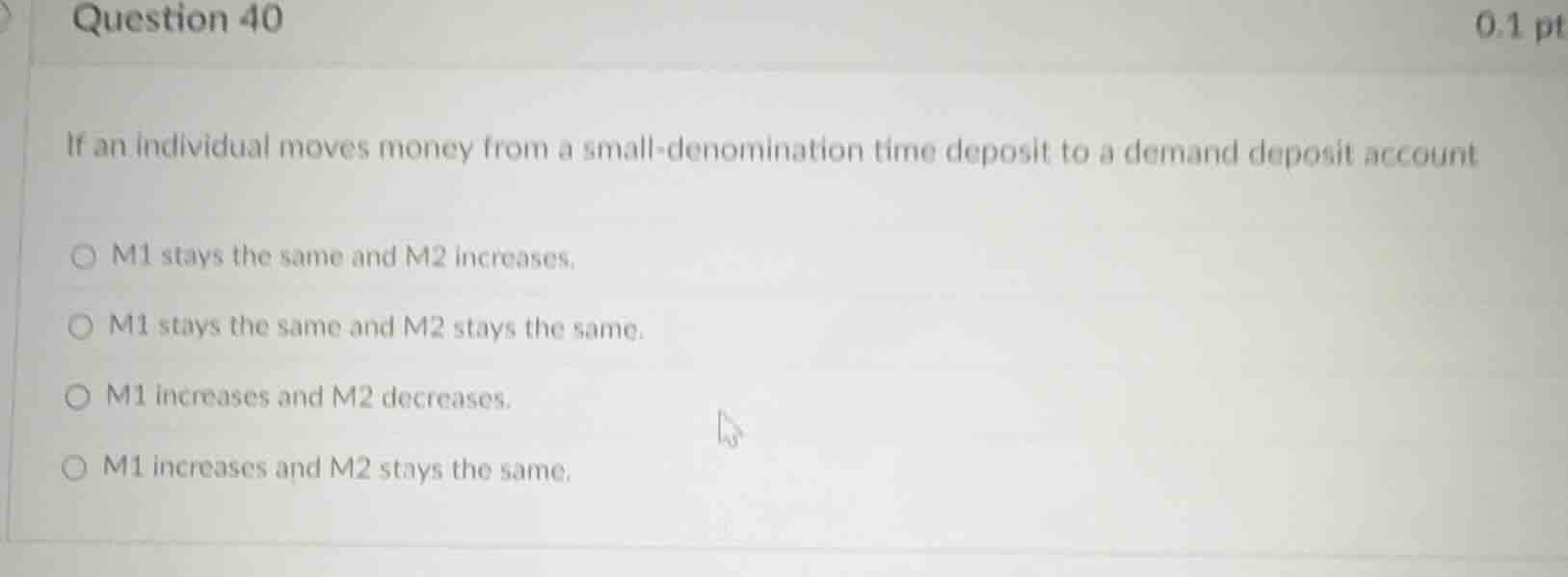
if an individual moves money from a small - denomination time deposit to a demand deposit account
m1 stays the same and m2 increases.
m1 stays the same and m2 stays the same.
m1 increases and m2 decreases.
m1 increases and m2 stays the same.
Brief Explanations
To solve this, we recall the definitions of M1 and M2. M1 includes demand deposits, currency, etc. M2 includes M1 plus savings deposits, small - denomination time deposits, money market mutual funds, etc.
- When money is moved from a small - denomination time deposit (part of M2 but not M1) to a demand deposit account (part of M1 and M2):
- For M1: Demand deposits increase, so M1 increases.
- For M2: Since we are moving money from one component of M2 (small - denomination time deposit) to another component of M2 (demand deposit, which is also in M1), the total of M2 remains the same. Because M2 is the sum of M1 and other components like small - denomination time deposits, savings deposits, etc. When we move from a non - M1 part of M2 to an M1 part (which is also in M2), the overall M2 doesn't change.

Snap & solve any problem in the app
Get step-by-step solutions on Sovi AI
Photo-based solutions with guided steps
Explore more problems and detailed explanations
D. M1 increases and M2 stays the same.