QUESTION IMAGE
Question
question 47 of 50
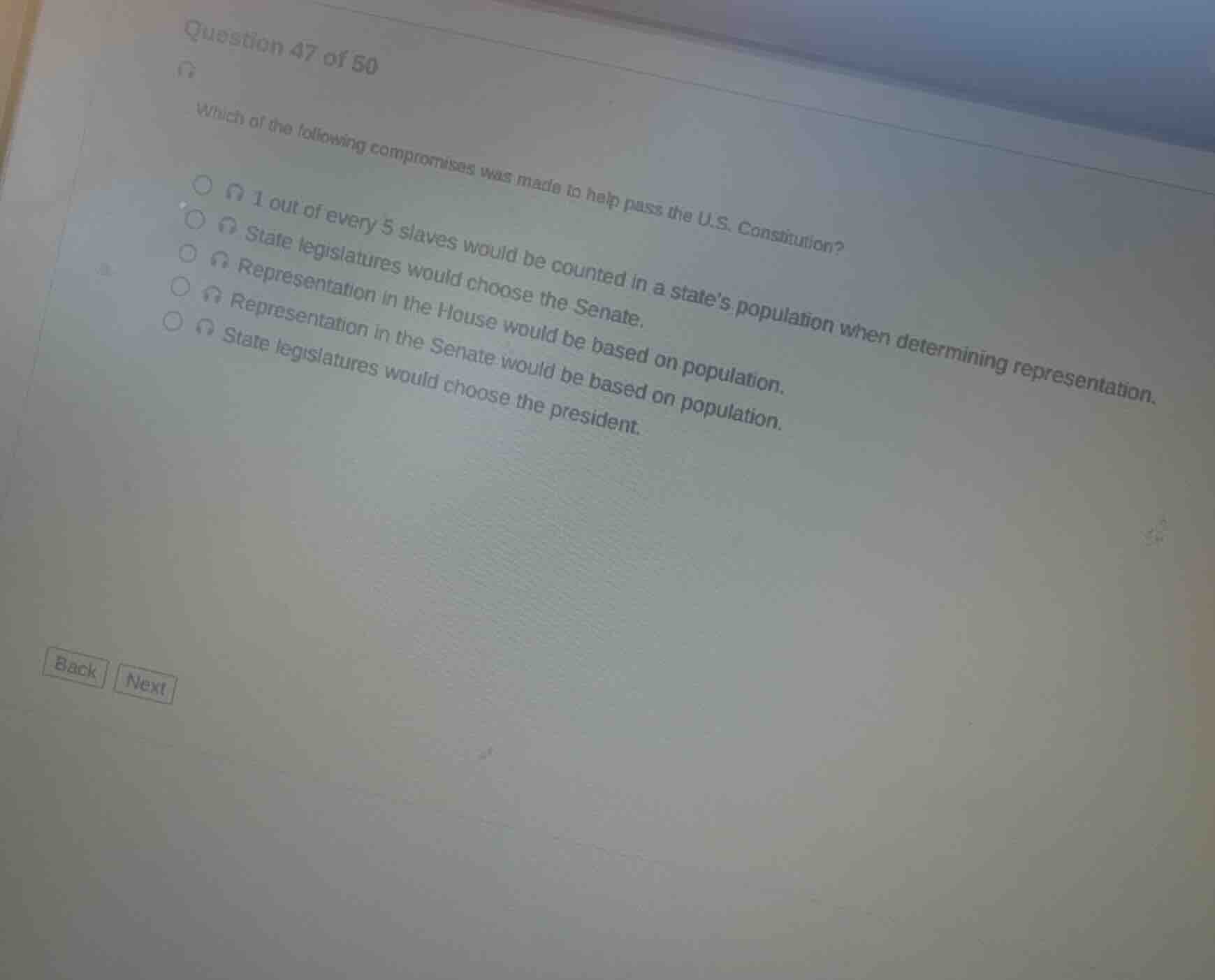
which of the following compromises was made to help pass the u.s. constitution?
1 out of every 5 slaves would be counted in a states population when determining representation.
state legislatures would choose the senate.
representation in the house would be based on population.
representation in the senate would be based on population.
state legislatures would choose the president.
To determine the correct compromise, we analyze each option:
- Option 1: The Three - Fifths Compromise stated that 3 out of every 5 slaves (not 1 out of 5) would be counted in a state's population for representation and taxation purposes. But wait, the option says "1 out of every 5 slaves" which is incorrect. Wait, no, let's re - check. The Three - Fifths Compromise was 3/5 of slaves counted. But maybe I misread. Wait, the first option: "1 out of every 5 slaves would be counted" – no, that's wrong. Wait, no, let's look at the options again. Wait, the correct compromise to pass the US Constitution was the Three - Fifths Compromise where 3/5 of slaves were counted. But wait, maybe the first option is miswritten? Wait, no, let's check the other options:
- Option 2: State legislatures choosing the Senate is part of the Great Compromise (Connecticut Compromise), but the Great Compromise was about House (population - based) and Senate (equal representation per state). So this option is incorrect as Senate representation is equal (2 per state), not based on state legislature choice for representation logic. Wait, no, the election of senators: originally, before the 17th Amendment, state legislatures chose senators. But the compromise for the Constitution's passage: the Great Compromise (House: population - based, Senate: equal per state). So this option is about how senators are chosen, not a compromise to pass the Constitution in terms of population/representation.
- Option 3: Representation in the House is based on population – this is part of the Great Compromise, which was crucial for passing the Constitution as it resolved the large - state vs. small - state dispute. Wait, but the Three - Fifths Compromise was also crucial. Wait, the question is which compromise was made to help pass the US Constitution. The Three - Fifths Compromise (counting 3/5 of slaves) and the Great Compromise (House: population, Senate: equal) were both crucial. But let's re - evaluate the options:
Wait, the first option: "1 out of every 5 slaves" – no, the correct was 3/5. But maybe there's a typo? Wait, no, maybe I made a mistake. Wait, let's check the options again. Wait, the first option: "1 out of every 5 slaves would be counted" – no. Wait, the correct answer is the Three - Fifths Compromise, but the first option has 1/5, which is wrong. Wait, no, maybe the first option is misprinted, and it's supposed to be 3/5? But as per the given options, let's re - assess. Wait, the other options:
- Option 4: Representation in the Senate is equal (2 per state), not population - based. So this is incorrect.
- Option 5: State legislatures choosing the president is not a main compromise for the Constitution's passage. The Electoral College was established, but state legislatures don't directly choose the president (Electors do, and originally Electors were chosen in various ways, including by state legislatures in some states, but this is not a key compromise to pass the Constitution like the Great or Three - Fifths Compromise).
Wait, I think I made a mistake. Let's start over. The two main compromises to pass the US Constitution were the Great Compromise (House: population - based representation, Senate: equal representation per state) and the Three - Fifths Compromise (counting 3/5 of slaves). Now, looking at the options:
Option 1: If we assume that it's a misprint and it's 3/5, but it says 1/5. No. Wait, maybe the first option is incorrect, and the third option: "Representation in the House would be based on population" – this is part of the Great Compromise, which…

Snap & solve any problem in the app
Get step-by-step solutions on Sovi AI
Photo-based solutions with guided steps
Explore more problems and detailed explanations
C. Representation in the House would be based on population. (Assuming the options are labeled A - E with A: 1 out of every 5 slaves..., B: State legislatures would choose the Senate, C: Representation in the House would be based on population, D: Representation in the Senate would be based on population, E: State legislatures would choose the president)