QUESTION IMAGE
Question
this question is not about solving the stated problem, but about understanding it.
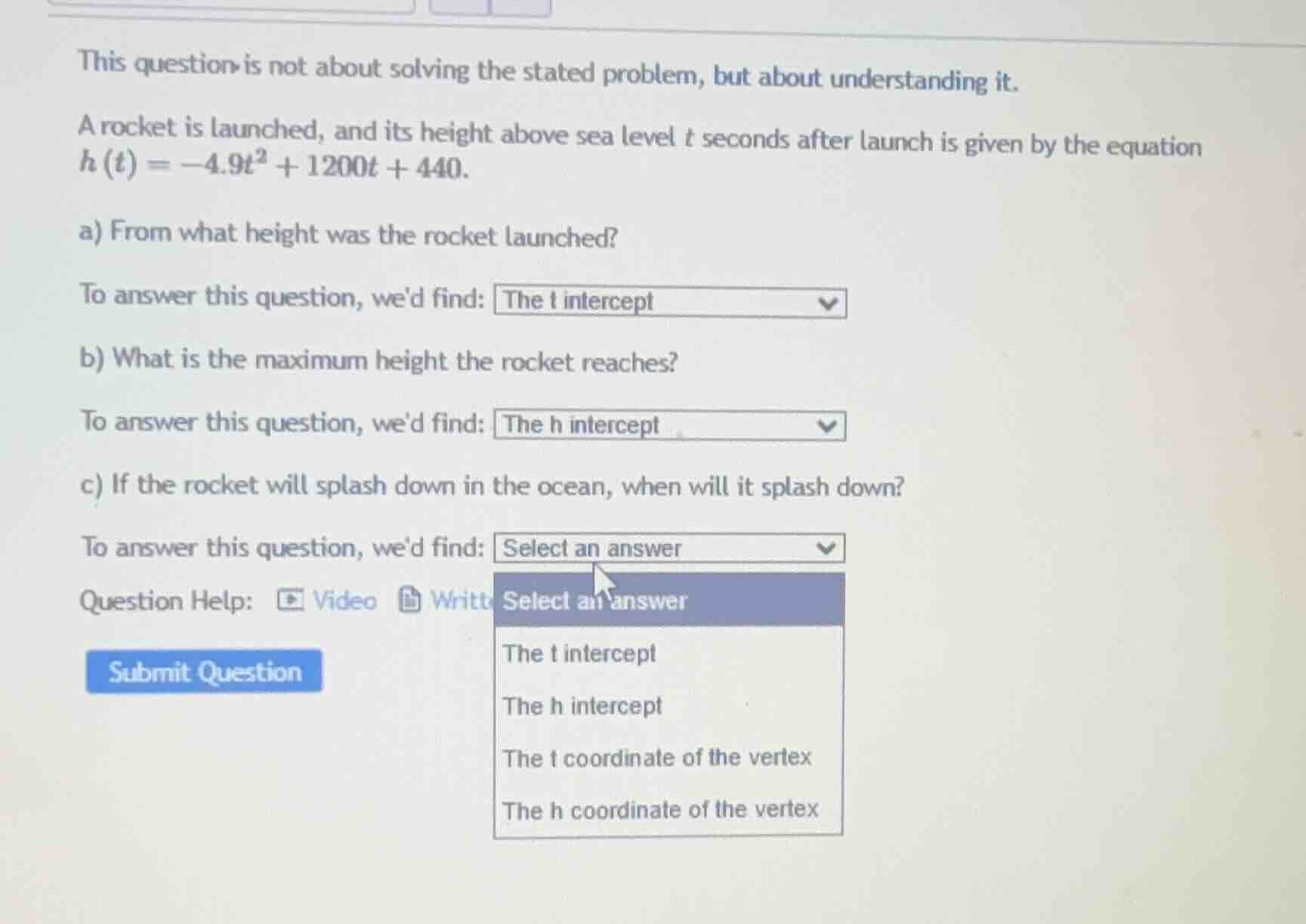
a rocket is launched, and its height above sea level t seconds after launch is given by the equation ( h(t) = -4.9t^2 + 1200t + 440 ).
a) from what height was the rocket launched?
to answer this question, wed find: the t intercept
b) what is the maximum height the rocket reaches?
to answer this question, wed find: the h intercept
c) if the rocket will splash down in the ocean, when will it splash down?
to answer this question, wed find: select an answer
question help: video writt
submit question
select an answer
the t intercept
the h intercept
the t coordinate of the vertex
the h coordinate of the vertex
Part (a)
To find the launch height, we need the height when \( t = 0 \) (launch time). The \( h \)-intercept (when \( t = 0 \)) of the function \( h(t)=-4.9t^{2}+1200t + 440 \) gives this value. The original choice of "The \( t \)-intercept" is incorrect. The correct approach is to evaluate \( h(0) \), which is the \( h \)-intercept. But since the question is about identifying the correct method, the error is in the dropdown: the correct should be "The \( h \)-intercept" (because at \( t = 0 \), we find \( h(0) \), the initial height, which is the \( h \)-intercept).
To find the maximum height of a quadratic function \( h(t)=at^{2}+bt + c \) (where \( a<0 \), so the parabola opens downward), we find the \( h \)-coordinate of the vertex. The vertex of a parabola \( at^{2}+bt + c \) has \( t \)-coordinate \( t=-\frac{b}{2a} \), and then we plug this \( t \) into \( h(t) \) to get the maximum height (the \( h \)-coordinate of the vertex). The original choice of "The \( h \)-intercept" is incorrect. The \( h \)-intercept is the initial height, not the maximum. The correct method is to find the \( h \)-coordinate of the vertex.
Splash - down occurs when the height \( h(t)=0 \). To find when \( h(t) = 0 \), we solve for \( t \) (where \( t>0 \), since time starts at 0). This is equivalent to finding the \( t \)-intercept of the function \( h(t) \) (the value of \( t \) when \( h(t)=0 \)).

Snap & solve any problem in the app
Get step-by-step solutions on Sovi AI
Photo-based solutions with guided steps
Explore more problems and detailed explanations
The original selection (The \( t \)-intercept) is incorrect. The correct answer for part (a) should be "The \( h \)-intercept" (because launch height is at \( t = 0 \), so we find \( h(0) \), the \( h \)-intercept).