QUESTION IMAGE
Question
question 5 of 5
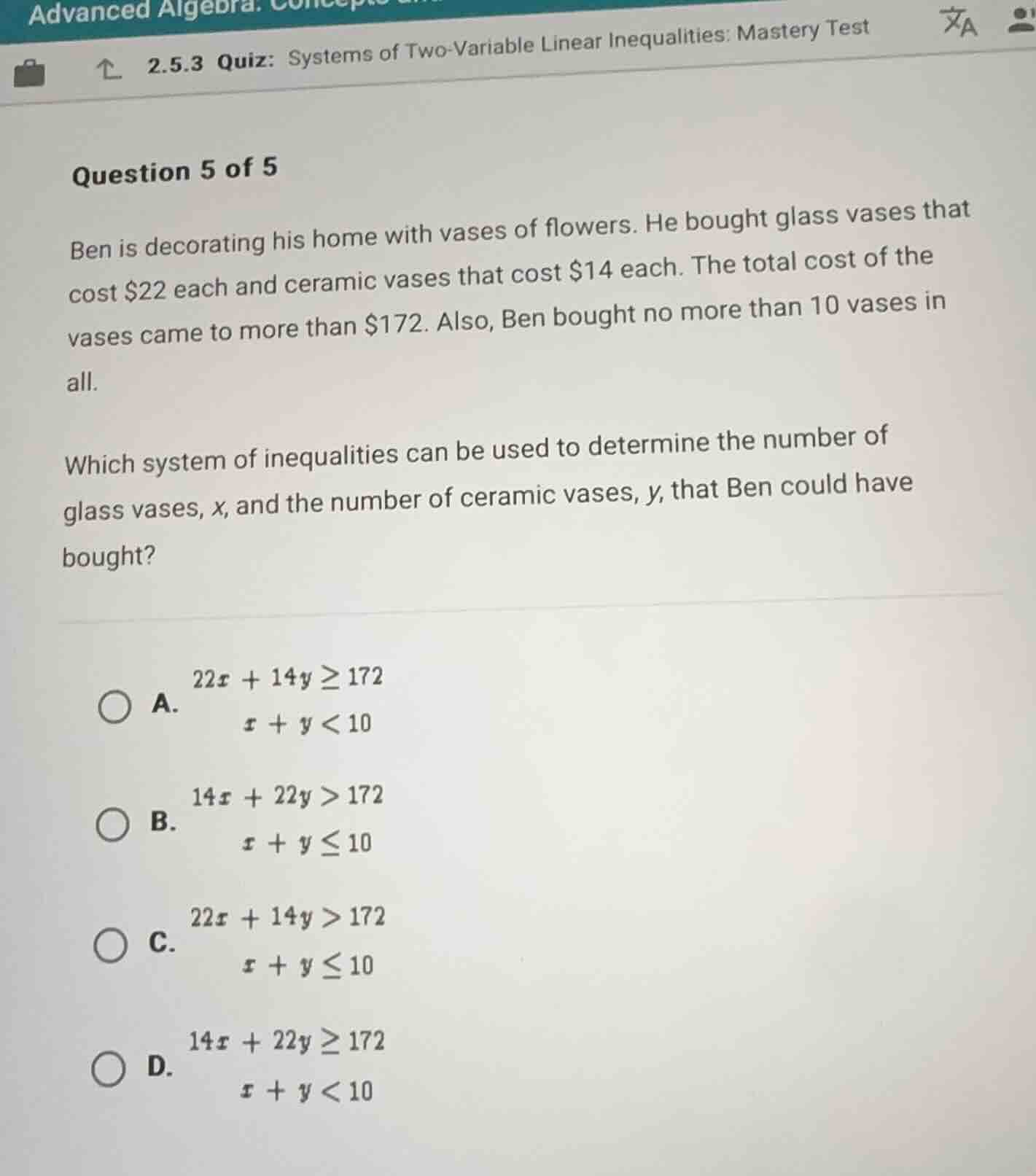
ben is decorating his home with vases of flowers. he bought glass vases that cost $22 each and ceramic vases that cost $14 each. the total cost of the vases came to more than $172. also, ben bought no more than 10 vases in all.
which system of inequalities can be used to determine the number of glass vases, x, and the number of ceramic vases, y, that ben could have bought?
a. \\(\
\\)
b. \\(\
\\)
c. \\(\
\\)
d. \\(\
\\)
Step1: Analyze cost inequality
Let \( x \) be glass vases (cost \$22) and LXI1 be ceramic vases (cost \$14). Total cost > \$172, so \( 22x + 14y > 172 \).
Step2: Analyze total vases inequality
Total vases ≤ 10, so \( x + y \leq 10 \).
Step3: Match with options
Option C has \( 22x + 14y > 172 \) and \( x + y \leq 10 \), which matches the inequalities.

Snap & solve any problem in the app
Get step-by-step solutions on Sovi AI
Photo-based solutions with guided steps
Explore more problems and detailed explanations
C. \(
\)