QUESTION IMAGE
Question
question:
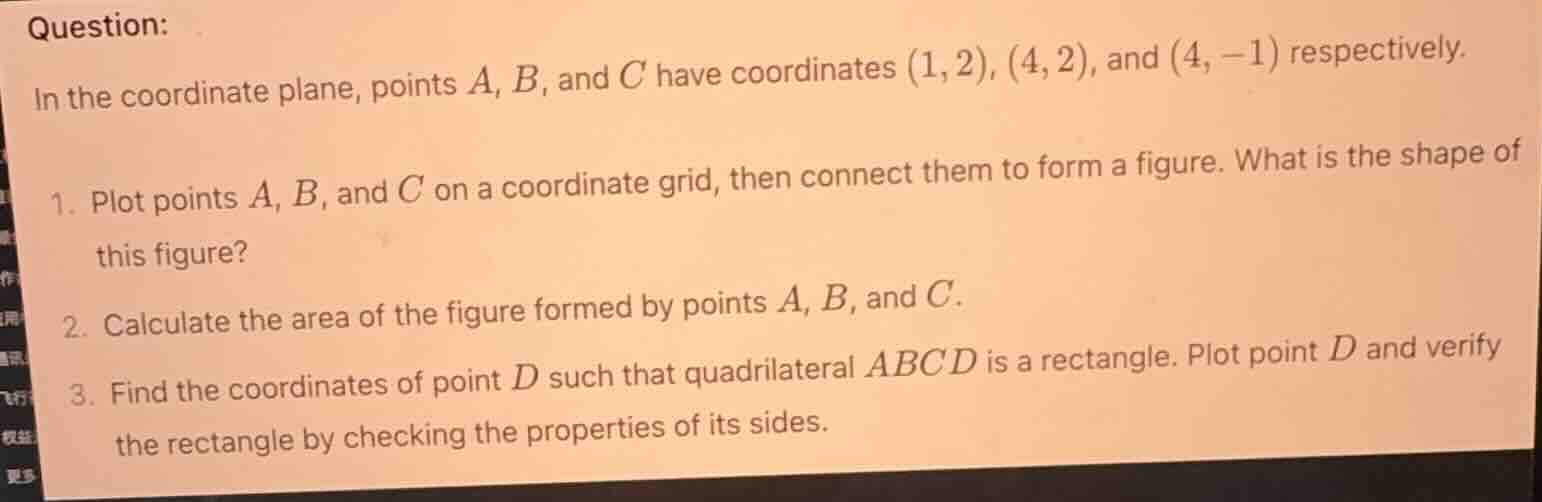
in the coordinate plane, points a, b, and c have coordinates (1,2), (4,2), and (4, -1) respectively.
- plot points a, b, and c on a coordinate grid, then connect them to form a figure. what is the shape of this figure?
- calculate the area of the figure formed by points a, b, and c.
- find the coordinates of point d such that quadrilateral abcd is a rectangle. plot point d and verify the rectangle by checking the properties of its sides.
Sub - Question 1
To determine the shape, we analyze the coordinates. For points \(A(1,2)\), \(B(4,2)\), and \(C(4, - 1)\):
- The distance between \(A\) and \(B\): Since the \(y\) - coordinates are the same (\(y = 2\)), the distance \(AB=\vert4 - 1\vert=3\) (using the formula \(d=\vert x_2 - x_1\vert\) when \(y_1 = y_2\)).
- The distance between \(B\) and \(C\): Since the \(x\) - coordinates are the same (\(x = 4\)), the distance \(BC=\vert-1 - 2\vert = 3\) (using the formula \(d=\vert y_2 - y_1\vert\) when \(x_1=x_2\)).
- The slope of \(AB\): \(m_{AB}=\frac{2 - 2}{4 - 1}=0\) (horizontal line). The slope of \(BC\): \(m_{BC}=\frac{-1 - 2}{4 - 4}\) is undefined (vertical line). So \(AB\perp BC\). And we have a triangle with two perpendicular sides of length 3, so it is a right triangle.
Step 1: Identify the base and height of the right triangle
For a right triangle, the two legs can be used as the base and height. From the coordinates:
- The length of \(AB\) (base): Since \(A(1,2)\) and \(B(4,2)\), \(AB=\vert4 - 1\vert = 3\).
- The length of \(BC\) (height): Since \(B(4,2)\) and \(C(4,-1)\), \(BC=\vert-1 - 2\vert=3\).
Step 2: Use the formula for the area of a right triangle
The formula for the area of a right triangle is \(A=\frac{1}{2}\times\text{base}\times\text{height}\).
Substitute base \( = 3\) and height \( = 3\) into the formula: \(A=\frac{1}{2}\times3\times3\).
Step 3: Calculate the area
\(A=\frac{9}{2}=4.5\)
Step 1: Recall the properties of a rectangle
In a rectangle \(ABCD\), \(AB\parallel CD\) and \(AD\parallel BC\), and \(AB = CD\), \(AD = BC\). Also, the coordinates of the vertices should satisfy the property that the vector \(\overrightarrow{AB}=\overrightarrow{DC}\) and \(\overrightarrow{AD}=\overrightarrow{BC}\).
We know \(A(1,2)\), \(B(4,2)\), \(C(4,-1)\). Let \(D(x,y)\).
- Since \(AB\) is from \((1,2)\) to \((4,2)\) (vector \(\overrightarrow{AB}=(4 - 1,2 - 2)=(3,0)\)), then \(\overrightarrow{DC}=(4 - x,-1 - y)\) should be equal to \(\overrightarrow{AB}=(3,0)\). So \(4 - x = 3\) and \(-1 - y = 0\).
- From \(4 - x = 3\), we get \(x = 4 - 3=1\). From \(-1 - y = 0\), we get \(y=-1\).
Step 2: Verify the coordinates
- Let's check the sides:
- \(AD\): From \(A(1,2)\) to \(D(1,-1)\), the length \(AD=\vert-1 - 2\vert = 3\), and \(BC = 3\), so \(AD = BC\).
- \(CD\): From \(C(4,-1)\) to \(D(1,-1)\), the length \(CD=\vert4 - 1\vert = 3\), and \(AB = 3\), so \(CD = AB\).
- The slope of \(AD\): \(m_{AD}=\frac{-1 - 2}{1 - 1}\) is undefined (vertical line), the slope of \(BC\) is undefined (vertical line), so \(AD\parallel BC\). The slope of \(CD\): \(m_{CD}=\frac{-1-(-1)}{1 - 4}=0\) (horizontal line), the slope of \(AB\) is 0 (horizontal line), so \(CD\parallel AB\).

Snap & solve any problem in the app
Get step-by-step solutions on Sovi AI
Photo-based solutions with guided steps
Explore more problems and detailed explanations
The shape of the figure (triangle \(ABC\)) is a right triangle.