QUESTION IMAGE
Question
question
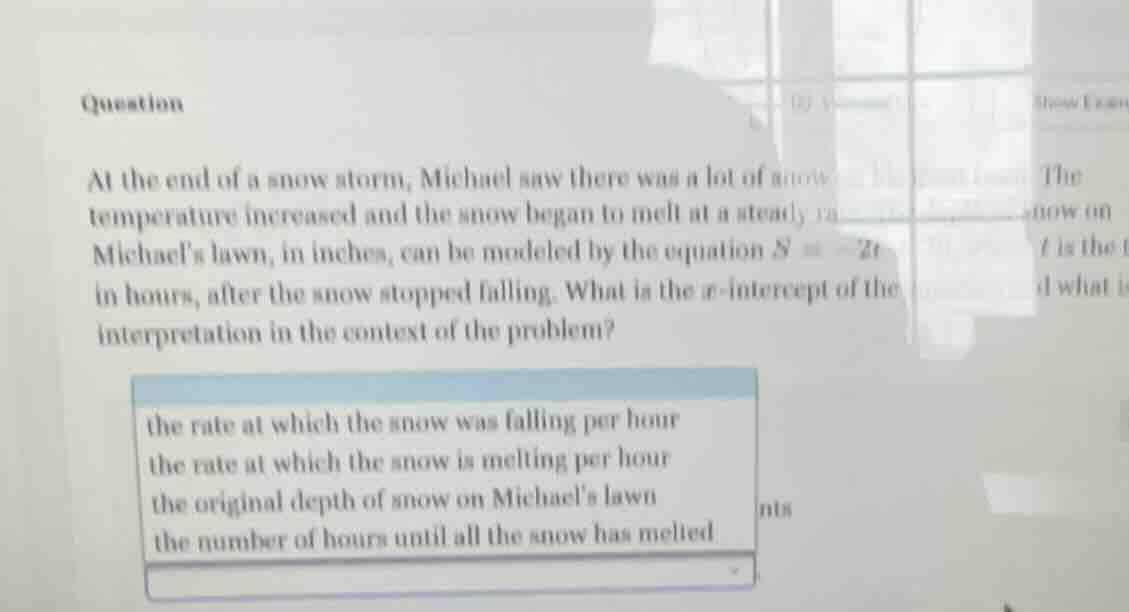
at the end of a snow storm, michael saw there was a lot of snow on his lawn. the temperature increased and the snow began to melt at a steady rate. the snow on michael’s lawn, in inches, can be modeled by the equation ( s = -2t + 10 ), where ( t ) is the time in hours, after the snow stopped falling. what is the ( t )-intercept of the equation, and what is its interpretation in the context of the problem?
options:
- the rate at which the snow was falling per hour
- the rate at which the snow is melting per hour
- the original depth of snow on michael’s lawn
- the number of hours until all the snow has melted
Step1: Recall the slope - intercept form of a linear equation
The slope - intercept form of a linear equation is \(y = mx + b\), where \(m\) is the slope and \(b\) is the \(y\) - intercept. In the context of the snow - melting problem, the equation for the snow depth \(S\) (in inches) as a function of time \(t\) (in hours) is given (we assume the full equation is \(S=- 2t + 10\) or a similar form with a \(y\) - intercept, since the problem mentions the \(y\) - intercept interpretation). Wait, actually, for the \(x\) - intercept (assuming the equation is \(S=-2t + b\), we can rewrite it as \(S=-2t + S_0\), where \(S_0\) is the initial snow depth). To find the \(x\) - intercept (let's assume the variable for time is \(t\) and snow depth is \(S\), so we want to find when \(S = 0\)), we set \(S = 0\) and solve for \(t\).
Step2: Analyze the \(x\) - intercept in context
The \(x\) - intercept of a function \(y = f(x)\) is the value of \(x\) when \(y = 0\). In the context of the snow - melting problem, \(S\) (snow depth) is the dependent variable and \(t\) (time) is the independent variable. When \(S = 0\), we are finding the time \(t\) when the snow depth is \(0\), which means all the snow has melted.
Let's assume the equation is \(S=-2t + 10\) (since the problem has a linear model for snow melting, with a negative slope for melting). To find the \(t\) - intercept (which is the \(x\) - intercept if we consider \(t\) as \(x\) and \(S\) as \(y\)), we set \(S = 0\):
\(0=-2t + 10\)
\(2t=10\)
\(t = 5\)
This \(t\) - value represents the number of hours until the snow depth \(S = 0\), i.e., until all the snow has melted.
Now let's analyze the options:
- "the rate at which the snow was falling per hour": The equation is about melting, not falling, and the rate of melting is the slope (\(-2\) in our assumed equation), not the intercept.
- "the rate at which the snow is melting per hour": This is the slope of the line (the coefficient of \(t\)), not the intercept.
- "the original depth of snow on Michael's lawn": This is the \(y\) - intercept (when \(t = 0\), \(S=S_0\)), not the \(x\) - intercept.
- "the number of hours until all the snow has melted": When \(S = 0\), we solve for \(t\), which gives the time when all the snow has melted, so this is the \(x\) - intercept in context.

Snap & solve any problem in the app
Get step-by-step solutions on Sovi AI
Photo-based solutions with guided steps
Explore more problems and detailed explanations
the number of hours until all the snow has melted