QUESTION IMAGE
Question
question
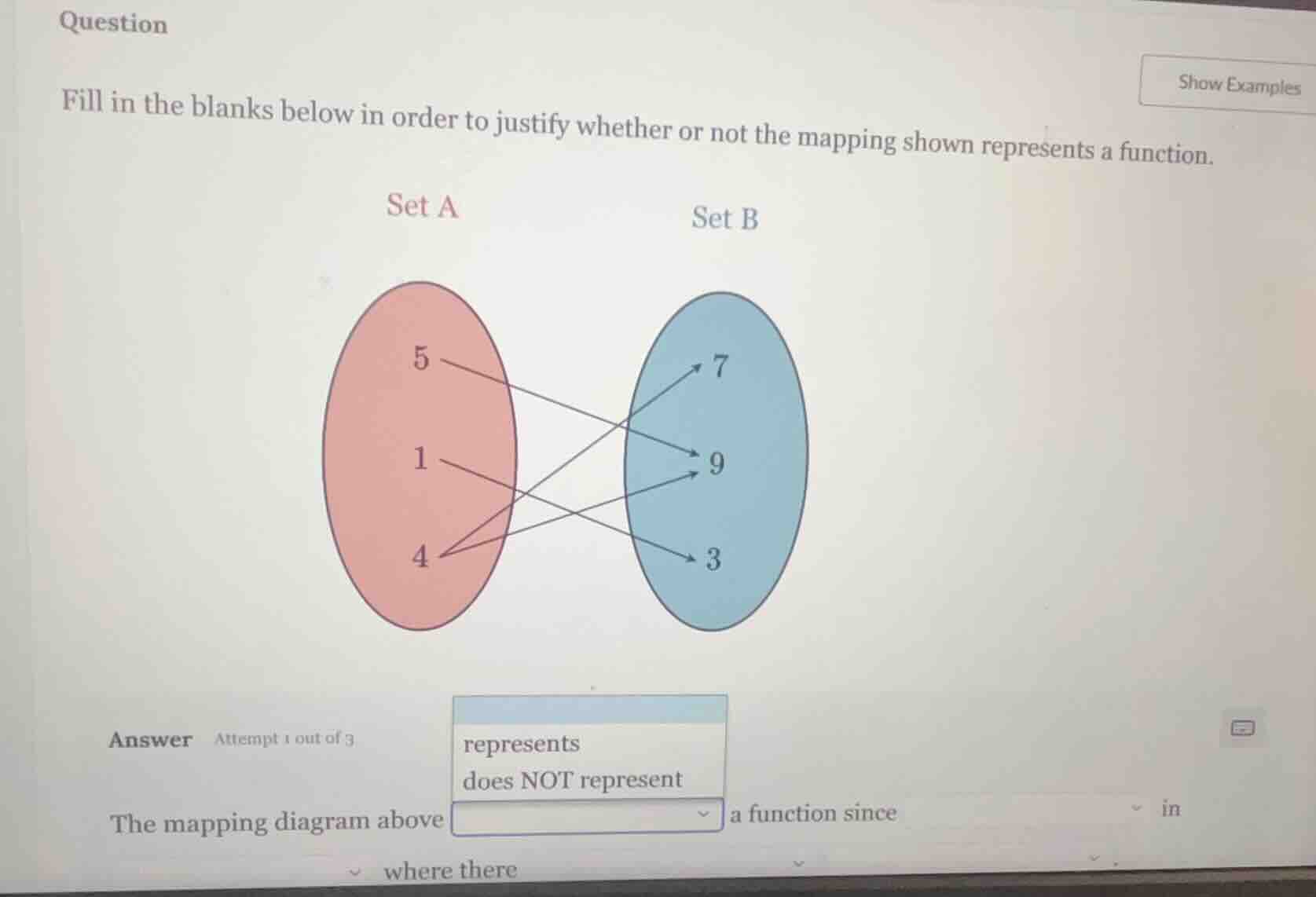
fill in the blanks below in order to justify whether or not the mapping shown represents a function.
set a set b
5 7
1 9
4 3
answer attempt 1 out of 3 represents
does not represent
the mapping diagram above a function since in
where there
Step1: Recall the definition of a function
A function is a relation where each element in the domain (Set A) is mapped to exactly one element in the codomain (Set B).
Step2: Analyze the mapping for each element in Set A
- For element 5 in Set A: Let's check its mappings. Wait, looking at the diagram, element 4 in Set A: Let's list the mappings:
- Element 5: Let's see the arrows. Wait, the elements in Set A are 5, 1, 4.
- Element 4: How many arrows come from 4? Looking at the diagram, element 4 has multiple arrows (mapped to more than one element in Set B). Wait, no, wait: Wait, the definition is each element in Set A (domain) must have exactly one image in Set B. Let's check each element:
- 5: Let's see the arrow from 5: where does it go? Wait, the diagram: 5 is connected to... Wait, maybe I misread. Wait, the problem is about the mapping: does each element in Set A have at most one arrow (i.e., mapped to exactly one element in Set B)? Wait, no: in the diagram, element 4 (in Set A) has multiple arrows (mapped to more than one element in Set B)? Wait, no, wait: Wait, the key is: in a function, every element in the domain (Set A) must map to exactly one element in the codomain (Set B). So if any element in Set A is mapped to more than one element in Set B, it's not a function.
Looking at the diagram: Let's check each element in Set A (5, 1, 4):
- 5: Let's see the arrow from 5: where does it point? Wait, maybe the diagram shows that element 4 (in Set A) has multiple arrows (i.e., 4 is mapped to more than one element in Set B). Wait, the problem's dropdown first is "represents" or "does NOT represent". Let's check:
Wait, the definition of a function: a relation from a set A to a set B is a function if every element in A has exactly one image in B. So if any element in A has more than one image in B, it's not a function.
Looking at Set A elements:
- 5: Let's assume the arrows: maybe 5 is mapped to one element? Wait, no, maybe the element 4: let's see, in the diagram, 4 has multiple arrows (mapped to, say, 7, 9, 3? Wait, no, the diagram: Set A is 5,1,4; Set B is 7,9,3. Let's check each element in Set A:
- 5: How many arrows? Let's see, the arrow from 5: maybe to 9? Wait, no, maybe I misinterpret. Wait, the key is: if an element in Set A is mapped to more than one element in Set B, then it's not a function.
Looking at element 4 in Set A: how many arrows come from 4? If 4 is mapped to multiple elements (e.g., 7, 9, 3? Wait, no, the diagram: let's count the arrows from each element in Set A:
- 5: let's say one arrow (to, e.g., 9)
- 1: one arrow?
- 4: multiple arrows (e.g., to 7, 9, 3)? Wait, no, maybe the diagram shows that 4 is mapped to more than one element. Wait, the first dropdown is "does NOT represent" because, for example, element 4 in Set A is mapped to more than one element in Set B (violating the function definition: each domain element has exactly one codomain element).
So the mapping diagram does NOT represent a function since (for example) the element 4 in Set A is mapped to more than one element in Set B (or some element in Set A has multiple mappings).

Snap & solve any problem in the app
Get step-by-step solutions on Sovi AI
Photo-based solutions with guided steps
Explore more problems and detailed explanations
The mapping diagram above \(\boldsymbol{\text{does NOT represent}}\) a function since (for example) the element \(4\) in Set \(A\) is mapped to more than one element in Set \(B\) (or any element in Set \(A\) has more than one corresponding element in Set \(B\), violating the definition of a function where each domain element must have exactly one codomain element).
(Note: The exact wording for the "since" part would depend on the dropdown options, but the key is that an element in Set A has multiple mappings. The first blank is "does NOT represent".)