QUESTION IMAGE
Question
question
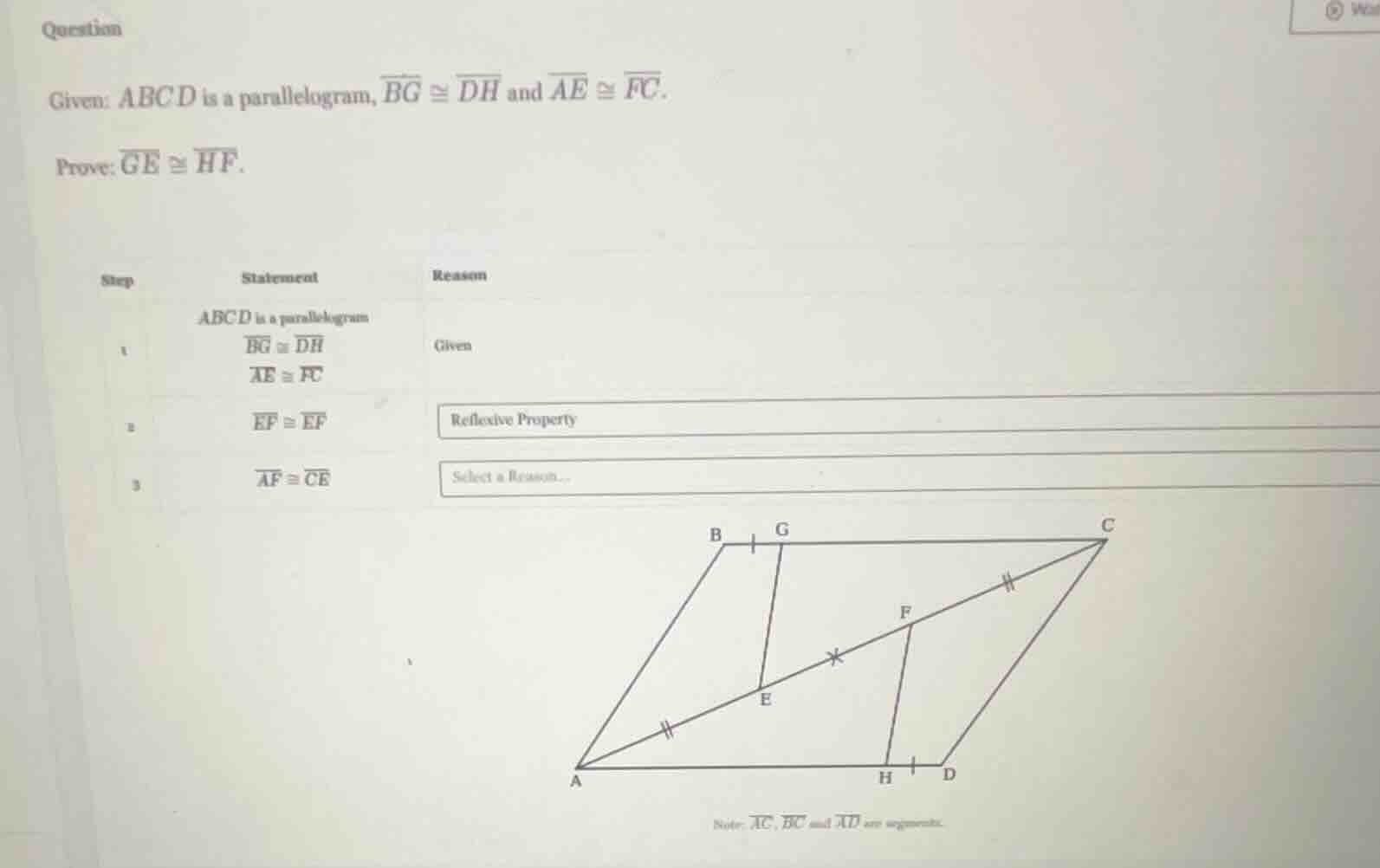
given: abcd is a parallelogram, \\(\overline{bg} \cong \overline{dh}\\) and \\(\overline{ae} \cong \overline{fc}\\).
prove: \\(\overline{ge} \cong \overline{hf}\\).
| step | statement | reason |
|---|---|---|
| 2 | \\(\overline{ef} \cong \overline{ef}\\) | reflexive property |
| 3 | \\(\overline{af} \cong \overline{ce}\\) | select a reason... |
(image of a parallelogram abcd with points g on bc, h on ad, e and f on ac, with markings indicating congruent segments bg, dh, ae, fc and ef, af, ce as per the statements.)
note: \\(\overline{ac}\\), \\(\overline{bc}\\) and \\(\overline{ad}\\) are segments.
Step1: Analyze the segments
We know that \( \overline{AE} \cong \overline{FC} \) (given) and we want to show \( \overline{AF} \cong \overline{CE} \). Notice that \( \overline{AF}=\overline{AE}+\overline{EF} \) and \( \overline{CE}=\overline{FC}+\overline{EF} \).
Step2: Apply the Addition Property of Congruence
Since \( \overline{AE} \cong \overline{FC} \) (given) and \( \overline{EF} \cong \overline{EF} \) (Reflexive Property), by the Segment Addition Postulate and the Addition Property of Congruence (if two segments are congruent and we add the same congruent segment to both, the results are congruent), we have \( \overline{AE}+\overline{EF} \cong \overline{FC}+\overline{EF} \), which means \( \overline{AF} \cong \overline{CE} \). The reason is "Segment Addition Postulate and Addition Property of Congruence (or more simply, if \( \overline{AE} \cong \overline{FC} \) and \( \overline{EF} \cong \overline{EF} \), then \( \overline{AE}+\overline{EF} \cong \overline{FC}+\overline{EF} \))".
For the overall proof of \( \overline{GE} \cong \overline{HF} \):
Step1: Recall properties of parallelogram
Since \( ABCD \) is a parallelogram, \( \overline{BC} \cong \overline{AD} \) (opposite sides of a parallelogram are congruent) and \( \overline{BC} \parallel \overline{AD} \) (opposite sides of a parallelogram are parallel). Also, we know \( \overline{BG} \cong \overline{DH} \) (given), so \( \overline{BC}-\overline{BG} \cong \overline{AD}-\overline{DH} \), which implies \( \overline{GC} \cong \overline{AH} \).
Step2: Use congruent triangles
We already have \( \overline{AF} \cong \overline{CE} \) (from earlier), \( \angle GCE \cong \angle HAF \) (alternate interior angles, since \( \overline{BC} \parallel \overline{AD} \) and \( \overline{AC} \) is a transversal), and \( \overline{GC} \cong \overline{AH} \) (from step1). So by SAS (Side - Angle - Side) Congruence Postulate, \( \triangle GCE \cong \triangle HAF \).
Step3: Conclude the congruence of segments
Since \( \triangle GCE \cong \triangle HAF \) by SAS, then their corresponding sides \( \overline{GE} \) and \( \overline{HF} \) are congruent (Corresponding Parts of Congruent Triangles are Congruent - CPCTC).
But for the specific step where we need the reason for \( \overline{AF} \cong \overline{CE} \), the reason is: "If \( \overline{AE} \cong \overline{FC} \) and \( \overline{EF} \cong \overline{EF} \), then \( \overline{AE}+\overline{EF} \cong \overline{FC}+\overline{EF} \) (Segment Addition and Addition Property of Congruence)".

Snap & solve any problem in the app
Get step-by-step solutions on Sovi AI
Photo-based solutions with guided steps
Explore more problems and detailed explanations
For the step where we prove \( \overline{AF} \cong \overline{CE} \), the reason is "Segment Addition Postulate and Addition Property of Congruence (or: If \( \overline{AE} \cong \overline{FC} \) and \( \overline{EF} \cong \overline{EF} \), then \( \overline{AE}+\overline{EF} \cong \overline{FC}+\overline{EF} \))". And for proving \( \overline{GE} \cong \overline{HF} \), we use properties of parallelogram, congruent triangles (SAS) and CPCTC to conclude \( \overline{GE} \cong \overline{HF} \).