QUESTION IMAGE
Question
question
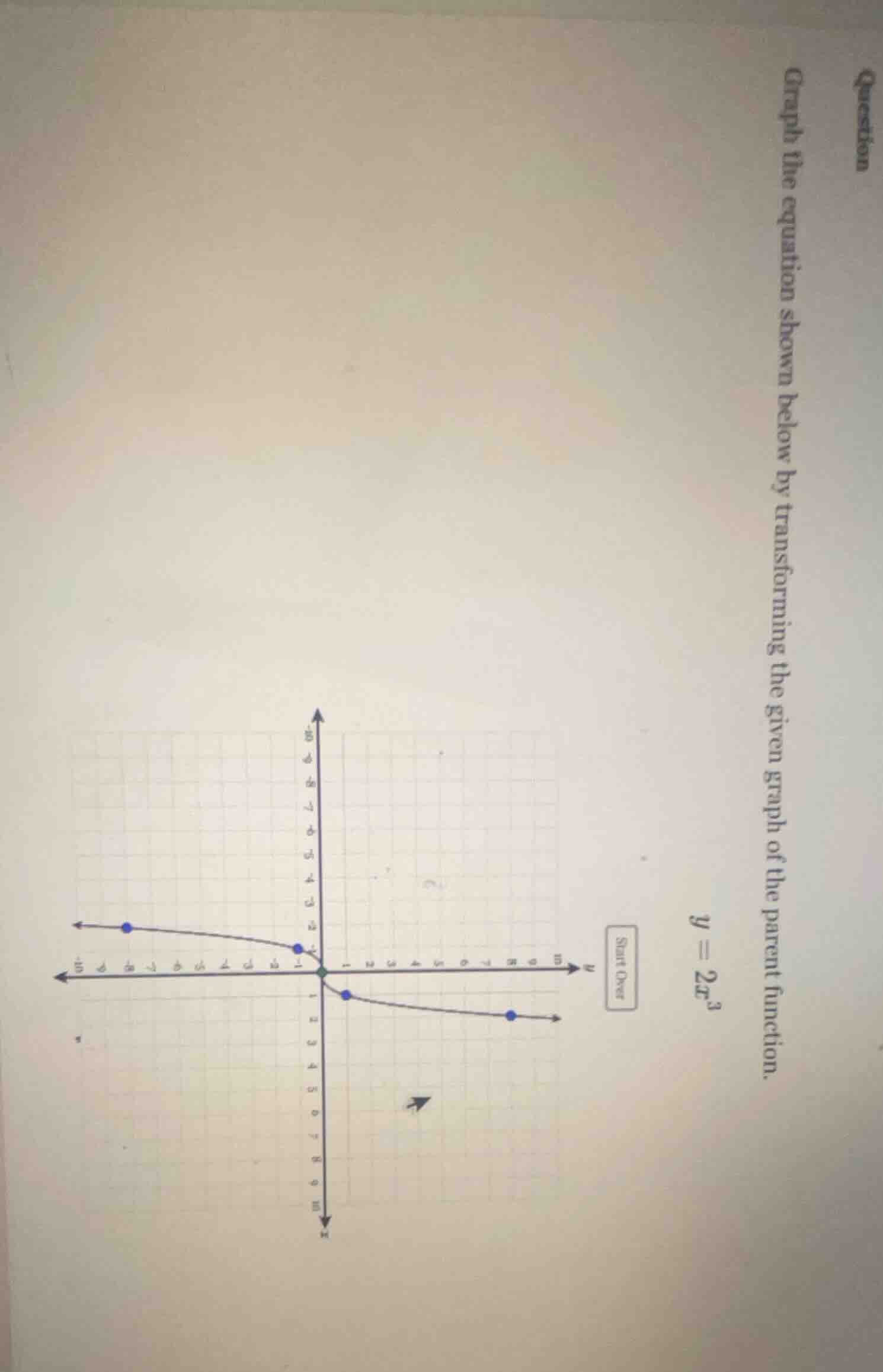
graph the equation shown below by transforming the graph of the parent function.
$y = 2x^3$
Step1: Identify Parent Function
The parent function for \( y = 2x^3 \) is \( y = x^3 \), a cubic function with a point - symmetric graph about the origin, passing through \((-2,-8)\), \((-1,-1)\), \((0,0)\), \((1,1)\), \((2,8)\).
Step2: Analyze Transformation
The function \( y = 2x^3 \) is a vertical stretch of the parent function \( y=x^3 \) by a factor of 2. For a vertical stretch by a factor of \( a>1 \) of the function \( y = f(x) \), the new function is \( y = a\cdot f(x) \). Here, \( f(x)=x^3 \) and \( a = 2 \), so each \( y \) - value of the parent function is multiplied by 2.
Step3: Plot Points for Transformed Function
- For \( x=-2 \): In the parent function \( y=x^3 \), \( y=-8 \). After transformation, \( y = 2\times(-8)=-16 \), so the point is \((-2,-16)\).
- For \( x = - 1\): In the parent function \( y=x^3 \), \( y=-1 \). After transformation, \( y=2\times(-1) = - 2\), so the point is \((-1,-2)\).
- For \( x = 0\): In the parent function \( y=x^3 \), \( y = 0\). After transformation, \( y=2\times0=0\), so the point is \((0,0)\).
- For \( x = 1\): In the parent function \( y=x^3 \), \( y = 1\). After transformation, \( y=2\times1 = 2\), so the point is \((1,2)\).
- For \( x = 2\): In the parent function \( y=x^3 \), \( y = 8\). After transformation, \( y=2\times8=16\), so the point is \((2,16)\).
Step4: Sketch the Graph
Plot the points \((-2,-16)\), \((-1,-2)\), \((0,0)\), \((1,2)\), \((2,16)\) and draw a smooth curve through them. The graph will have the same general shape as \( y = x^3 \) (a cubic curve) but will be "steeper" because of the vertical stretch by a factor of 2.

Snap & solve any problem in the app
Get step-by-step solutions on Sovi AI
Photo-based solutions with guided steps
Explore more problems and detailed explanations
To graph \( y = 2x^3 \):
- Start with the parent function \( y=x^3 \), which has points \((-2,-8)\), \((-1,-1)\), \((0,0)\), \((1,1)\), \((2,8)\).
- Apply a vertical stretch by a factor of 2: multiply the \( y \) - coordinates of the points of \( y = x^3 \) by 2 to get \((-2,-16)\), \((-1,-2)\), \((0,0)\), \((1,2)\), \((2,16)\).
- Plot these new points and draw a smooth cubic - shaped curve through them.