QUESTION IMAGE
Question
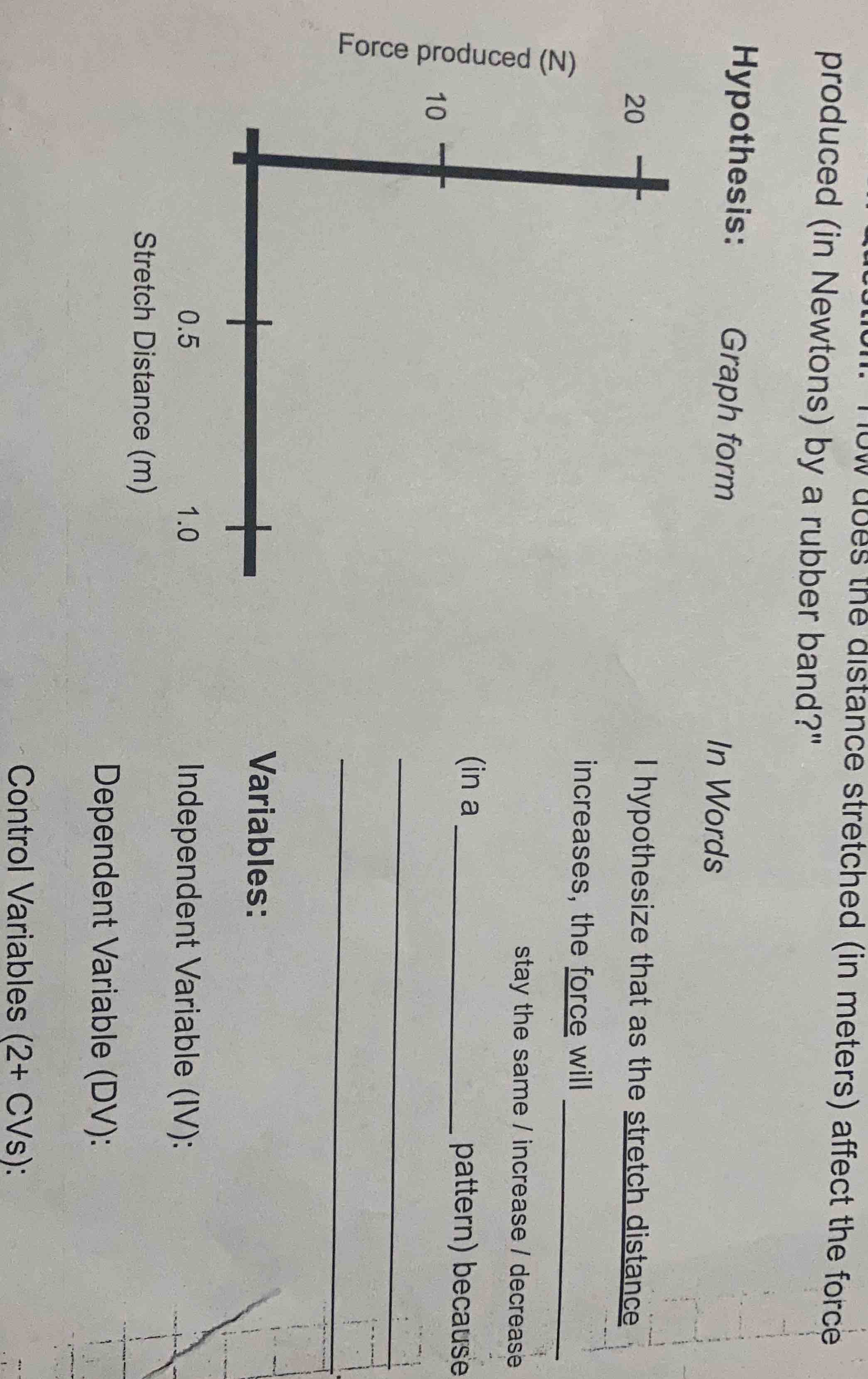
question: how does the distance stretched (in meters) affect the force produced (in newtons) by a rubber band?
hypothesis:
graph form
graph with force produced (n) on x - axis (10, 20 marked) and stretch distance (m) on y - axis (0.5, 1.0 marked)
in words
i hypothesize that as the stretch distance increases, the force will blank (stay the same / increase / decrease) in a blank pattern) because blank
variables:
independent variable (iv):
dependent variable (dv):
control variables (2 + cvs):
- Hypothesis (In Words): The graph shows that as stretch distance (x-axis) increases, force produced (y-axis) increases in a straight, proportional way, which follows Hooke's Law for elastic materials like rubber bands (within their elastic limit).
- Variables:
- Independent Variable: The variable being tested/changed is the stretch distance of the rubber band.
- Dependent Variable: The variable being measured is the force produced by the rubber band.
- Control Variables: These are factors kept constant to ensure a fair test; examples include using the same rubber band each time, stretching it at the same temperature, and measuring force in the same direction.

Snap & solve any problem in the app
Get step-by-step solutions on Sovi AI
Photo-based solutions with guided steps
Explore more problems and detailed explanations
Hypothesis:
In Words
I hypothesize that as the stretch distance increases, the force will increase in a linear (straight-line) pattern because rubber bands follow Hooke's Law (force is proportional to stretch distance within their elastic range).
Variables:
- Independent Variable (IV): Stretch Distance (in meters)
- Dependent Variable (DV): Force Produced (in Newtons)
- Control Variables (2+ CVs):
- The same rubber band (consistent elasticity)
- Constant environmental temperature (prevents elasticity changes)