QUESTION IMAGE
Question
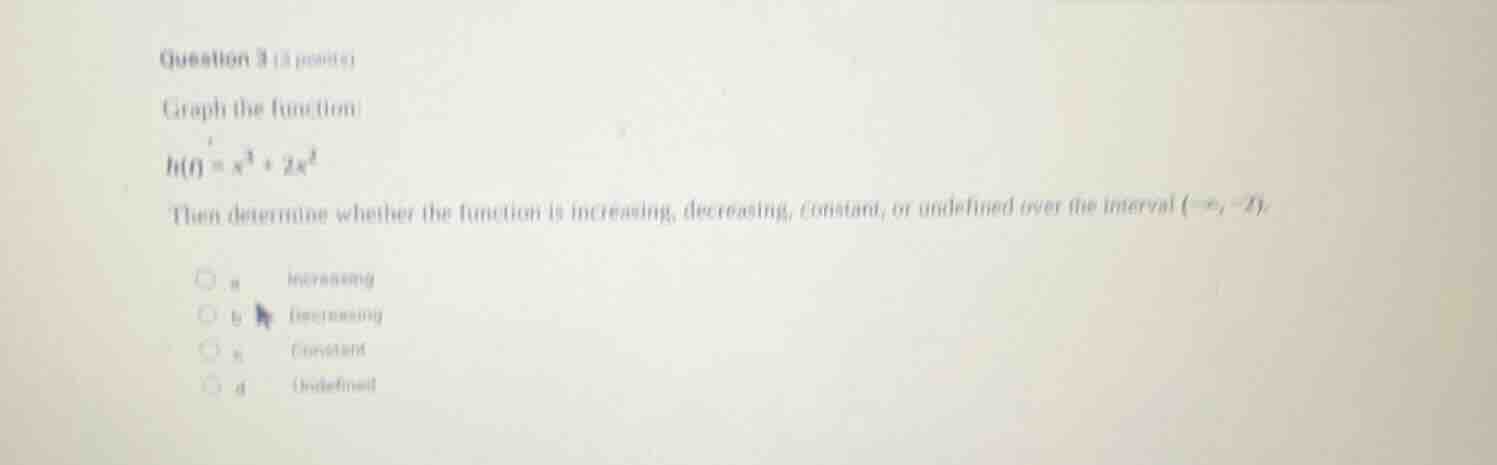
question 3 (1 point)
graph the function
$h(x) = x^3 + 2x^2$
then determine whether the function is increasing, decreasing, constant, or undefined over the interval $(-\infty, -2)$.
\bigcirc a \hspace{1em} increasing
\bigcirc b \hspace{1em} decreasing
\bigcirc c \hspace{1em} constant
\bigcirc d \hspace{1em} undefined
Step 1: Find the derivative of \( h(t) \)
To determine if a function is increasing or decreasing over an interval, we can use its derivative. The function is \( h(t) = t^3 + 2t^2 \). The derivative \( h'(t) \) is found using the power rule. For \( t^n \), the derivative is \( nt^{n - 1} \). So, \( h'(t) = 3t^2 + 4t \).
Step 2: Analyze the derivative on \( (-\infty, -2) \)
We can factor the derivative: \( h'(t) = t(3t + 4) \). Now, we test a value in the interval \( (-\infty, -2) \), say \( t = -3 \). Plugging into the derivative: \( h'(-3) = (-3)(3(-3) + 4) = (-3)(-9 + 4) = (-3)(-5) = 15 \). Since \( h'(-3) = 15 > 0 \), the derivative is positive on the interval \( (-\infty, -2) \). A positive derivative means the function is increasing on that interval.

Snap & solve any problem in the app
Get step-by-step solutions on Sovi AI
Photo-based solutions with guided steps
Explore more problems and detailed explanations
a. increasing