QUESTION IMAGE
Question
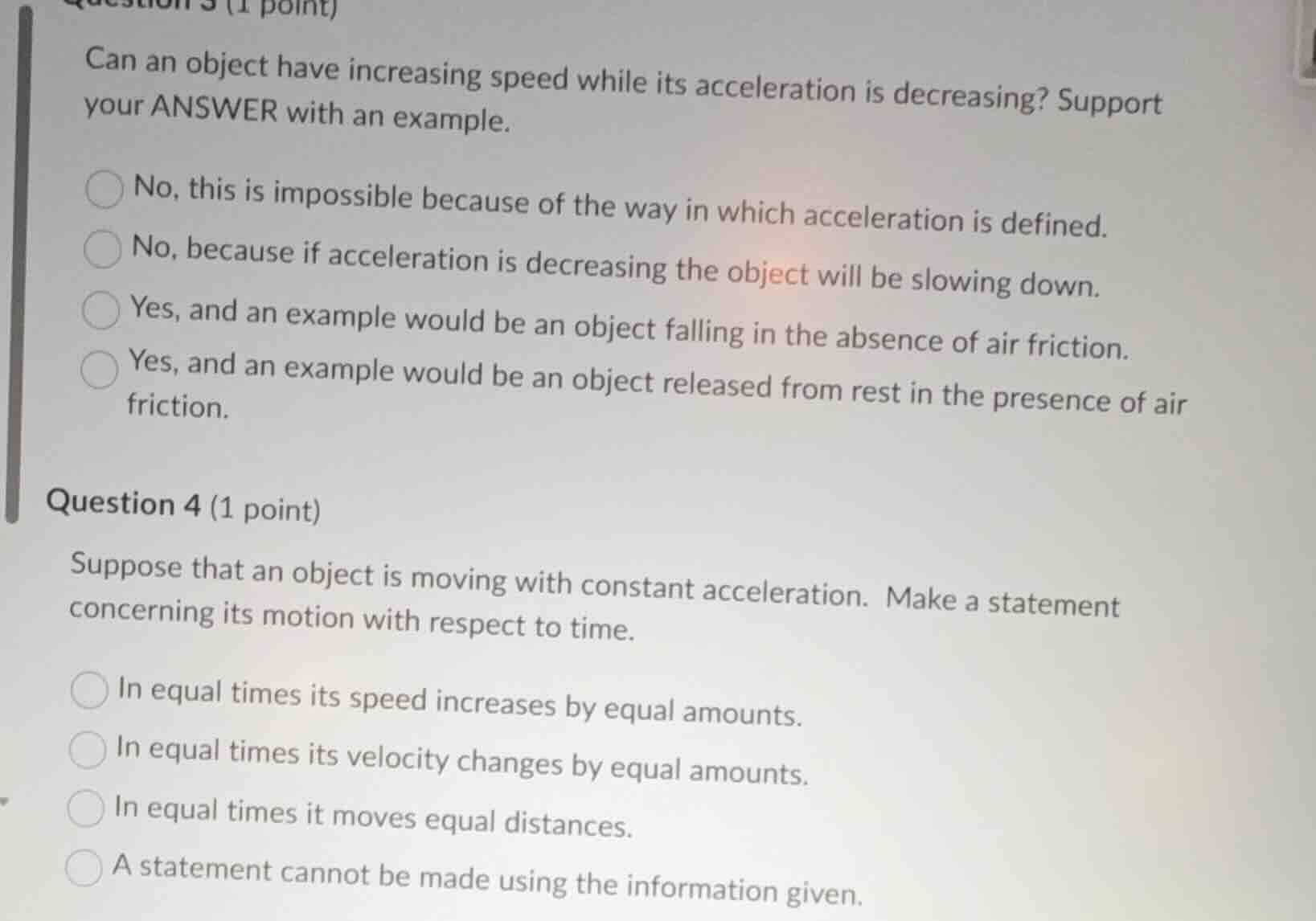
question 3 (1 point)
can an object have increasing speed while its acceleration is decreasing? support your answer with an example.
○ no, this is impossible because of the way in which acceleration is defined.
○ no, because if acceleration is decreasing the object will be slowing down.
○ yes, and an example would be an object falling in the absence of air friction.
○ yes, and an example would be an object released from rest in the presence of air friction.
question 4 (1 point)
suppose that an object is moving with constant acceleration. make a statement concerning its motion with respect to time.
○ in equal times its speed increases by equal amounts.
○ in equal times its velocity changes by equal amounts.
○ in equal times it moves equal distances.
○ a statement cannot be made using the information given.
Question 3
To determine the answer, we analyze each option:
- The first two options claim it's impossible, but this is incorrect. Acceleration is the rate of change of velocity (or speed, in scalar terms for speed). If acceleration is positive (same direction as velocity) but decreasing, speed can still increase (just at a slower rate).
- The third option's example (falling without air friction) has constant acceleration (gravity), so acceleration isn't decreasing, so it's incorrect.
- The fourth option: When an object is released from rest with air friction, air resistance increases with speed, so the net force (and thus acceleration, \(a = \frac{F_{net}}{m}\)) decreases (since \(F_{net}=mg - F_{air}\), and \(F_{air}\) increases). But as long as acceleration is positive (downward, same as velocity direction), speed increases, even though acceleration is decreasing. So this is correct.
Recall the definition of acceleration: \(a=\frac{\Delta v}{\Delta t}\), or \(\Delta v = a\Delta t\). If acceleration \(a\) is constant, then for equal time intervals \(\Delta t\), the change in velocity \(\Delta v\) will be equal (since \(\Delta v = a\Delta t\), and \(a\) and \(\Delta t\) are constant).
- The first option: "speed" is a scalar, but acceleration affects velocity (vector). However, if we consider speed (magnitude of velocity) and acceleration is in the direction of motion, speed will increase by equal amounts in equal times. But the second option about velocity change is more general (since velocity is a vector, and acceleration is the rate of velocity change).
- The third option: For constant acceleration, the distance covered in equal times is not equal (e.g., in free fall, distance increases as \(d = v_0t+\frac{1}{2}at^2\), so in equal \(\Delta t\), distance increases by larger amounts).
- The fourth option is incorrect as we can make a statement.
- The second option: Since \(a=\frac{\Delta v}{\Delta t}\), if \(a\) is constant, \(\Delta v = a\Delta t\). So in equal times (\(\Delta t\) equal), \(\Delta v\) (change in velocity) is equal (because \(a\) is constant). This is correct. Also, the first option is also correct in the case of speed (if acceleration is in the direction of motion), but the second option is more fundamental (applies to velocity, which is a vector, and acceleration is a vector quantity). However, both the first and second options have merit, but the second is more general. Wait, let's re - check:
Acceleration is the rate of change of velocity. So \(a=\frac{\Delta v}{\Delta t}\), rearranged \(\Delta v=a\Delta t\). If \(a\) is constant, then for any equal time intervals \(\Delta t\), the change in velocity \(\Delta v\) is the same. So "In equal times its velocity changes by equal amounts" is correct. Also, if the acceleration is in the direction of motion, speed (magnitude of velocity) will also increase by equal amounts in equal times. But the option "In equal times its velocity changes by equal amounts" is a more accurate and general statement about constant acceleration (since acceleration is defined as the change in velocity over time).

Snap & solve any problem in the app
Get step-by-step solutions on Sovi AI
Photo-based solutions with guided steps
Explore more problems and detailed explanations
Yes, and an example would be an object released from rest in the presence of air friction.