QUESTION IMAGE
Question
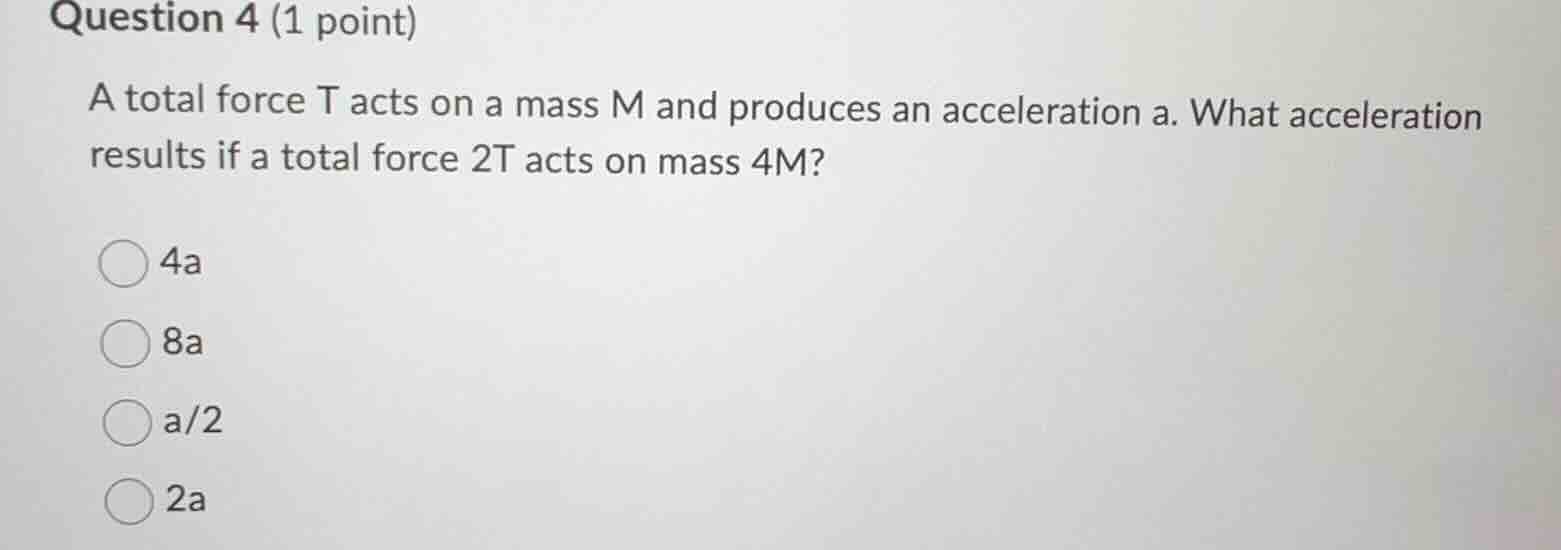
question 4 (1 point)
a total force t acts on a mass m and produces an acceleration a. what acceleration results if a total force 2t acts on mass 4m?
4a
8a
a/2
2a
Step1: Recall Newton's Second Law
Newton's second law states that \( F = ma \), where \( F \) is force, \( m \) is mass, and \( a \) is acceleration. For the first case, we have \( T = M \cdot a \).
Step2: Apply Newton's Second Law to the second case
In the second case, the force is \( 2T \) and the mass is \( 4M \). Let the new acceleration be \( a' \). So, \( 2T = 4M \cdot a' \).
Step3: Substitute \( T = M \cdot a \) into the second equation
From the first equation, \( T = Ma \), so substitute \( T \) in the second equation: \( 2(Ma) = 4M \cdot a' \).
Step4: Solve for \( a' \)
Simplify the equation: \( 2Ma = 4M \cdot a' \). Divide both sides by \( 2M \): \( a = 2a' \)? Wait, no, wait. Wait, let's do it again. \( 2T = 4M a' \), and \( T = Ma \), so substitute \( T \): \( 2(Ma) = 4M a' \). Then, \( 2Ma = 4M a' \). Divide both sides by \( 2M \): \( a = 2a' \)? No, that's not right. Wait, divide both sides by \( 4M \): \( a' = \frac{2T}{4M} \). But \( T = Ma \), so substitute \( T \): \( a' = \frac{2(Ma)}{4M} \). The \( M \) cancels out: \( a' = \frac{2a}{4} = \frac{a}{2} \). Wait, no, wait, \( 2T = 4M a' \), \( T = Ma \), so \( 2(Ma) = 4M a' \). Then, \( 2Ma = 4M a' \). Divide both sides by \( 2M \): \( a = 2a' \)? No, that's incorrect. Wait, let's do the algebra again. Starting over:
From \( T = M a \), so \( a = \frac{T}{M} \).
For the second case, \( F = 2T \), \( m = 4M \), so \( a' = \frac{F}{m} = \frac{2T}{4M} = \frac{T}{2M} \).
But since \( a = \frac{T}{M} \), then \( \frac{T}{2M} = \frac{a}{2} \). So the new acceleration \( a' = \frac{a}{2} \).

Snap & solve any problem in the app
Get step-by-step solutions on Sovi AI
Photo-based solutions with guided steps
Explore more problems and detailed explanations
\( \frac{a}{2} \) (which corresponds to the option "a/2")