QUESTION IMAGE
Question
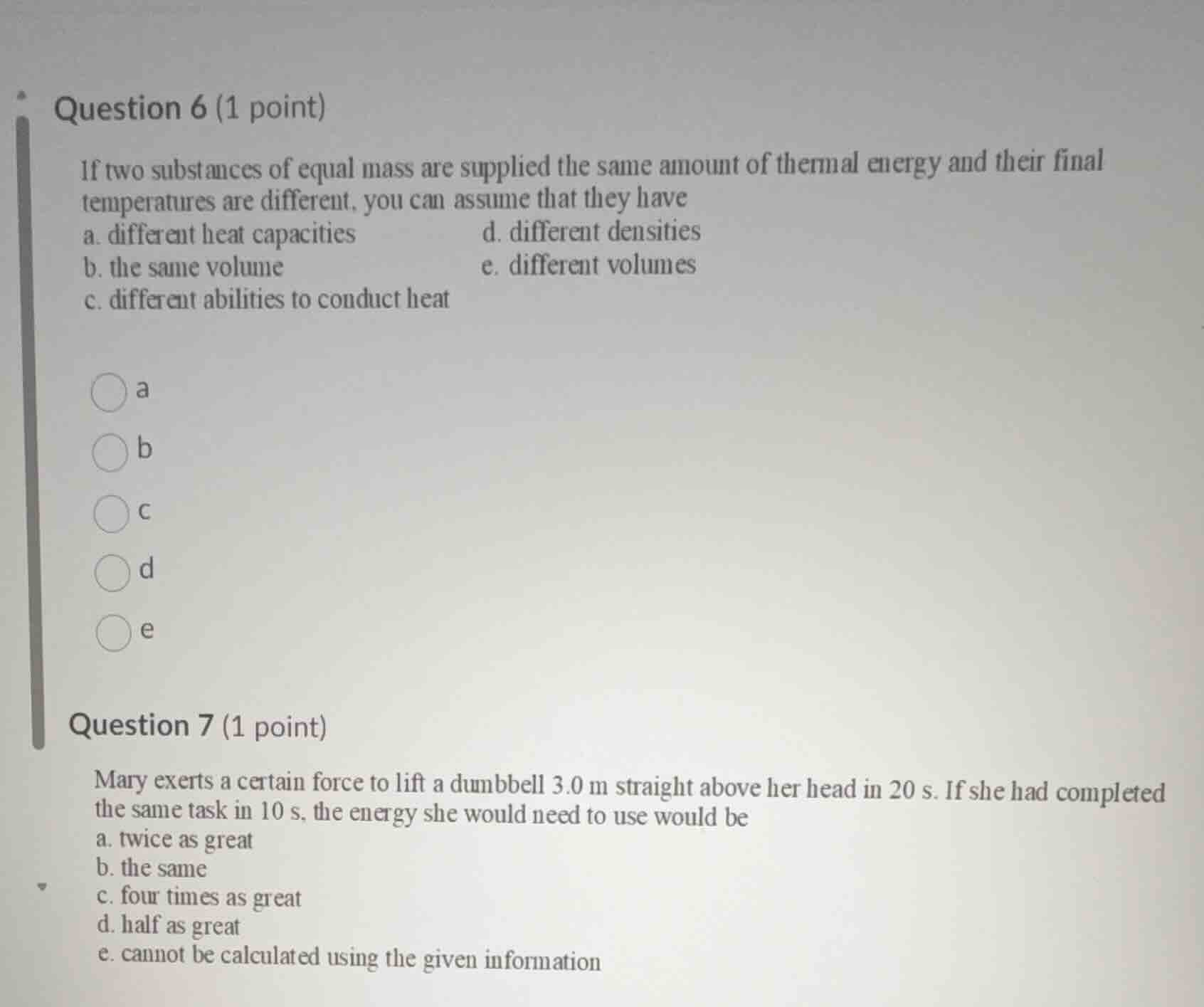
question 6 (1 point)
if two substances of equal mass are supplied the same amount of thermal energy and their final temperatures are different, you can assume that they have
a. different heat capacities d. different densities
b. the same volume e. different volumes
c. different abilities to conduct heat
a
b
c
d
e
question 7 (1 point)
mary exerts a certain force to lift a dumbbell 3.0 m straight above her head in 20 s. if she had completed the same task in 10 s, the energy she would need to use would be
a. twice as great
b. the same
c. four times as great
d. half as great
e. cannot be calculated using the given information
Question 6
The formula for heat energy is \( Q = mc\Delta T \), where \( Q \) is thermal energy, \( m \) is mass, \( c \) is specific heat capacity, and \( \Delta T \) is temperature change. Given \( m \) and \( Q \) are equal, if final temperatures (and thus \( \Delta T \)) differ, \( c \) (heat capacity) must differ. Volume, density, and heat conduction ability are not directly related to this temperature - energy - mass relationship.
The work done (and thus energy used, as energy is the ability to do work) in lifting an object is \( W = Fd \), where \( F \) is force and \( d \) is distance. The time taken to do the work affects power (\( P=\frac{W}{t} \)), not the work (energy) itself. Since the force and distance are the same, the energy needed is the same regardless of time.

Snap & solve any problem in the app
Get step-by-step solutions on Sovi AI
Photo-based solutions with guided steps
Explore more problems and detailed explanations
a. different heat capacities