QUESTION IMAGE
Question
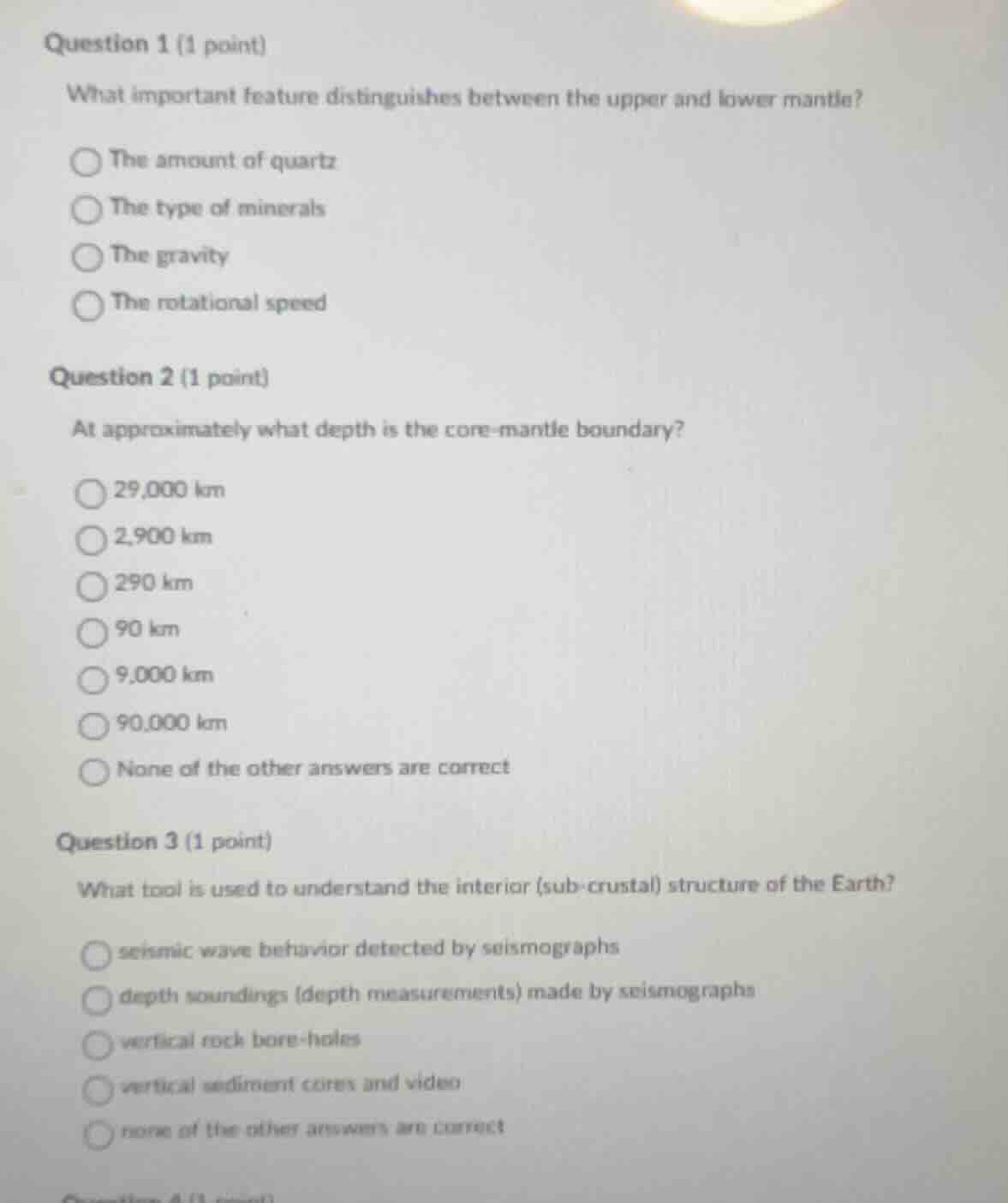
question 1 (1 point)
what important feature distinguishes between the upper and lower mantle?
the amount of quartz
the type of minerals
the gravity
the rotational speed
question 2 (1 point)
at approximately what depth is the core-mantle boundary?
29,000 km
2,900 km
290 km
90 km
9,000 km
90,000 km
none of the other answers are correct
question 3 (1 point)
what tool is used to understand the interior (sub-crustal) structure of the earth?
seismic wave behavior detected by seismographs
depth soundings (depth measurements) made by seismographs
vertical rock bore-holes
vertical sediment cores and video
none of the other answers are correct
- For Question 1: The upper and lower mantle are distinguished by the phase change of minerals due to increasing pressure with depth, changing their structure and type.
- For Question 2: Geoscientific data confirms the core-mantle boundary is at ~2,900 km below Earth's surface.
- For Question 3: Seismic waves change speed and direction when passing through different Earth layers; seismographs detect these behaviors to map sub-crustal structure, as direct drilling to deep layers is not feasible.

Snap & solve any problem in the app
Get step-by-step solutions on Sovi AI
Photo-based solutions with guided steps
Explore more problems and detailed explanations
- The type of minerals
- 2,900 km
- seismic wave behavior detected by seismographs