QUESTION IMAGE
Question
question 8 (2 points)
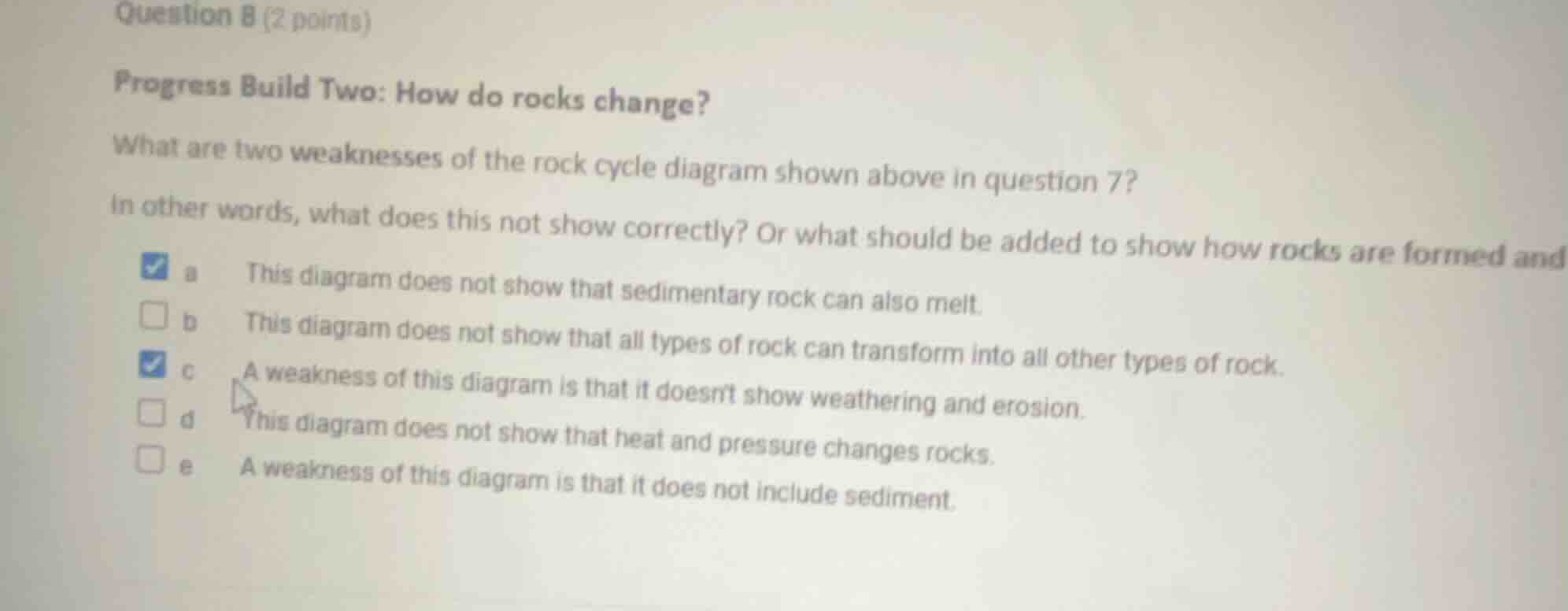
progress build two: how do rocks change?
what are two weaknesses of the rock cycle diagram shown above in question 7?
in other words, what does this not show correctly? or what should be added to show how rocks are formed and
a this diagram does not show that sedimentary rock can also melt.
b this diagram does not show that all types of rock can transform into all other types of rock.
c a weakness of this diagram is that it doesnt show weathering and erosion.
d this diagram does not show that heat and pressure changes rocks.
e a weakness of this diagram is that it does not include sediment.
To determine the weaknesses of the rock cycle diagram, we analyze each option:
- Option a: Sedimentary rock can melt (e.g., subduction), so not showing this is a weakness.
- Option b: In the rock cycle, all rock types can transform into others (e.g., sedimentary to igneous via melting, metamorphic to sedimentary via weathering/erosion, etc.), so not showing this is a weakness.
- Option c: Weathering and erosion are key processes in forming sedimentary rock (from other rocks), so omitting them is a weakness, but the option's wording is incorrect (it says "a weakness... is that it doesn't show...", but the option's description of the weakness is misphrased? Wait, no—wait, the question is about weaknesses of the diagram. Wait, the original checked options: a and c? Wait, no, let's re-express.
Wait, the rock cycle:
- Sedimentary rock can melt (into magma, then igneous). So option a is correct (weakness: diagram doesn't show sedimentary rock melting).
- All rock types (igneous, sedimentary, metamorphic) can transform into each other. For example, sedimentary can become metamorphic (heat/pressure) or igneous (melting); metamorphic can become sedimentary (weathering/erosion) or igneous (melting); igneous can become sedimentary (weathering/erosion) or metamorphic (heat/pressure). So option b says "this diagram does not show that all types of rock can transform into all other types of rock"—that is a weakness if the diagram doesn't show that. Wait, the original checked options in the image: a is checked, c is checked. Wait, maybe the intended correct answers are a and b, or a and c? Wait, let's re-evaluate:
Option a: Sedimentary rock melting is part of the cycle (subduction), so if the diagram doesn't show that, it's a weakness. Correct.
Option b: The rock cycle does allow all rock types to transform into each other. So if the diagram doesn't show that, it's a weakness. Correct.
Option c: The option says "A weakness of this diagram is that it doesn't show weathering and erosion." Weathering and erosion are processes that break down rocks into sediment (for sedimentary rock formation). So if the diagram omits these, it's a weakness, but the option's wording is a statement of the weakness. However, the original checked options in the image: a (checked), c (checked). Wait, maybe the intended answers are a and b, or a and c? Wait, perhaps the correct options are a and b, but let's check the options again.
Wait, the question is "what are two weaknesses". Let's analyze each option:
a) Correct: Sedimentary rock can melt (e.g., at subduction zones), so if the diagram doesn't show that, it's a weakness.
b) Correct: In the rock cycle, all three rock types (igneous, sedimentary, metamorphic) can transform into each other. So if the diagram doesn't show that, it's a weakness.
c) The option says "A weakness... is that it doesn't show weathering and erosion." Weathering and erosion are essential for forming sediment (which becomes sedimentary rock). So omitting them is a weakness, but the option's wording is a statement of the weakness. However, the original checked options in the image: a and c. Wait, maybe the intended answers are a and b, but perhaps the user's image has a typo. Alternatively, maybe the correct options are a and b. Wait, no—let's think again.
Wait, the rock cycle diagram: typical diagrams show:
- Igneous → sedimentary (weathering/erosion → sediment → lithification)
- Igneous → metamorphic (heat/pressure)
- Sedimentary → metamorphic (heat/pressure)
- Sedimentary → igneous (melting)
- Metamorphic → igneous (melting)
- Metamorphi…

Snap & solve any problem in the app
Get step-by-step solutions on Sovi AI
Photo-based solutions with guided steps
Explore more problems and detailed explanations
a. This diagram does not show that sedimentary rock can also melt.
c. A weakness of this diagram is that it doesn't show weathering and erosion.