QUESTION IMAGE
Question
question
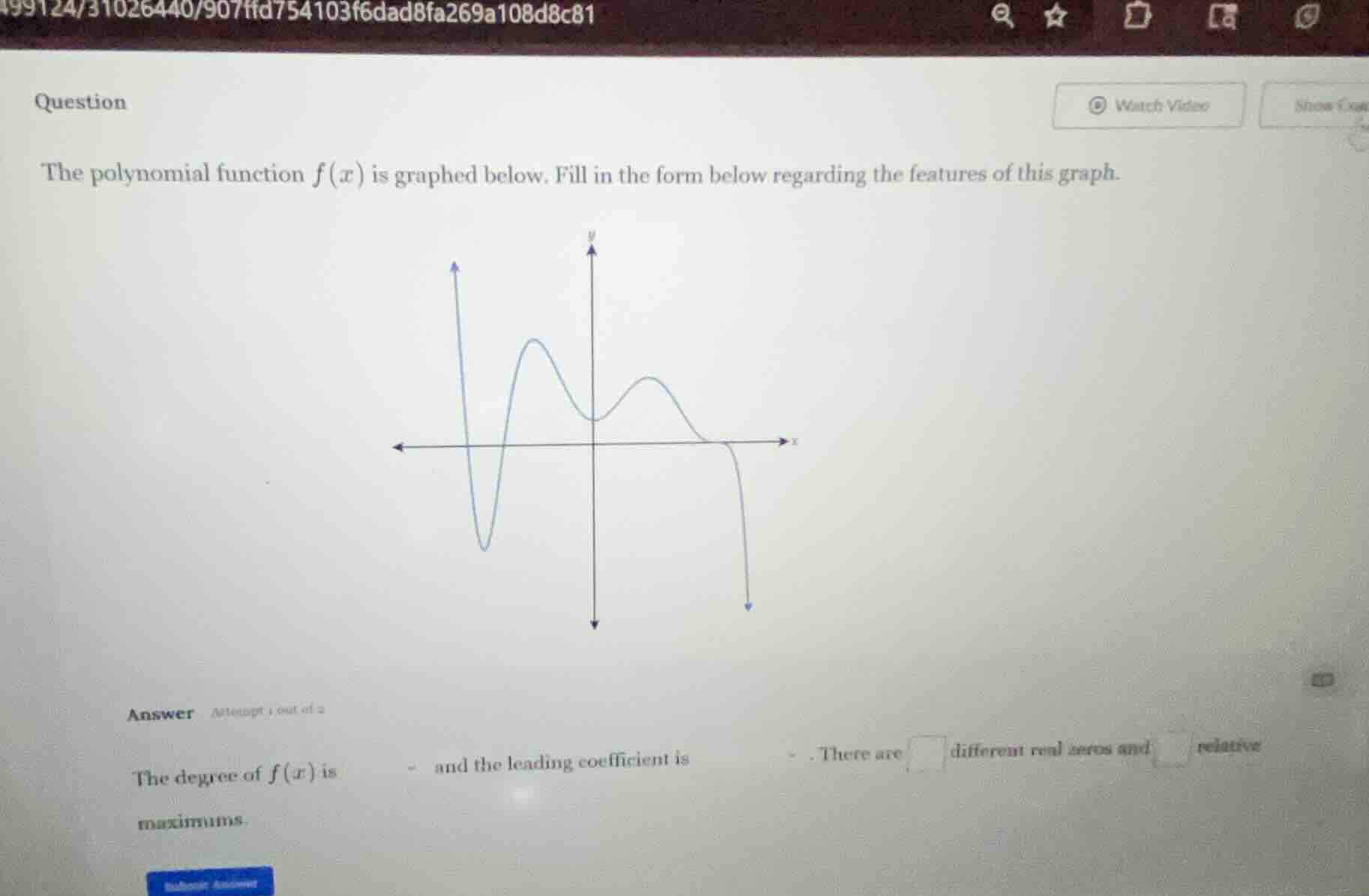
the polynomial function $f(x)$ is graphed below. fill in the form below regarding the features of this graph.
answer attempt 1 out of 2
the degree of $f(x)$ is and the leading coefficient is . there are different real zeros and relative maximums.
Step1: Determine the degree of the polynomial
The end - behavior of a polynomial function is determined by the degree (even or odd) and the leading coefficient (positive or negative). For a polynomial function \(y = a_nx^n+\cdots+a_1x + a_0\), if the degree \(n\) is odd:
- If the leading coefficient \(a_n>0\), as \(x
ightarrow+\infty\), \(y
ightarrow+\infty\) and as \(x
ightarrow-\infty\), \(y
ightarrow-\infty\).
- If the leading coefficient \(a_n < 0\), as \(x
ightarrow+\infty\), \(y
ightarrow-\infty\) and as \(x
ightarrow-\infty\), \(y
ightarrow+\infty\).
In the given graph, as \(x
ightarrow+\infty\), \(y
ightarrow-\infty\) and as \(x
ightarrow-\infty\), \(y
ightarrow+\infty\). So the degree of the polynomial is odd. Also, the number of turning points (relative maxima and minima) of a polynomial function \(y = f(x)\) of degree \(n\) is at most \(n - 1\). Let's count the number of turning points: we can see that there are 4 turning points (2 relative maxima and 2 relative minima). Since the number of turning points \(T\leq n - 1\), and \(T = 4\), then \(n-1\geq4\), so \(n\geq5\). Also, from the end - behavior, since it's an odd - degree polynomial and the leading coefficient is negative (because as \(x
ightarrow+\infty\), \(y
ightarrow-\infty\)), and the number of real zeros: we can see that the graph intersects the \(x\) - axis at 3 points, so there are 3 real zeros. The number of relative maxima: we can see from the graph that there are 2 "peaks" (relative maxima).
So, the degree of \(f(x)\) is odd (specifically, since the number of turning points is 4, the degree \(n = 5\) (because for a degree \(n\) polynomial, the maximum number of turning points is \(n - 1\), so if \(n-1 = 4\), \(n = 5\))), the leading coefficient is negative, the number of different real zeros is 3, and the number of relative maxima is 2.
Step2: Analyze the leading coefficient sign
As \(x
ightarrow+\infty\), the graph goes down ( \(y
ightarrow-\infty\)) and as \(x
ightarrow-\infty\), the graph goes up ( \(y
ightarrow+\infty\)). For a polynomial \(f(x)=a_nx^n+\cdots\), when \(n\) is odd, if \(a_n<0\), the end - behavior is \(x
ightarrow+\infty\), \(f(x)
ightarrow-\infty\) and \(x
ightarrow-\infty\), \(f(x)
ightarrow+\infty\). So the leading coefficient is negative.
Step3: Count the real zeros
The real zeros of a polynomial function are the \(x\) - intercepts of its graph. By looking at the graph, we can see that the graph intersects the \(x\) - axis at 3 distinct points. So there are 3 different real zeros.
Step4: Count the relative maxima
A relative maximum is a point on the graph where the function changes from increasing to decreasing. By looking at the graph, we can see that there are 2 such "peaks" (points where the function has a local maximum).

Snap & solve any problem in the app
Get step-by-step solutions on Sovi AI
Photo-based solutions with guided steps
Explore more problems and detailed explanations
The degree of \(f(x)\) is \(\boldsymbol{5}\) (odd), and the leading coefficient is \(\boldsymbol{\text{negative}}\). There are \(\boldsymbol{3}\) different real zeros and \(\boldsymbol{2}\) relative maxima.