QUESTION IMAGE
Question
question 1
1 pts
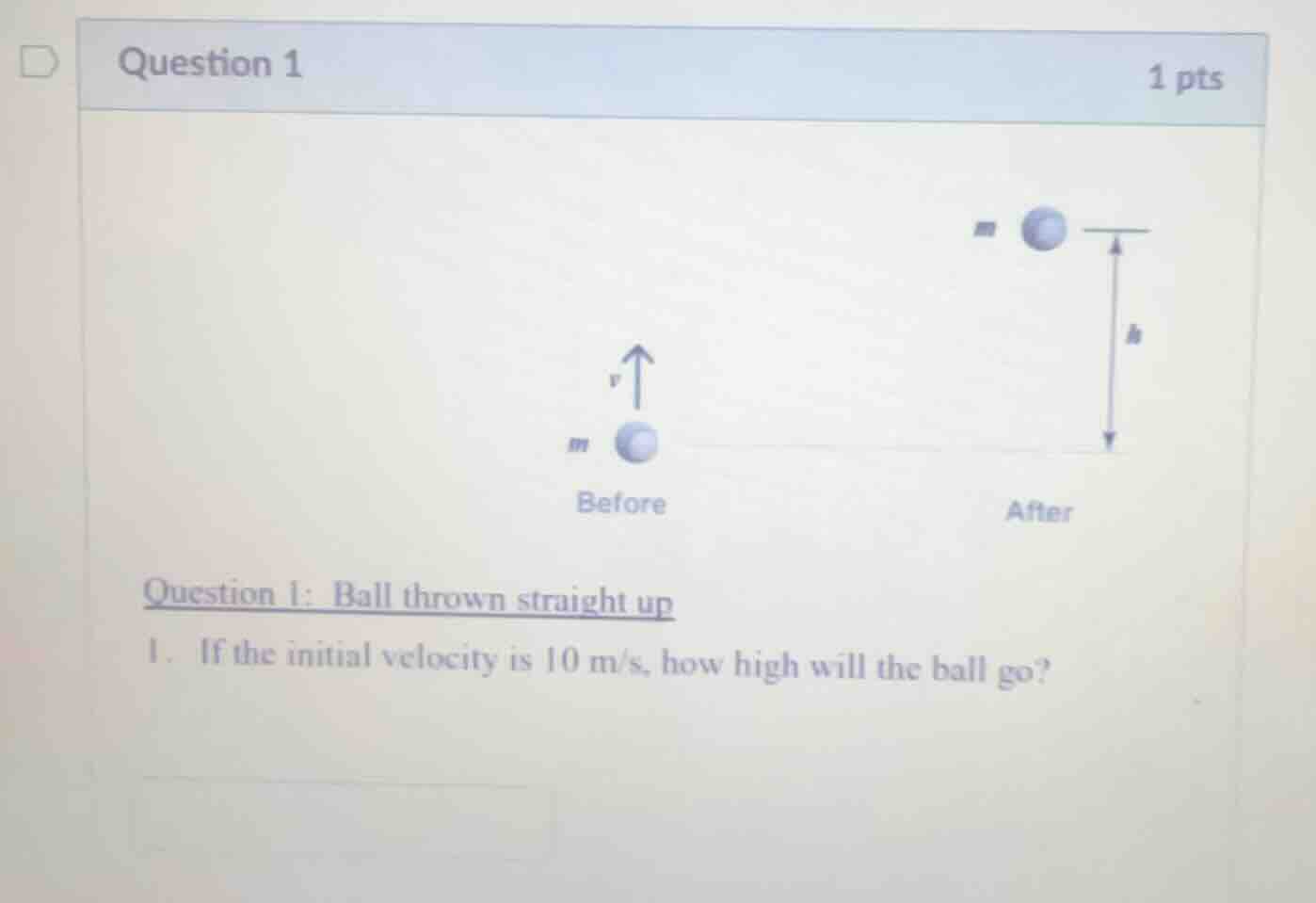
question 1: ball thrown straight up
- if the initial velocity is 10 m/s, how high will the ball go?
Step1: Identify the physics concept
This problem involves a ball thrown straight up, so we can use the kinematic equation for vertical motion. At the maximum height, the final velocity \( v_f = 0 \, \text{m/s} \). The acceleration due to gravity \( g = 9.8 \, \text{m/s}^2 \) (acting downward, so we take it as negative in the upward direction). The initial velocity \( v_i = 10 \, \text{m/s} \). The kinematic equation we use is \( v_f^2 = v_i^2 + 2a\Delta y \), where \( \Delta y = h \) (the height we want to find), and \( a = -g = -9.8 \, \text{m/s}^2 \).
Step2: Rearrange the kinematic equation
We want to solve for \( h \) (which is \( \Delta y \)). Rearranging the equation \( v_f^2 = v_i^2 + 2a\Delta y \) for \( \Delta y \):
\[
\Delta y=\frac{v_f^2 - v_i^2}{2a}
\]
Substitute \( v_f = 0 \), \( v_i = 10 \, \text{m/s} \), and \( a=- 9.8 \, \text{m/s}^2 \):
\[
h=\frac{0-(10)^2}{2\times(- 9.8)}
\]
Step3: Calculate the height
First, calculate the numerator: \( 0 - 100=- 100 \)
Then, calculate the denominator: \( 2\times(-9.8)=-19.6 \)
Now, divide the numerator by the denominator:
\[
h=\frac{-100}{-19.6}\approx5.10 \, \text{m}
\]

Snap & solve any problem in the app
Get step-by-step solutions on Sovi AI
Photo-based solutions with guided steps
Explore more problems and detailed explanations
The ball will go approximately \( \boldsymbol{5.10 \, \text{meters}} \) high. (If we use \( g = 10 \, \text{m/s}^2 \) for approximation, the calculation would be \( h=\frac{0 - 10^2}{2\times(-10)}=\frac{-100}{-20} = 5 \, \text{m} \), but using \( g = 9.8 \, \text{m/s}^2 \) gives a more accurate result of approximately \( 5.10 \, \text{m} \).)