QUESTION IMAGE
Question
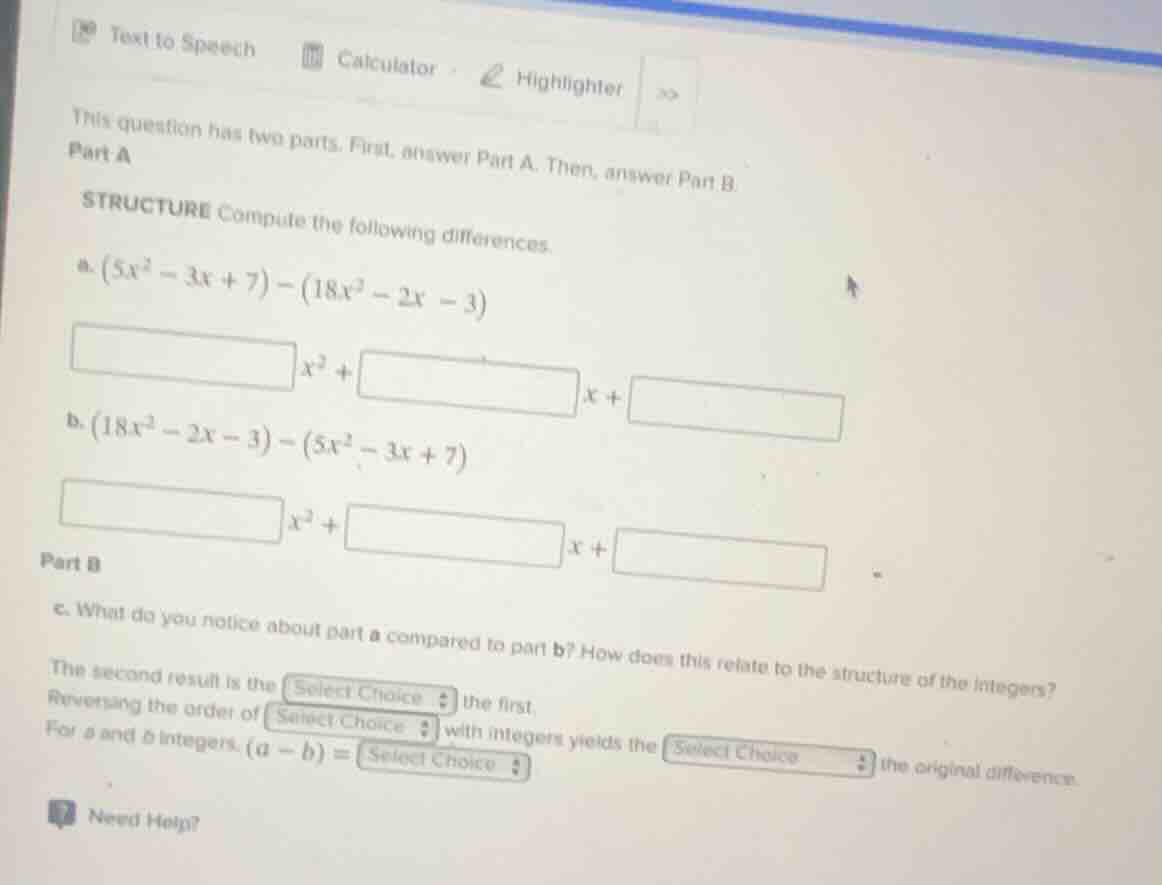
this question has two parts. first, answer part a. then, answer part b
part a
structure compute the following differences.
a. ((5x^2 - 3x + 7) - (18x^2 - 2x - 3))
(square x^2 + square x + square)
b. ((18x^2 - 2x - 3) - (5x^2 - 3x + 7))
(square x^2 + square x + square)
part b
c. what do you notice about part a compared to part b? how does this relate to the structure of the integers?
the second result is the (\text{select choice}) the first.
reversing the order of (\text{select choice}) with integers yields the (\text{select choice}) the original difference.
for (a) and (b) integers, ((a - b) = \text{select choice})
Part A
a.
Step1: Distribute the negative sign
$(5x^2 - 3x + 7) - (18x^2 - 2x - 3) = 5x^2 - 3x + 7 - 18x^2 + 2x + 3$
Step2: Combine like terms for \(x^2\)
$5x^2 - 18x^2 = -13x^2$
Step3: Combine like terms for \(x\)
$-3x + 2x = -x$
Step4: Combine constant terms
$7 + 3 = 10$
Step1: Distribute the negative sign
$(18x^2 - 2x - 3) - (5x^2 - 3x + 7) = 18x^2 - 2x - 3 - 5x^2 + 3x - 7$
Step2: Combine like terms for \(x^2\)
$18x^2 - 5x^2 = 13x^2$
Step3: Combine like terms for \(x\)
$-2x + 3x = x$
Step4: Combine constant terms
$-3 - 7 = -10$
- For the first blank: The result of part b is the negative of the result of part a. So the second result is the "negative of" the first.
- For the second blank: Reversing the order of "subtraction" with integers (since we are subtracting two polynomials, similar to subtracting integers)
- For the third blank: Reversing the order of subtraction with integers yields the "negative of" the original difference.
- For the fourth blank: By the property of subtraction of integers, \((a - b)=-(b - a)\), so \((a - b)= - (b - a)\) (or in terms of the relation here, if we consider the two polynomials as like two integers, reversing the subtraction order gives the negative of the original difference)

Snap & solve any problem in the app
Get step-by-step solutions on Sovi AI
Photo-based solutions with guided steps
Explore more problems and detailed explanations
\(-13\) \(x^2 +\) \(-1\) \(x +\) \(10\)